
Wine Not Wednesday
October 14@ 5:30 pm—9:00 pm

“A Garden of Knowledge”: How One Man Talked His Way Into Building an Arts Town
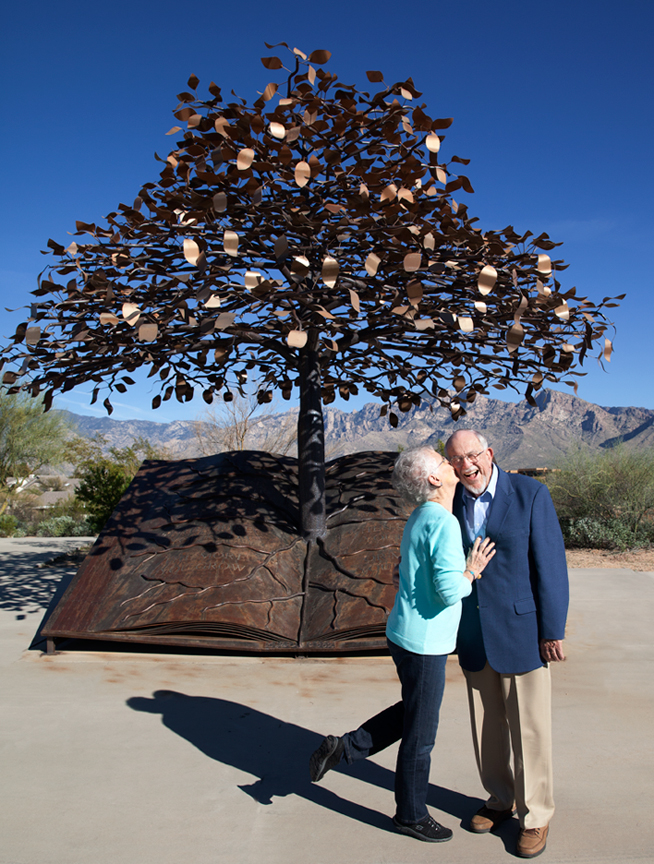
Dick and Marge Eggerding, married 71 years, have called Oro Valley home since 1988.
Dick Eggerding is 93 years old, and he still remembers exactly what Oro Valley looked like the day he decided it needed art.
“There was no town hall, no town, nothing,” he says of arriving in 1988, when the population stood at around 5,000. “I’m an entrepreneur by nature. I love to start things.” He searches for the right image, and lands on one that explains more about the next three decades than any resume could: an empty garden of knowledge, his for the taking. If you had an idea, you could simply walk into town hall and say so.
Nobody stopped him. Nobody, it turns out, has stopped him since.
Long before Oro Valley existed as more than open desert, Eggerding was a tenor. Born in St. Louis in 1933, he was two years old when his father died — a World War I veteran who’d contracted the Spanish flu stateside, in the trenches of a training camp at Fort Leonard Wood, Missouri. The flu enlarged his heart, and it finally caught up with him years later. His father had at least left the family in decent shape by starting a small automobile dealership; his mother raised Dick and his older brother Ted through the rest of the Depression on her own.
It was his grandfather, a judge who loved poetry and fine art, who stepped in as a mentor. And it was his mother, an opera singer, who raised her boys on music — Dick a tenor, his brother a baritone, singing together at churches and in St. Louis’s German singing societies from the time Dick was 16.
He was good enough to make it a career. He sang light opera through high school, attended Washington University on a voice scholarship, and once shared a stage as a backup singer with the Broadway composer Richard Rodgers, brought in for a St. Louis Symphony fundraiser — Eggerding still calls it one of the thrills of his life. New York was the obvious next step, the kind of place you’d need to go to make music a real career.
He’d met Marjorie — Marge — in high school instead, and by the time he had to choose between New York and marriage, it wasn’t close. They married in 1954, when Dick was 21, and have now been married 71 years.
The Korean War draft caught up with him not long after. Rather than wait, he volunteered — and one week before his enlistment would have ended, safely stateside, the Army shipped him overseas instead. “One week,” he says. “If I had just waited one more week, I never would have gone.”
The crossing nearly killed him. His troop ship, a converted Liberty ship called the Freeman, hit heavy Pacific storms en route to Adak — and diverted to rescue the crew and passengers of a sister ship, the Washington Mail, which had split in half in the same storm. Eggerding’s ship strung buoys across the gap and pulled the survivors off the sinking bow, among them four Belgian priests and six Belgian nuns.
In Japan, stationed at Itazuke Air Force Base — the same base Ted Williams flew combat missions from — Eggerding was assigned to a G2 intelligence unit despite having no training for it, eventually doing research work connected to why almost no American prisoners escaped North Korean POW camps, research that helped shape the military’s postwar Code of Conduct.
It was travel through Japan and elsewhere in Asia that led to the project Eggerding is proudest of from those years. He kept encountering mixed-race children who’d been ostracized by their communities and asked a group of Baptist missionaries near Fukuoka whether something could be done. Their answer: yes, if he could raise the money. So, a 20-something Army corporal set up shop at the end of the payday line on two military bases with a hand-lettered sign asking for donations — and raised enough to buy land and build a home that ultimately sheltered 34 children.
He came home to St. Louis on Christmas Eve, walking in on his family mid-celebration, and set about building a civilian life. A friend who ran a large insurance agency taught him the business, and Eggerding spent the next 35 years in commercial insurance — Safeco in Seattle, later the Great American Companies — rising through branch management, surviving a tornado that leveled his Kansas City home while his wife rode it out with their toddler son, and eventually writing agency-management manuals distributed nationally through the insurance industry’s trade association. He once addressed 7,500 fellow agents at a San Francisco convention; midway through the speech, his granddaughter ran down the aisle, and he simply picked her up and kept talking.
Eggerding and Marge settled in Oro Valley in 1988, drawn partly by her mother’s retirement in Scottsdale and partly by a job offer Marge received, almost on the spot, from Sierra Tucson, where she’d go on to build a second career in psychotherapy. Dick, freshly retired from insurance, wasn’t done starting things.
He got involved first through his homeowners’ association, then through the town’s arts advisory board — a small, informal group that had been bringing in occasional symphony performances. He recruited a friend, Bob Weede, and by the mid-1990s the two of them were running full arts festivals at what’s now Jim Kriegh Park, then still known as Dennis Weaver Park (named, ironically, for a county supervisor who’d opposed the town’s founding — Oro Valley later renamed it for Jim Kriegh, the town’s actual founder).
The festivals were ambitious from the start — juried, professional, drawing artists from as far as Taos through an exchange arrangement Eggerding built with the art colony in Tubac. They were also, memorably, at the mercy of the weather. At one event, a dust devil tore through the grounds, scattered paintings across Oracle Road, collapsed the tents, and picked a woman clean off her feet, depositing her on the hood of a car on loan from a local dealership. A boys’ choir from Tucson kept singing as their risers came apart around them. Nobody was hurt.
By the mid-’90s, Eggerding and Weede realized the informal arts board had outgrown itself — they needed a nonprofit that could raise money. An arts assessment commissioned from the Arizona Arts Commission agreed, and recommended two things: form an arts council, and adopt a public art ordinance. One public meeting to discuss the findings, held at a packed Sun City Hall, produced instant chaos when the crowd heard the word “assessment” and assumed it meant a tax — half the room walked out before anyone could explain otherwise.
The council came together anyway. In 1997, Eggerding and Weede formally founded the Greater Oro Valley Arts Council.
The ordinance took a little longer, and a little more selling. Town staffer Jim Copus wrote the actual code language, with Eggerding reviewing it, and the two of them held an educational seminar for local builders before it went to a vote — expecting no one to show up. Instead, the room filled, including the town’s most prominent commercial developers. One of them, David Mehl of Cottonwood Properties, walked in opposed to the idea and walked out fully in favor of it; others, including developer Don Diamond’s company, were supportive from the start.
The ordinance passed, requiring one percent of new commercial and public construction costs to fund public art. It’s the reason Oro Valley now has hundreds of pieces of public art scattered across town: hand-laid tile at a rest stop on Lambert and First, the “Lazy Lizards” trailhead tile at Catalina State Park that later won a national trails award, a carved Native American figure at a gas station on Rancho Vistoso. The Tree of Knowledge, the hand-soldered bronze sculpture outside the public library, once appeared on the cover of an airline in-flight magazine. Eggerding used a small NEA grant to self-publish a booklet cataloging the town’s public art, then handed out the copies as informal rewards to people who’d gone out of their way to support it.
The council’s high-water mark came on the Fourth of July 2003, when Eggerding arranged for the Tucson Symphony to perform Tchaikovsky’s 1812 Overture at a joint concert and fireworks show, complete with real cannon fire timed to the music, an idea he borrowed from the Boston Symphony’s own tradition. The cue system nearly failed when the El Conquistador hotel crew forgot to keep their phone line open; Eggerding drove back to the site at 80 miles an hour to fix it in person, narrowly avoiding a ticket, and made it in time. Roughly 8,000 people turned out, bused in from parking lots across town.
By 2005, with the council’s budget grown from a $2,000 startup loan to $600,000 a year, Eggerding — pushing 70 — handed the organization off to new leadership. The council went on to become the Southern Arizona Arts and Cultural Alliance in 2009 and is known today as Art State Arizona.
He’s not finished yet. This September, Eggerding will give what he calls his “final lecture” on Oro Valley’s history to the town’s Community Academy — a talk he gave once before, entirely without notes, to a two-hour audience that included the current town manager.
What he built next — a fight to save two pieces of land before developers could get to them, and finally, a memorial born out of loss — is Part Two.
*Dick Eggerding will discuss the founding of the Oro Valley Historical Society, the Land Conservation Committee’s fight to save Naranja Park and Steam Pump Ranch, and the origins of the Arizona Heroes Memorial in the second installment of this series.*
—
**Sources:** This article draws on two on-the-record interviews conducted by ILoveOV with Dick Eggerding in July 2026; his 2003 tribute booklet, *Muse of Oro Valley*; his self-written 2021 career summary; and “The History of Public Art in Oro Valley by Dick Eggerding,” provided by the Oro Valley Historical Society (ovhistory.org), which includes a January 2023 interview transcript.