
At Ease Cookz & Trivia
September 29@ 5:30 pm—9:00 pm

Theresa Poalucci spent 44 years in the newspaper business before retiring to SaddleBrooke and discovering what she was always meant to make. From acrylic flows to alcohol inks to digitally composed fine art printed on metal and acrylic, she has built a body of work as bold and colorful as the desert she calls home — and given back to the arts community at every step along the way.
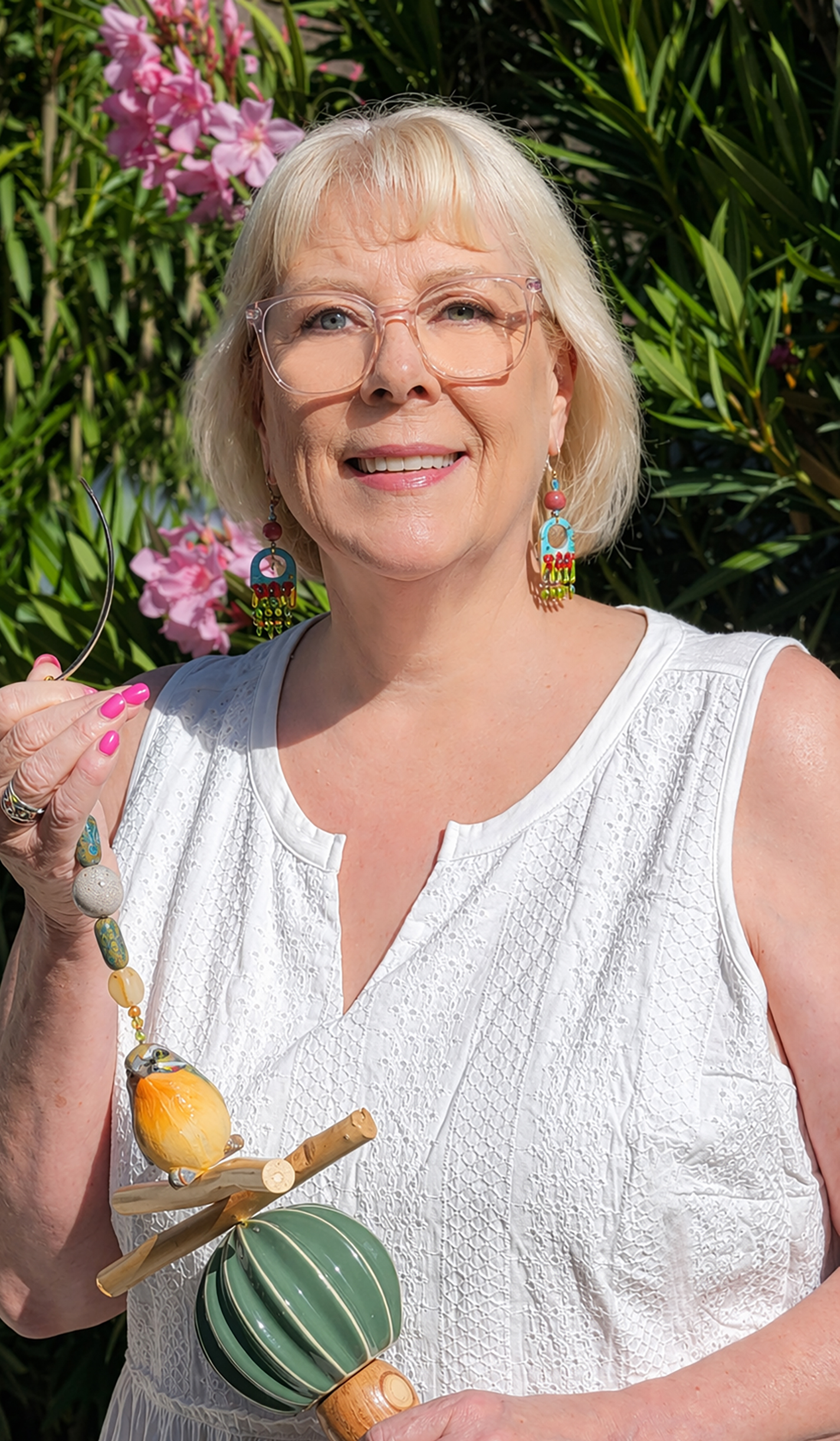 Theresa Poalucci never planned any of this: not the art career, not living in SaddleBrooke, nor decades spent building in every community she joined. Her guiding force has always been giving back—through art, leadership, and action, connecting creativity to community impact.
This thread of connection runs through every chapter of her story.
Theresa grew up surrounded by her mother’s paintings. Art filled her childhood, but words, not art, drew her forward.
“I wanted to be a writer,” she says. “I read a lot as a kid. I took creative writing classes.” She later earned a psychology degree from the University of Washington—a degree she used mainly in advertising. While in college, she began working as a graphic artist for a newspaper chain. Her writing talent was noticed, and she became the editor and then the owner of the chain.
“I ended up with 13 newspapers and 56 other publications,” she says, almost as a passing observation. “I spent 44 years in the newspaper business.”
She was a self-taught graphic artist, starting on a typesetting machine long before today’s industry tools. Despite decades of deadlines and meetings, painting was always present—not as a profession, but as a form of relief.
“The publishing business was so stressful. Painting was like going to the spa.” Early paintings were given away—one to the city hall, another to a bank, others to friends’ offices. For her, painting and gifting art became both a way to give back and a means to breathe.
What she didn’t know then was that she was practicing.
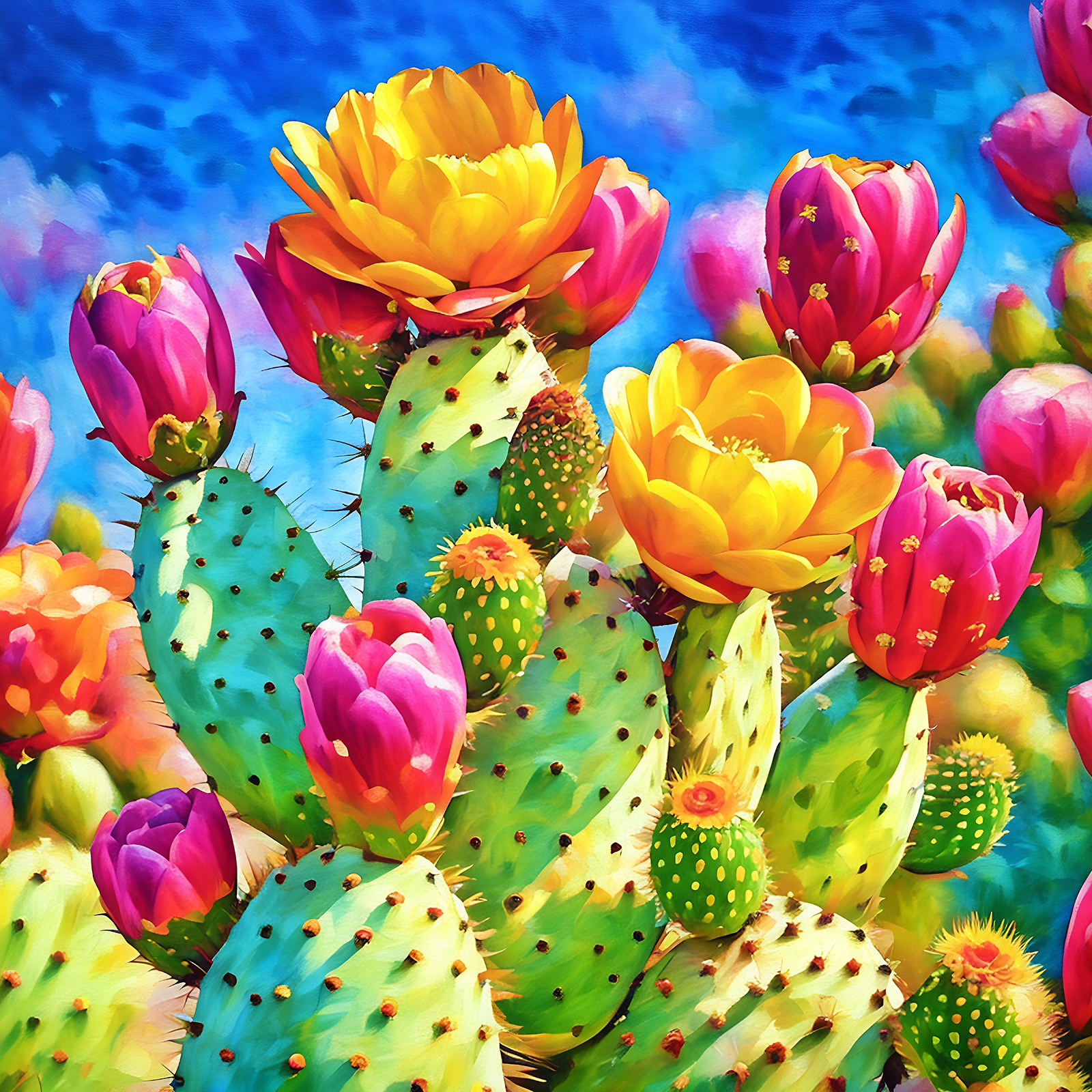
Cactus Blossoms A vibrant mix of pink and yellow flowers against a bright blue sky. Opuntia, Desert Flora, Blooming Cactus
When the newspaper industry contracted, Theresa retired and moved to Arizona. Immediately after, she saw a new challenge in this phase of life.
Her mother, later in life, had taken up sculpting and won awards. One of Theresa’s daughters is an award-winning sculptor. The two of them had teased Theresa for years: the DNA passed you by, Mom.
“That felt like a challenge to me,” she says, and you can still hear the competitive spark in it.
She joined the Southern Arizona Clay Artists, specifically to learn to sculpt. Because of her background — years on boards of chambers of commerce, Rotary, community organizations of every kind — she was soon on their board and eventually became their president. She always joins things with her whole self.
She learned to sculpt faces, adorning them with rays and forming suns and moons. This work earned her gallery entry, but the medium’s practical challenges—drying, unpredictable glazes, fragility—began to wear on her.
“I’m clumsy enough,” she says, laughing. “Ceramics turned out to be not the medium for me.”
After a break, she returned to painting, now focused on her real goals.
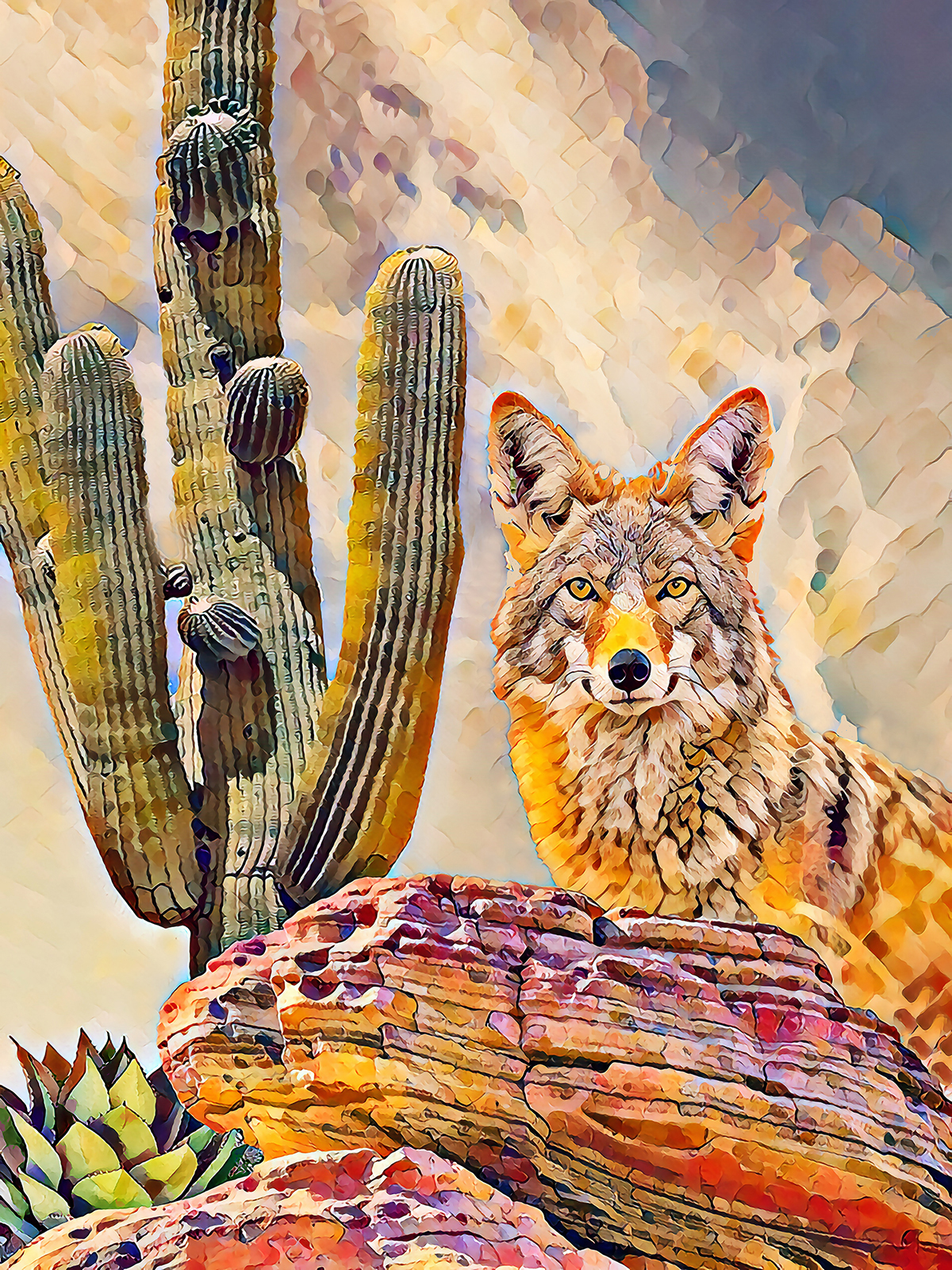 What she was after, it turns out, was scale, color, and a certain kind of controlled chaos.
She discovered acrylic flow painting — a technique in which thinned acrylic paint is poured directly onto canvas in carefully chosen combinations, then tilted and guided to create organic, sweeping movement. Color bleeds into color. Mountains emerge from what appears to be pure accident. Cactus shapes appear in the abstract, and she follows them, adding skies and details afterward.
“I keep experimenting,” she says. “I found that if I used a funnel and stacked the paint a certain way, I could create mountains. It really looks good because it looks like a desert mountain — there are so many layers to it.”
She began working on canvases five feet wide and four feet tall. Some were larger. She defines herself as a colorist—her walls feature only bold, vibrant work—and the flow technique delivered the striking results she sought. The Southern Arizona Arts Guild embraced her large pieces when other galleries declined to show them, and she sold many there. One gallery in Catalina, Absolutely Art, always keeps two of her largest paintings: one facing the window, one facing the gallery interior.
The only thing that eventually slowed her large canvas work was logistics. Their minivan, the only vehicle that could haul a canvas that big, finally gave out at 250,000 miles. “We’re probably going to buy another one eventually,” she says, “and then I’ll go back to big canvases.”
While Theresa was deep in her acrylic flow work, she met Vesta Abel, a businesswoman who had owned a company that made stamps and ink. Soon after, Vesta offered to teach her alcohol inks, and Theresa’s world opened again.
Alcohol inks are pure pigments suspended in 91% rubbing alcohol and applied to non-porous surfaces, such as Yupo paper. They, like acrylic flows, are gloriously difficult to control. They are brighter than watercolor but carry that same luminous quality. They allow extraordinary texture. And they are, Theresa discovered, almost irresistible to beginners.
“You can get bright color and texture without working very hard at it — something a brush artist has to earn,” she says. “They’re so fun.”
She began teaching alcohol inks and, by her own accounting, is probably the most active teacher of the technique in Tucson. She has taught hundreds of students over the years. Currently, she teaches four or five art classes each month and creates special events, channeling her commitment to giving back. She sees teaching as integral to both her art and her impact.
 Painting With Pixels
Throughout all these shifts — the flows, the inks, the teaching, and the galleries — Theresa was also sitting with a question that every artist who is also a businessperson eventually faces. She had spent her whole career in a world built around reproduction and distribution. Painting, as a business model, made no sense to her.
“You spend hours and hours on a painting. You sell it once, and it’s gone. Very poor ROI.”
She had been a graphic artist for more than four decades. She understood the Adobe Suite the way a carpenter understands a hammer — not as a novelty but as a native tool. Gradually, as these various art forms progressed, a new process began to take shape for her.
It begins with a photograph she has taken, or a drawing or ink painting she has created by hand. She imports these into the computer, arranges the scene—adding a deer she has drawn in ink, inserting a cactus she painted separately, removing a stop sign from a landscape—then methodically refines the piece, adjusting color, fixing anything that doesn’t meet her standards, painting detail with a digital brush as she would with a physical one. She runs the composite through artistic filters to unify the image, then enhances saturation and vibrance, relying on her deep knowledge of how printing presses reproduce color.
“I spend my time on the thing I think is the important part of the painting,” she says. “The animal, the face, the personality. Anybody can paint a cactus. It’s like painting a giant pickle with arms.”
The finished files go to a professional printer. She offers her work on acrylic — vivid, glossy, the image printed on film and mounted to the surface — or on metal, which has a cooler, more matte quality. She tested the merit of metal printing herself, setting a piece in the hottest corner of her backyard for a full year just to see if it could survive an Arizona summer. It could.
She limits editions to 25 professional prints and issues a letter of authenticity with each one. Her largest pieces — 40 by 30 inches — sell for $695. Smaller sizes are usually between $250 to $350.
There is a question that follows digital art into every gallery, every show, every casual conversation. Theresa has heard it more times than she can count, and she has her answer ready.
“They say, ‘Oh, she’s just using AI.’ I’m not. It’s my photograph. It’s my drawing.”
She is not defensive—she is direct, with the confidence of someone with 40-plus years of expertise. The tools have evolved. That is the nature of art.
“Leonardo da Vinci made paint using walnut oil and bushes. Am I not an artist because I now use acrylic paint I can buy in any color I want? It’s just a new tool.”
She draws the parallel to photography, which faced its own version of this debate when it first entered galleries. Nearly every photographer working today processes their images digitally before printing them. The question, she suggests, isn’t what tools you used. It’s whether the work is yours.
And hers is. Every element — photographed, drawn, painted, composed, refined — originates with her hands and her eye. Through every medium, her work remains rooted in giving back to her community.
The harder reality, she admits, is that galleries are still sorting through it. She was in the K. Newby Gallery in Tubac for a time, but they found it difficult to explain her process to customers whose starting expectation was a higher-priced canvas painting. She remains at the Southern Arizona Arts Guild, at Absolutely Art Gallery in Catalina, and at Desert Artisans Gallery in Tucson. She enters juried online competitions and has accumulated more than 80 awards and honorable mentions in 2024 and 2025 alone — evidence, she says, that her work holds up when judged alongside artists from around the world.
“If you see a piece of art you like, buy it,” she says. “Buy it because you love it and you want to live with it. The days of buying art as an investment are long gone unless you’re a billionaire.”
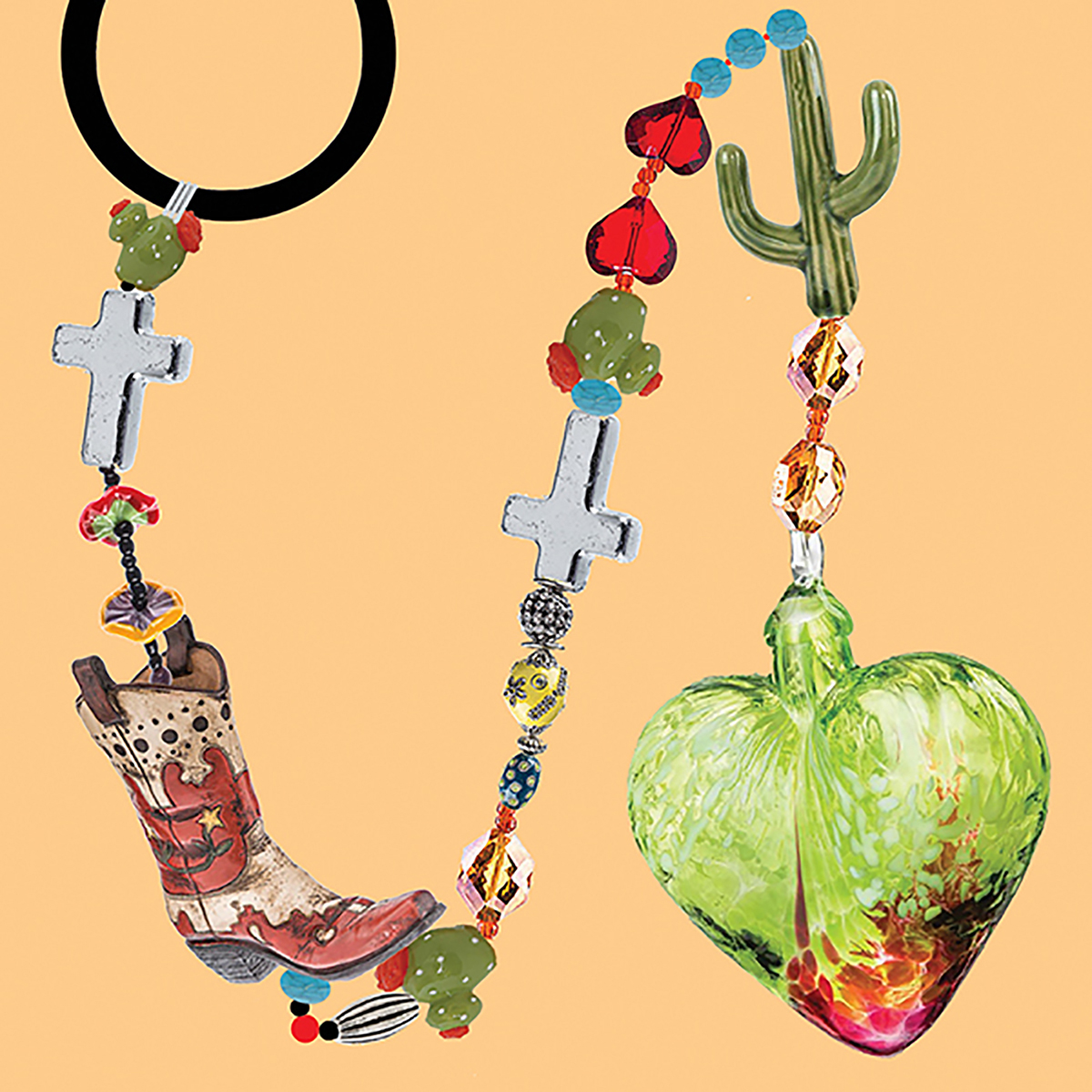
Not everything Theresa makes involves a screen or a canvas. For the past seven years, she has also been making what she calls “Patio Jewels™” — assemblages of found objects, drilled by her husband, combined into colorful hanging garden sculptures. Gems, small birds, and repurposed pieces discovered at gem shows and wholesale markets. No two are alike. She has made approximately 700 of them.
They sell for under $100 and sell steadily — at Absolutely Art Gallery, at K. Newby in Tubac, at the SAAG Gallery, and at outdoor art shows. They are the piece someone picks up for a friend’s birthday, the thing that catches light in a pot by the front door. In a body of work built around bold color and joyful making, the Patio Jewels might be the most purely joyful things of all.
Here is what Theresa Poalucci does beyond the art itself.
She designed the Southern Arizona Arts Guild’s logo — the one on their sign at Joesler Village on River Road. She built their website. For years, she ran their marketing operation nearly single-handedly: ads, graphics, social media, press releases. She recently brought on a co-director to help, because the guild has grown too large for one person to carry.
For Desert Artisans Gallery, she produces a weekly email blast for their mailing list and assists in planning their special events, such as the Van Gogh event and the upcoming Media Mix-Up featuring Frida Kahlo day. She provided the Van Gogh cutout that many artists in the room called corny until each visitor lined up to take a photograph with it.
She is on the board of the SaddleBrooke Fine Arts Guild. She writes an art column for a local publication every month. She recently built a website for a local gallery, but eventually had to step back because she could not commit as many volunteer hours as they had hoped.
She is now writing a course to teach free to guild members — called something like Tips for Emerging Artists. Everything she had to learn the hard way over 12 years: the difference between an artist statement, an art bio, and an art resume. How to photograph your work correctly. How to name your files. How to approach a gallery. How to develop a recognizable style.
“I paid thousands of dollars to get that information myself,” she says. “I would like to just see it be out there.”
She has been this way her whole adult life — in Rotary, on chamber boards, in the communities she passed through during her newspaper years. She does not exactly describe it as generosity. She describes it as an obligation.
“If you’re doing something in the community, you also give back. If you’re expecting something from the community, you must give it back.”
Ask Theresa Poalucci why any of this — the painting, the teaching, the volunteering, the patio jewels, the international art competition entries — why it all matters, and she comes back to something simple.
“For me, it’s not so much about selling it as sharing it.”
She wants people to be surrounded by art. She wants people who would never walk into a gallery — who assume it’s too expensive, too intimidating, not for them — to have something real on their walls. She prices her work accordingly. She shows up at home shows, sidewalk sales, and studio tours, not because those venues pay well but because the people there might never otherwise find her.
“I just think art is important,” she says. “It’s an important component of our lives. If you think of a home where there was nothing on the walls — I can’t imagine.”
She went to a concert the night before we met, performed by Oro Valley’s own Joe Bourne, who is also an artist, and she came away lit up by it. She goes to the symphony. She goes to the theater. She believes in the arts the way some people believe in air.
Her mother painted. Her daughter sculpts. The DNA, it turns out, did not pass Theresa Poalucci by. It just arrived in its own time, in its own form — painted with pixels, poured in rivers of color, assembled from found things, on view to anyone who wants it.
You can find her work at the Southern Arizona Arts Guild Gallery at Joesler Village, at Absolutely Art Gallery in Catalina, at Desert Artisans Gallery in Tucson, and at artisttheresapoalucci.com. Her digital fine art prints on metal and acrylic are also available through the Theresa Poalucci Collection at Sonoran Art.

;>)
;>)