
Wine Not Wednesday
October 14@ 5:30 pm—9:00 pm

In Part One, Dick Eggerding described the “garden of knowledge” he found when he arrived in Oro Valley in 1988 — open ground where anyone with an idea could simply show up and start building. He used that ground to found the town’s arts council and its public art ordinance.
Part Two of a two-part Featured Citizen series on Dick Eggerding
In Part One, Dick Eggerding described the “garden of knowledge” he found when he arrived in Oro Valley in 1988 — open ground where anyone with an idea could simply show up and start building. He used that ground to found the town’s arts council and its public art ordinance.
But art wasn’t the only thing Eggerding decided was worth saving before it disappeared. Twice more he went looking for something at risk — first two pieces of land that developers already had their eye on, then the town’s own history — before, in the project that means the most to him personally, he set out to build a memorial to the people he’d lost.
“Dick Eggerding is a true visionary whose dedication has profoundly shaped Oro Valley’s growth over the past 30 years, from the Arts to Naranja Park and the General Plan. The memorial stands as a testament to his commitment to honoring heroes and his selfless spirit. A mentor and friend, I am deeply honored to be part of this journey.”
—Lisa Hopper Executive Director, Arizona Heroes Memorial
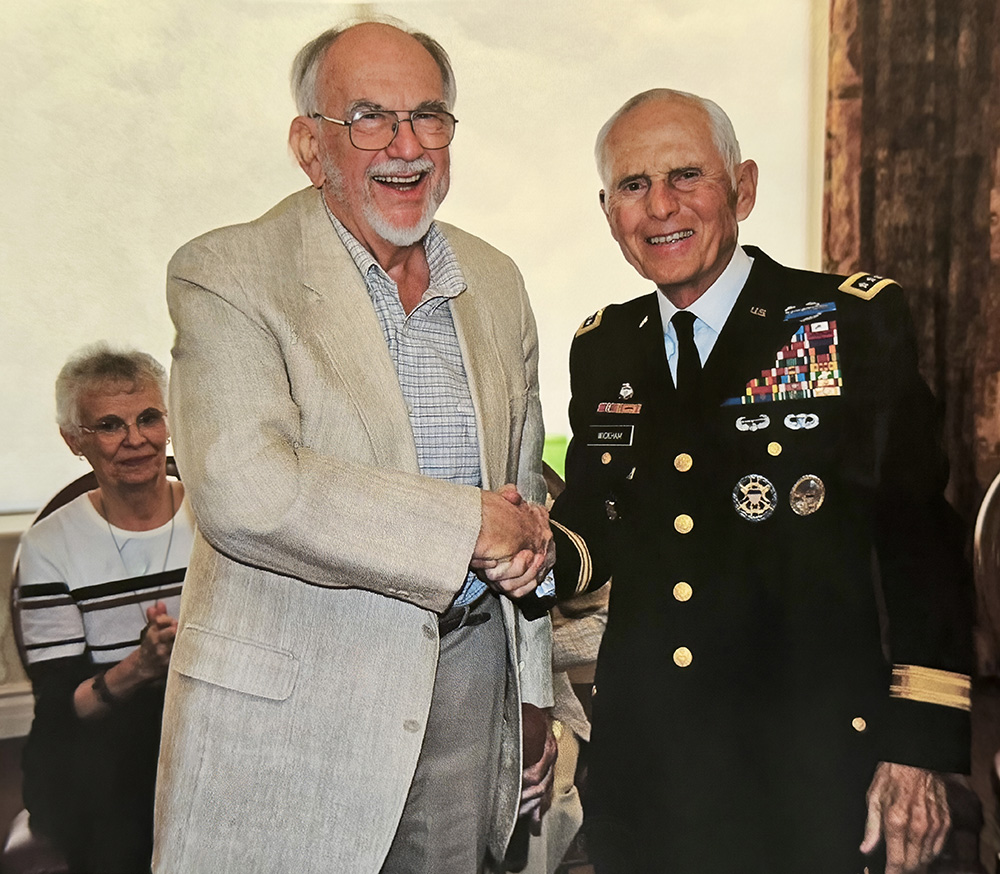
Dick Eggerding and General Markham
In the early 2000s, former council member Al Kunisch called Eggerding with a simple request: help me start a committee. The result was the Citizens Land Conservation Committee — Eggerding, Kunisch, Pat Spoerl, town founder Jim Kriegh, Richie Fineberg, and Carol Baker among its members — formed around two properties nobody wanted to see paved over.
The first was a former asphalt plant site that would eventually become Naranja Park, a 200-plus-acre property with an old dam and lake still visible today. The second was Steam Pump Ranch, featuring a home (now a museum staffed by the OVHS) built in the 1870’s and a cluster of buildings built by a subsequent owner of the ranch during the 1930’s near Oracle and Hardy roads. Then being sold off piecemeal by feuding family owners — with one buyer reportedly ready to put a Brake Masters franchise on the site.
Scouting land for the committee wasn’t always polite work. Eggerding recalls going alone to look over what’s now Kelly Ranch, near Rancho Vistoso, only to have a caretaker come out with a shotgun demanding to know what he was doing. He made it back over the fence.
The committee’s work culminated in a bond issue that authorized the town to acquire Naranja Park, Steam Pump Ranch, and Kelly Ranch together. The campaign wasn’t without its own small scandal: when a candidate running for council asked to reference the bond on her campaign materials, the committee agreed — not realizing that federal law barred using bond-committee materials for candidate promotion. The county fined the group $1,500; the ten committee members split it, $150 apiece, and moved on. Eggerding went on to chair the Naranja Park site task force, and the task force interviewed 125 stakeholders before finalizing plans for the park.
Chairing the task force’s executive committee alongside him was retired four-star General John Wickham — a name most people driving past Naranja Park today would never recognize, but one of the most decorated soldiers of his generation. Wickham earned two Silver Stars in Vietnam, was nearly killed leading his battalion at the Battle of LZ Colt in 1967, and went on to serve as Army Chief of Staff under President Reagan and later as Commander in Chief of United States and Korean forces. He retired to Sun City Tucson in the early 1990s and quietly became one of Oro Valley’s most active civic volunteers, chairing resident councils and serving on town committees well into his nineties.
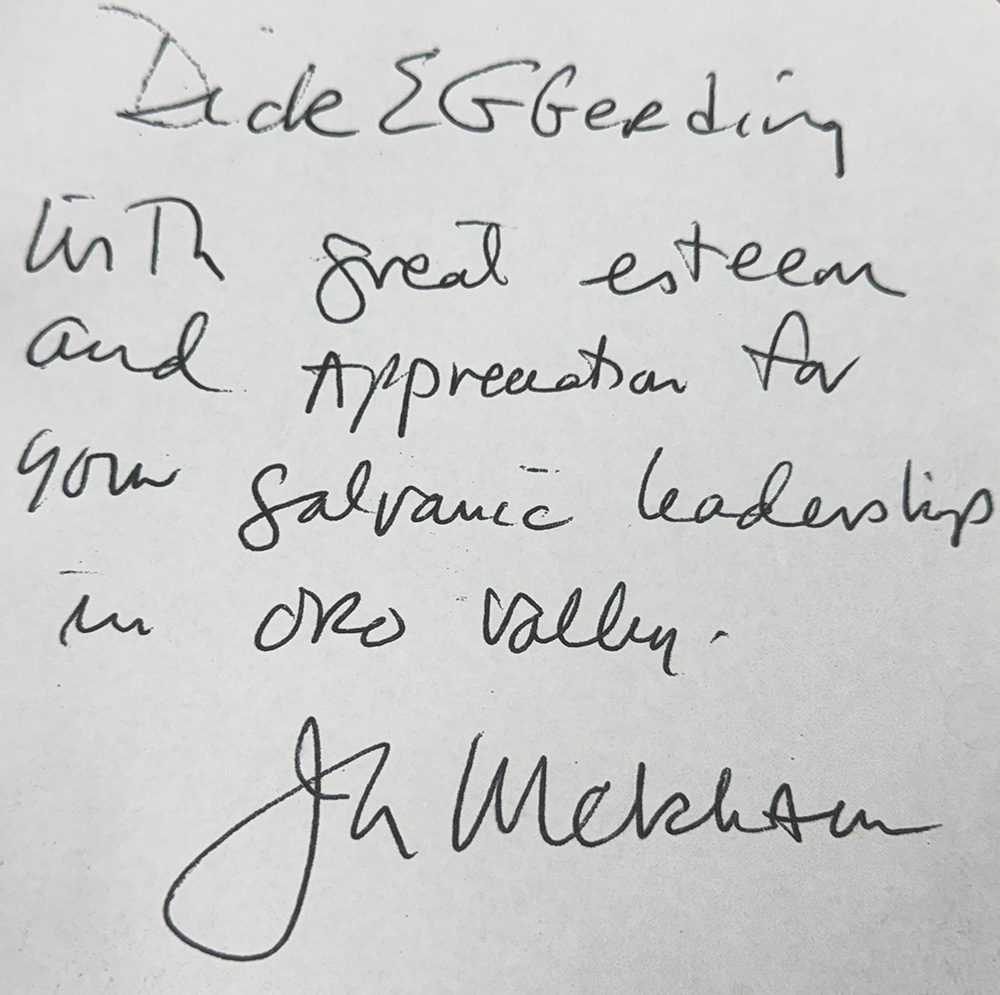
General Markham to Dick Eggerding
Eggerding and Wickham became close friends through that work — a friendship that outlasted the task force itself by two decades. Wickham, who also published a book of his own poetry late in life, wrote Eggerding a personal note not long before he died in 2024 at age 95, thanking him for what he called his “galvanic leadership in Oro Valley.” Eggerding still has it.
A couple of footnotes Eggerding likes to point out: Jim Kriegh Park was originally named Dennis Weaver Park, after a county supervisor who’d opposed Oro Valley’s incorporation — the town later renamed it in honor of Kriegh instead. Lambert Lane carries a similar irony, named for another county supervisor who opposed the town’s founding, whose own son later served on the Oro Valley council.
The Oro Valley Historical Society exists because Jim Kriegh believed someone should write the town’s history down before it disappeared. It was his idea, Eggerding says — he brought Eggerding and Pat Spoerl together, the same three who’d already gotten to know each other through the Land Conservation Committee, and the trio worked with then-town attorney Tobin Sidles, who did much of the nonprofit’s legal paperwork pro bono, on his own time.
The society went on to secure a national historic designation for Steam Pump Ranch — which came with its own tradeoffs. Under that designation, restoration work has to use materials true to the original construction, which is part of why the ranch’s steam pump house looks the way it does today, rebuilt from salvaged materials rather than fully reconstructed. The pump itself was originally brought from Germany by ranch founder George Pusch; some of the Pusch family’s original furniture reportedly still sits in a downtown Tucson museum basement, held there pending funding Eggerding says the town has never quite pulled together to bring it home.
“It is said that “it takes a village”, but that village needs a leader, and Dick Eggerding is definitely that leader. I don’t mean a master or ruler, but the kind of leader who sees a concern, listens, and actually works with others to come to a solution for the problem. Dick did that with others in the community to keep Steam Pump Ranch from becoming another small retail area. We would have lost over 100 years of history if he had not helped to form the Land Conservation Committee which eventually led to the formation of the Oro Valley Historical Society formed to keep Oro Valley History alive!”
—Devon Sloan, Secretary OV Historical Society
Funding the society’s ongoing work — including basic upkeep of the historic buildings it maintains — remains, in Eggerding’s own words, an unresolved issue nearly two decades on. It’s not a complaint so much as an old worry he keeps returning to: some things you build outlast you; others need tending nobody has fully committed to yet.
Eggerding’s father, as told in Part One, was a World War I veteran who came home with a heart weakened by the Spanish flu and died young. That loss echoed through the family for a generation: an aunt and uncle’s 21 children between them meant Eggerding grew up with cousins scattered across nearly every theater of the Second World War. One, Marv Korte, marched with Patton’s Third Army all the way to Bastogne and was wounded by shellfire there. Others were wounded at Anzio and at Tarawa. A cousin who became a motorcycle officer was killed in the line of duty years later.
Eggerding carried all of that quietly for decades. What moved it from private family history into a public project was watching September 11 unfold on television, like everyone else. He began pushing for what he called a “Military/First Responder Living Memorial” at Naranja Park — deliberately including police, firefighters, and medical personnel alongside veterans, rather than treating their sacrifices as separate categories. The Town Council authorized a feasibility study, and what’s now the Arizona Heroes Memorial began to take shape.
Eggerding is quick to redirect credit for how it got built. He hired Lisa Hopper — a physicist by training, with a background in running a nonprofit construction venture overseas — to lead fundraising and project management, and it was Hopper, not Eggerding, who made the connection that led to the memorial’s major elements being built for free. A chance conversation at a local restaurant led to an introduction to a relative in construction; that relative turned out to run a firm whose typical government contracts total hundreds of millions of dollars, including sections of the U.S.–Mexico border wall. He offered to build the memorial’s structures pro bono. Twelve months later, it was done.
“She deserves the credit for it,” Eggerding says of Hopper. “I just mentioned it — she made it happen.”
He’s equally quick to credit the Heroes Memorial Board, whose steady support and dedication turned the vision into reality.
The memorial has been years in the making, with fundraising and expansion still ongoing — a project Eggerding, even now, describes less as a finished monument than an ongoing responsibility, the latest in a long line of things he’s built in a town that was mostly empty when he found it.
He’s saved land from asphalt plants and shotgun-toting caretakers. He’s helped preserve a ranch that still, in places, can’t be fully restored without imported German-milled parts and a five-million-dollar bill his hometown museum has never covered. He, Jim Kriegh, and Pat Spoerl built a historical society still hunting for steady funding. None of it, to hear him tell it, reads as failure. It reads like a town that was, and still mostly is, a blank canvas — one he’s spent 37 years convinced was worth painting on, whether or not he ever got to see every piece finished.
“Dick has often been referred to as The Muse of Oro Valley because he was seminal in starting the Greater Oro Valley Arts Council (which subsequently became SAACA and now Art State Arizona.) He was a master at galvanizing volunteers to support art and music in Oro Valley with festivals, the Town’s purchase of paintings by local artists, and a visual arts committee that selected the first public art piece, the metal tree at the OV Public Library. Whenever you’d see Dick approaching you knew he had a big idea that would involve hours of volunteerism for the arts. But you never minded because he was brilliant at selling his big visions with enthusiasm.”
—Diane Loving, Founder of Southern Arizona Arts Guild
This concludes ILoveOV’s two-part Featured Citizen series on Dick Eggerding.
Sources: This article draws on two on-the-record interviews conducted by ILoveOV with Dick Eggerding in July 2026; his 2003 tribute booklet, Muse of Oro Valley; his self-written 2021 career summary; “The History of Public Art in Oro Valley by Dick Eggerding,” provided by the Oro Valley Historical Society (ovhistory.org); and General John Wickham’s obituary, published by the Arizona Daily Star/Legacy.com (May 2024), along with a personal note and photograph provided by Mr. Eggerding.
Editor’s Note
I’d been told by people all over Oro Valley to interview Dick Eggerding. It took me a while to figure out how to reach him, which is funny looking back since the answer was right in front of me the whole time.
I spent four sessions with Dick to put together these two articles, and I could have kept going. He knows an incredible amount about Oro Valley, from the early days through decades of activities most people have forgotten. His work in the arts stands out especially, including his role in SAAG and Oro Valley’s one percent for art program, and, in particular, his dive into and commitment to the Heroes Memorial. That kind of work leaves a mark on a town.
Two articles barely scratch the surface. It would probably take a year’s worth of articles to capture his history and Oro Valley’s.
Thank you, Dick, for your time and your generosity in sharing it.