Live Music–Little House of Funk
October 16@ 2:00 pm—9:00 pm

Coyotes have always run the Sonoran Desert after dark — now they’re running the golf course, the campfire, and Sunday football too. Tucson artist Theresa Poalucci’s playful new Coyote Collection has found a home at Sonoran Art, pairing her character-driven fine art with Oro Valley’s own desert landscape studio. It’s a partnership rooted in the same love of place, told in two different ways.
 There is a moment, if you spend enough time in Oro Valley, when the desert stops looking like scenery and starts looking like a cast of characters. The javelina family that ambles through at dusk. The roadrunner that seems to own the block. And, most of all, the coyotes — clever, scrappy, endlessly entertaining, and just human enough in their habits to make you wonder what they get up to when nobody’s watching.
That question has become the foundation of one of Southern Arizona’s most delightful new bodies of work. Tucson artist Theresa Poalucci has spent the past year imagining exactly that — coyotes camping, coyotes golfing, coyotes settling in for football on a Sunday afternoon — and the result, her Coyote Collection, is now finding a new home through Sonoran Art, the Oro Valley studio known for its archival prints of the Sonoran Desert landscape. It’s a partnership that, on the surface, pairs two very different creative approaches. Look closer, and it makes perfect sense: both are, at their core, a love letter to this particular stretch of desert.

Theresa Poalucci didn’t set out to become a full-time artist. She grew up surrounded by her mother’s paintings and sculptures, and while art was always present, it was words that first pulled her forward. She read constantly as a kid, took creative writing classes, and eventually earned a psychology degree from the University of Washington — a degree she ended up applying mostly in advertising.
It was a part-time job as a graphic artist for a newspaper chain, taken on while she was still in college, that quietly redirected her career. Her writing was noticed, and over time she moved from staff artist to editor to owner, eventually running thirteen newspapers and dozens of other publications across Washington State. It was a 40-year run in journalism and publishing — writing, editing, designing, and eventually managing the business side of an entire media operation.
Art, during those decades, stayed close by as a hobby and a stress reliever. It wasn’t until she and her husband relocated to Southern Arizona and settled in SaddleBrooke that painting moved from the margins to the center. She built a home studio, studied sculpture, and began creating the outdoor pieces she calls “Patio Jewels.” Today she works across acrylics, alcohol inks, mixed media, and digital art — whatever best serves the story a particular piece is trying to tell.
Her range is considerable, from expressive abstracts and Southwestern landscapes to wildlife and botanicals. Still, a consistent thread runs through it all: color, character, and a genuine affection for the place she now calls home. “I am all about color and big, bold brush strokes,” she has said of her work, describing how the desert’s wide-open spaces push her toward large canvases and warm, saturated palettes.
That instinct for character and story has also made her a fixture of the Southern Arizona arts community well beyond her own easel. She sits on the board of the SaddleBrooke Fine Arts Guild, writes an art column for a local publication, and has quietly built and maintained marketing infrastructure — logos, websites, email campaigns, event planning — for organizations including the Southern Arizona Arts Guild and Desert Artisans Gallery. Her work has shown at Absolutely Art Gallery, the Southern Arizona Arts Guild Gallery, K. Newby Gallery in Tubac, and Desert Artisans Gallery, and it has been recognized in regional, national, and international juried competitions, including a top three finish for her piece “Curious Coyote” in a recent international animal-art awards competition — an early hint, in hindsight, of where her imagination was headed.
The Coyote Collection takes the desert’s most recognizable resident and asks a simple, funny question: what if coyotes had weekends? What if they golfed, camped, played pickleball, watched football, and threw the occasional candlelit dinner for two?
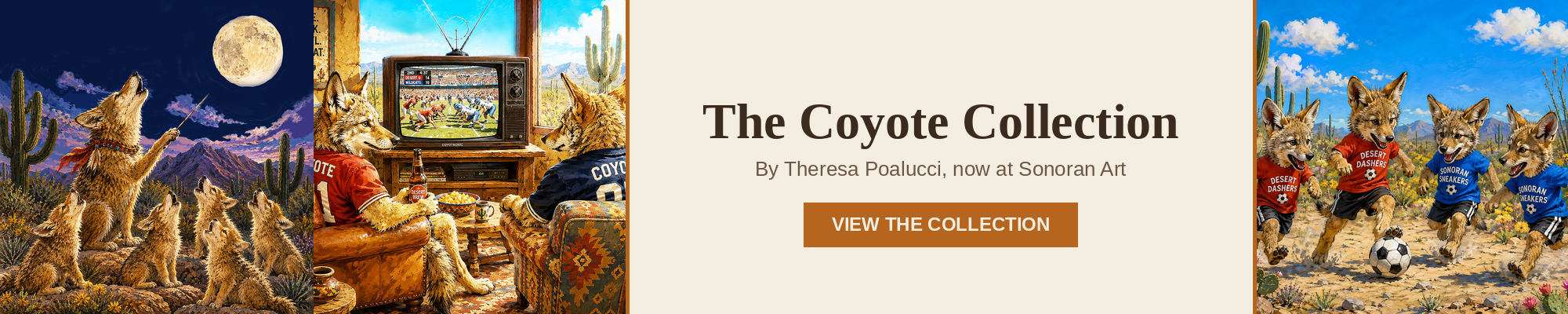
The pieces that make up the collection answer that question with a level of detail and warmth that turns each one into a small story. In “Happy Campers,” two old friends settle into camp chairs as the sun drops behind the mountains, marshmallows roasting over a glowing fire. In “Paws for Par,” a determined golfer lines up a final putt with total focus, seemingly unbothered by the Sonoran Desert stretching out behind him. “Sunday in the Sonoran” finds two coyotes deep in a football ritual — team jerseys, a cold desert brew, an old television propped on a stand — while “For the Birds” turns the usual predator-and-prey relationship on its head, with a curious pack passing around a pair of binoculars to watch the birds overhead. “Desert Troubadour” imagines a lone coyote as a wandering musician, guitar in hand beneath a golden sky, and “Campfire Cuisine” leans into the collection’s sense of humor with two cowboy coyotes gathered around a fire for a meal that is, with a wink, “definitely locally sourced.”
Every piece is printed on metal, a finish that suits the collection’s bright palette and clean lines, giving the artwork a durability and vibrancy that holds up in a sunroom, a patio, or a busy family room. And every piece, despite its humor, carries something more sincere underneath: an affection for an animal that has learned to thrive — cleverly, stubbornly, adaptably — in a landscape that doesn’t make thriving easy. That’s the note the whole collection is built on. The jokes are the entry point; the admiration is the point.
Sonoran Art has built its reputation on a different but complementary vision of the same desert. Based in Oro Valley, the studio produces archival canvas and metal prints capturing Pusch Ridge, the Santa Catalina Mountains, monsoon skies, and the golden-hour light that defines this part of Arizona — landscapes fulfilled locally through Centric Photo in Tucson and shipped ready to hang. Where Sonoran Art has specialized in the desert’s scenery, Poalucci’s Coyote Collection brings the desert’s personality — the wildlife equivalent of populating a beautiful stage with characters who have somewhere to be.
That’s really the logic behind bringing the two together. A landscape print captures a place. A Poalucci coyote captures a mood, a joke, a moment of recognition. Displayed together — or even side by side on the same wall — they tell a fuller story about what it actually feels like to live in the Sonoran Desert: the drama of the mountains at sunset, and the very real possibility that something with a tail and a sense of humor is watching you enjoy it.
It also reflects something Poalucci has said about her own approach to art and community: she wants people who might never walk into a traditional gallery — who assume fine art is too expensive or too intimidating — to end up with something real and original on their walls anyway. Sonoran Art’s model, built around accessible, locally produced prints available directly online, offers exactly that kind of entry point. Pairing her narrative, character-driven pieces with a platform already devoted to bringing Sonoran Desert art into local homes is a natural next step for a collection built on approachability and humor in the first place.
The Coyote Collection is now available as metal prints through Sonoran Art, alongside the studio’s existing lineup of Sonoran Desert landscapes. Individual pieces range in size and price, with several — including “Happy Campers,” “Paws for Par,” “Sunday in the Sonoran,” and “Coyote Cooldown” — available at 24″ x 18″, and others, like “Desert Troubadour” and “For the Birds,” offered in a 20″ x 20″ format.
For longtime followers of Theresa Poalucci’s work, the collection is a natural evolution — the same eye for color and character that has defined her career, applied to a subject that could only have come from living, and looking closely, right here in the Sonoran Desert. For Sonoran Art, it’s an expansion of what a “desert print” can be: not just the mountain at sunset, but the neighbor who happens to have four legs, a lounge chair, and absolutely no shame about napping through the hottest part of the day.