
Heirloom Farmers Market
October 24@ 8:00 am—12:00 pm

CONVERSATIONS ACROSS CENTURIES: Thomas Jefferson
In June’s installment of our year-long series celebrating America’s 250th birthday, we sit down with the author of the Declaration of Independence. Thomas Jefferson – diplomat, scientist, architect, and the man who wrote “all men are created equal” while enslaving over 600 people – confronts the contradiction that defines both his legacy and America’s founding.
From Monticello to the Louisiana Purchase, from the Library of Congress to the University of Virginia, Jefferson shaped American ideals while embodying its deepest hypocrisies. What would he think of Oro Valley’s free public library offering access to all human knowledge? How does he reconcile his beautiful words with his terrible choices? And what advice would he offer a nation still grappling with the gap between its principles and its practices?
Discover the brilliant, flawed man whose words launched a revolution but whose life revealed how hard those words are to live by – and learn why honest confrontation with our contradictions matters more than comfortable myths.
Part of ILoveOV.com’s special series: Conversations Across Centuries
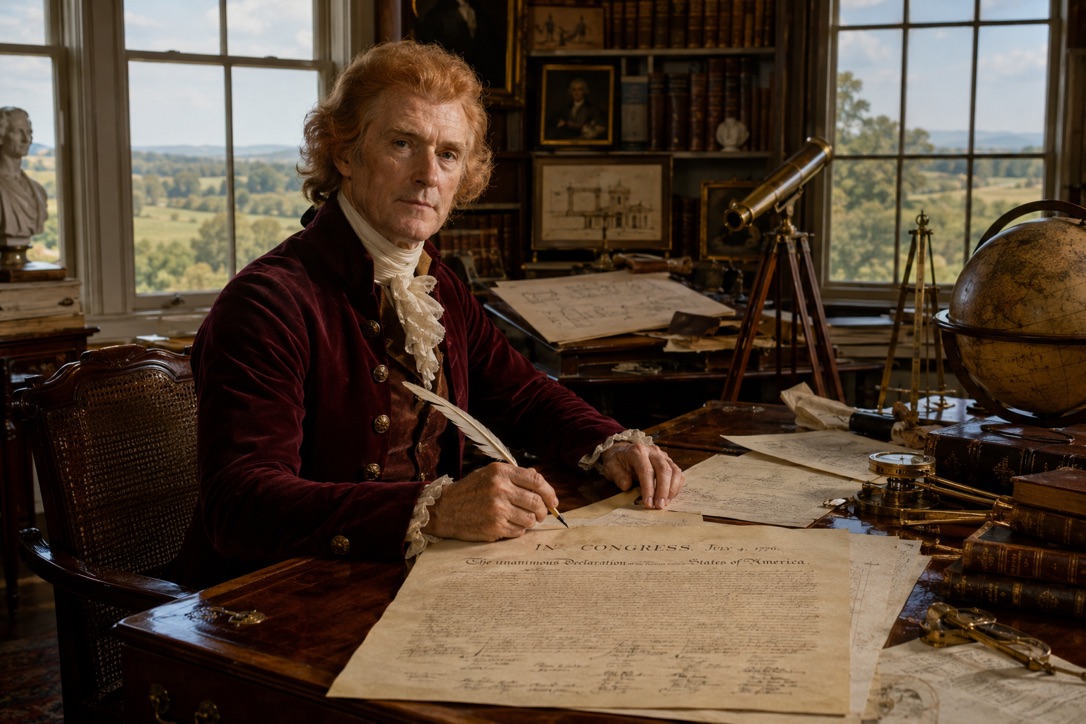
Thomas Jefferson at his Monticello study writing desk with quill pen working on Declaration of Independence manuscript, surrounded by telescope, globe, architectural drawings, and books, wearing burgundy 18th century coat with white cravat, Virginia countryside visible through large windows
In our sixth installment of Conversations Across Centuries, we sit down with the author of the Declaration of Independence. Thomas Jefferson – diplomat, architect, scientist, president, and the man whose words defined American ideals while his actions embodied its deepest contradictions – shares his thoughts on liberty, slavery, and what it means when your finest words outlive your worst deeds.
Mr. President, thank you for joining us. What motivated you to risk everything for independence?
Mr. Jefferson is fine. I’ve never been comfortable with titles or formalities – they smack of monarchy, of inherited privilege I spent my life opposing.
What motivated me? Intellectual conviction more than personal grievance, if I’m honest. I was wealthy, comfortable, educated. Independence didn’t promise to improve my material circumstances. If anything, it threatened them.
But I’d studied Locke, Montesquieu, the Scottish Enlightenment philosophers. I understood that government derives its just powers from the consent of the governed, that natural rights exist independent of any king’s grant. The British system – Parliament claiming authority to bind us in all cases whatsoever – was philosophically indefensible.
I also believed, perhaps naively, that we could create something genuinely new. Not just independence from Britain, but a republic based on reason rather than tradition, on merit rather than birth, on the pursuit of happiness rather than the maintenance of hierarchy.
The Declaration wasn’t just a list of grievances against George III. It was a statement of universal principles. “All men are created equal” – I meant that. I believed it. That I failed to live by it is my eternal shame, but the principle itself was sincere.
What was your greatest fear during the Revolution?
That we’d fracture immediately after victory, or that we’d simply recreate British institutions with American names.
Thirteen colonies with different economies, different religious traditions, different interests – holding them together required constant negotiation, constant compromise. I feared Virginia and Massachusetts would go their separate ways, that the union would dissolve before it had properly formed.
I also feared we’d establish an American aristocracy. That the same families who’d held power under British rule would simply transfer that power to the new system. That we’d replace King George with President-King Washington, replace the House of Lords with a Senate of landowners.
And I feared ignorance. A republic requires educated citizens capable of self-government. If we didn’t build schools, didn’t promote learning, didn’t create an informed electorate, democracy would devolve into mob rule or manipulation by demagogues.
My entire life’s work – the University of Virginia, my library that became the Library of Congress, my insistence on public education – stemmed from that fear. Ignorance and freedom cannot coexist.
You wrote “all men are created equal” while enslaving over 600 people across your lifetime. How do you reconcile that?
[Long silence]
I don’t. I can’t. There is no reconciliation, only the bald fact of hypocrisy.
I knew slavery was wrong. I wrote against it as a young man – my original draft of the Declaration included a passage condemning the slave trade, though Congress removed it. I advocated for gradual emancipation. I wrote in Notes on the State of Virginia that slavery had a corrupting influence on both the enslaved and the enslaver.
But I never freed them. Not during my life – I freed only five people in my will, members of the Hemings family. Everyone else remained enslaved, sold after my death to pay my debts.
The rationalizations I told myself seem pathetic now. That emancipation without colonization would lead to race war. That individual manumission was financially impossible given my debts. That the next generation would solve what mine couldn’t.
All lies I told myself to maintain my comfort while articulating principles I refused to live by.
Here’s the truth I avoided: Ending slavery would have cost me everything – Monticello, my lifestyle, my position in Virginia society, my political viability. And I chose my comfort over my principles. I chose economic interest over the lives and freedom of hundreds of human beings.
The words I wrote were true. The life I lived was false. History will judge me for both, and should.
What compromises did you make that still trouble you?
Beyond slavery, which towers over everything else?
I compromised my principles on executive power. I opposed Hamilton’s expansive view of federal authority, argued for strict constitutional interpretation – then as president, I purchased Louisiana without clear constitutional authorization. I believed the ends justified the means, that doubling the nation’s size was worth the philosophical inconsistency.
I was wrong. Once you start bending principles for expedience, you’ve opened a door that’s hard to close.
I also compromised my relationship with John Adams over political differences. We became bitter enemies during the 1800 election – my supporters called him a monarchist, his called me an atheist and radical. We wasted years that could have been spent in friendship.
We reconciled late in life through letters, and those exchanges became some of my most cherished correspondence. But I regret the lost years, the bitterness, the inability to disagree politically while maintaining personal respect.
And I compromised truth for image. I cultivated a public persona – the enlightened philosopher-farmer, the man of science and reason – while hiding aspects of my life that contradicted it. I presented myself as simple and republican while living like an aristocrat, running up enormous debts to maintain Monticello’s grandeur.
Authenticity would have served me better than performance.
What would surprise us most about daily life in your era?
How much time even the wealthy spent on practical matters. I designed Monticello, managed a plantation, bred crops, conducted scientific experiments, built gadgets – endless physical and mental labor that modern conveniences have eliminated.
We had no running water, no electricity, no refrigeration. Food preservation was constant work. Communication was slow – a letter to France took two months. Travel was arduous – Philadelphia to Monticello was a week’s journey.
Also, how much was simply accepted that you’d find intolerable. Child mortality, disease, dental pain, lack of anesthesia. Violence – duels, public punishments, brutality toward enslaved people. Women and children were treated as property under the law.
And how small our world was, geographically and intellectually. The educated class was tiny. Everyone of note knew everyone else. The same few hundred people shaped politics, culture, and law. It was intimate and suffocating.
We thought we knew the world, but we knew only a tiny sliver – the Atlantic coast, European capitals. The West was mysterious, Indigenous nations were barely understood, Africa was fantasy. Our confidence exceeded our knowledge.
If you could witness one moment 250 years in the future – 2026 – what would you want to see?
The Library of Congress. Not the building, though I’d love to see what became of my collection – but the democratization of knowledge it represents.
I believed passionately that information should be freely available, that ordinary citizens needed access to books, to learning, to the accumulated wisdom of humanity. A republic depends on it.
So I want to see if you achieved that. Can anyone access the world’s knowledge? Are there libraries in every town? Can farmers read philosophy, can laborers study science, can women pursue any field of learning?
And I want to know if you’ve maintained the principle of religious freedom. I fought for the Virginia Statute for Religious Freedom – the achievement I was proudest of after the Declaration. The idea that government has no business in matters of conscience, that belief cannot be compelled.
Have you preserved that? Or has religious persecution crept back in?
You’re told that Oro Valley, Arizona – a desert town you never imagined – has a public library offering free access to millions of books and instant digital access to virtually all human knowledge, and that the town council meetings are public and transparent. Your reaction?
[Visibly moved]
A public library. Free access. In a desert settlement. This is extraordinary.
First: How did you settle desert? I commissioned the Lewis and Clark expedition to map the West, but Arizona – that’s Spanish territory in my time, isn’t it? How did it become part of the United States?
[Told about westward expansion, Mexican-American War, acquisition]
We expanded to the Pacific? Good God. The republic I knew was thirteen states along the Atlantic. You’re telling me we span a continent?
But back to this library – free access to all human knowledge? How does that work? Do you have printing presses in every town? How do you afford to give books away?
[Told about the internet, digital access, computers]
I’m trying to understand. You have machines that access… everything? Every book ever written, every scientific paper, every document? Instantly? Available to anyone?
This is either democracy’s perfection or its destruction. The democratization of knowledge was my life’s dream. But if any fool can publish nonsense alongside Newton and Locke, how do citizens distinguish truth from lies?
[Told: It’s complicated, no central authority, ongoing challenge]
Then you’ve achieved the access but not the wisdom. Knowledge without discernment is just noise.
But tell me about these town council meetings in Oro Valley – public and transparent, you said? Citizens can attend? Can speak? Can observe how decisions are made?
That’s proper republican government. Small enough for direct participation, transparent enough for accountability. That’s what I envisioned for ward republics – local communities governing themselves, citizens engaged in the daily work of democracy.
How many people attend these meetings? Are citizens informed about the issues? Or do they delegate everything to representatives and only complain later?
What advice would you give Americans celebrating the 250th birthday?
First: Education, education, education. I cannot overstate this. A democracy cannot function with an ignorant citizenry. You can have the finest constitution ever written – and I helped write it – but it’s worthless if people don’t understand it, can’t think critically, can’t evaluate claims and evidence.
Fund schools. Pay teachers well. Make learning accessible to everyone regardless of birth or wealth. An educated plowman is more valuable to a republic than an ignorant nobleman.
Second: Defend the separation of church and state absolutely. Government has no business enforcing religious belief, and religion has no business wielding governmental power. The moment you breach that wall, you’ve planted seeds of tyranny.
Third: Resist the concentration of power. Whether in banks, corporations, government, or individuals – concentrated power corrupts. Distribute it, check it, balance it. Eternal vigilance isn’t just about external enemies. It’s about watching those who govern you.
Fourth: Embrace change. I wrote that the earth belongs to the living, that no generation should be bound by the decisions of previous ones. Each generation should be free to govern itself. That’s why we included amendment processes – so your Constitution can be changed when the people demand it. Don’t worship us founders. We were fallible men making the best decisions we could with the knowledge we had. You know more. Do better.
Fifth: Confront your contradictions honestly. I failed at this. I articulated beautiful principles while living in violation of them. Don’t make my mistake. If you claim to value freedom, extend it to everyone. If you preach equality, practice it. Hypocrisy corrodes everything.
Sixth: Preserve local democracy. Federal government is necessary for some things, but don’t let it swallow everything. Towns, counties, communities – these are where citizens learn democracy by doing it. Keep power as local as possible.
Finally: Remember that the pursuit of happiness was meant seriously. Not just material wealth, not just pleasure, but genuine human flourishing. A society that makes its citizens miserable has failed regardless of its GDP.
And one more thing: Free the people you’ve enslaved. Whatever form that slavery takes in your era – economic, racial, social, legal – identify it and end it. Don’t wait for the next generation. Don’t make excuses. Just do the right thing I failed to do.
Thomas Jefferson died July 4, 1826, at Monticello, exactly fifty years after the Declaration of Independence and hours before John Adams died in Massachusetts. His last words were reportedly about the approaching anniversary. He was 83. His tombstone, which he designed, lists three achievements: Author of the Declaration of Independence, Author of the Virginia Statute for Religious Freedom, and Father of the University of Virginia. He did not include being president. He freed five people in his will – all members of the Hemings family. The remaining 130 enslaved people at Monticello were sold to pay his debts.