
American Made, with The Presidio Boys
October 11@ 6:00 pm—8:00 pm

CONVERSATIONS ACROSS CENTURIES: George Washington
In July’s installment of our year-long series celebrating America’s 250th birthday, we sit down with the man who could have been king — and walked away. George Washington — commander of the Continental Army, presiding officer of the Constitutional Convention, America’s first president — shares his unfiltered thoughts on duty, sacrifice, political faction, and the extraordinary importance of giving up power gracefully.
From the frozen hell of Valley Forge to the voluntary surrender of the presidency, Washington’s story is one of principle over ambition. He warned against exactly the “spirit of party” that threatens republics. He believed the health of democracy depends not on grand capitals but on ten thousand communities — like Oro Valley — making decisions about how to live together.
What would he think of a desert town of 50,000 that didn’t exist in his lifetime? How would he react to four women on a seven-member town council? And what does his Farewell Address — written 230 years ago — have to say to Americans in 2026?
Discover the founder who understood that the greatest act of leadership is knowing when to step aside.
Part of ILoveOV.com’s special series: Conversations Across Centuries
 July 2026 — Celebrating America’s 250th Birthday
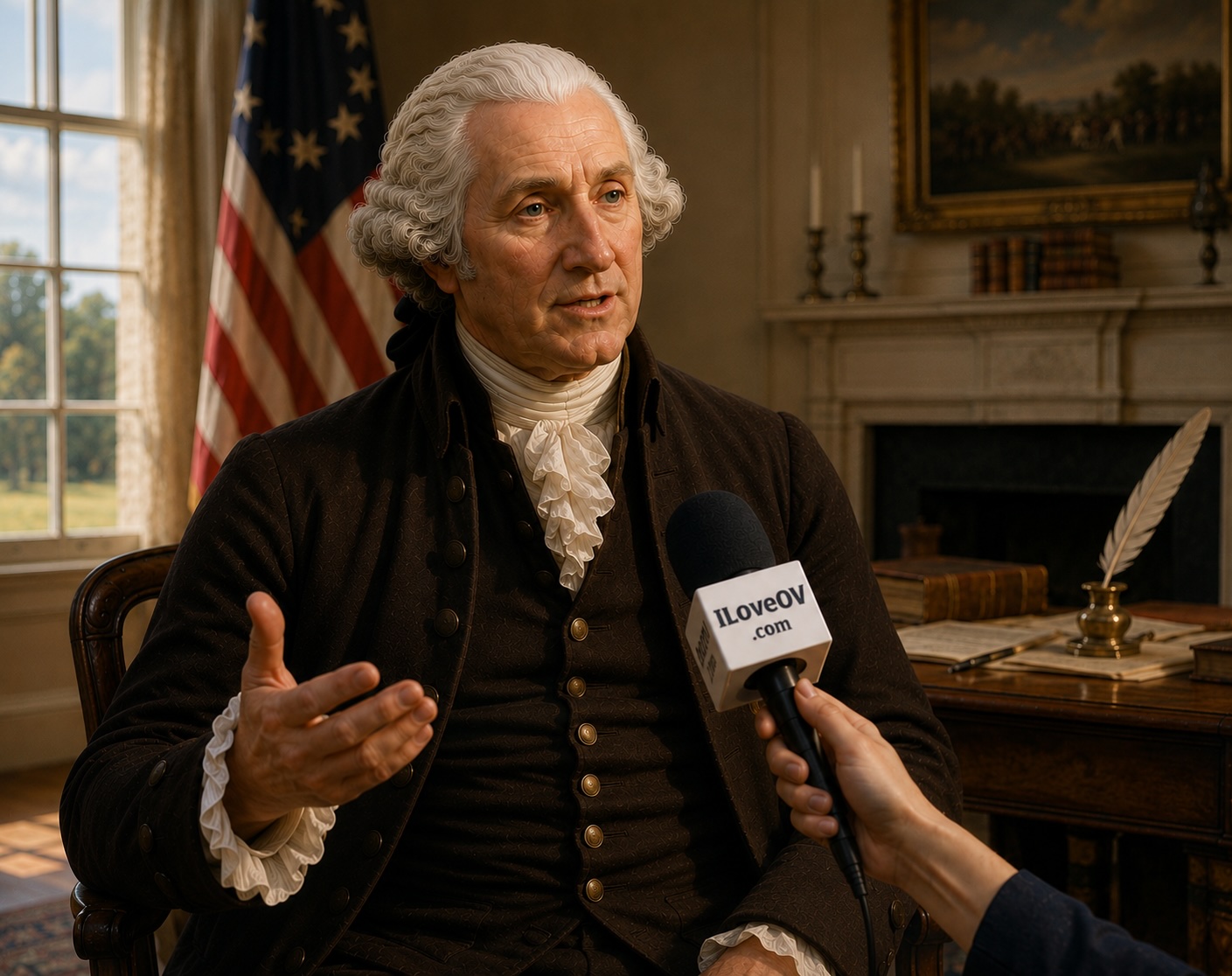
In our seventh installment of Conversations Across Centuries, we sit down with the man who could have been king — and chose not to be. George Washington — commander of the Continental Army, presiding officer of the Constitutional Convention, and America’s first president — reflects on duty, sacrifice, and what it means to build something meant to outlast you.
General Washington, thank you for joining us. What motivated you to risk everything for independence?
You may call me General — I was a soldier far longer than I was a president, and the title sits more comfortably on me.
What motivated me? A sense of duty I could not escape, however much I might have wished to.
You must understand: I had everything to lose. Mount Vernon was prosperous. I had land, standing, and the respect of my neighbors in Virginia. I was a man of considerable comfort. Revolution was not a romantic adventure for me — it was a grave undertaking I entered with full knowledge of what failure would mean. Failure meant the gallows. It meant watching everything I had built reduced to ash.
But when the Massachusetts militiamen stood at Lexington and Concord in April of 1775, something shifted. The question was no longer whether we had legitimate grievances — that had been settled. The question was whether men of standing and means would stand with ordinary farmers and tradesmen or leave them to face the Crown alone. I could not stand aside. To do so would have been a betrayal of everything I believed about honor and duty.
I will confess something, though your readers may find it surprising: I was not certain we could win. I was not even certain I was the right man to lead the army. But I accepted the command because no one else stepped forward, and because some things must be attempted even when the outcome is uncertain.
You endured eight years of war, Valley Forge among its darkest chapters. How did you keep your men — and yourself — going?
Valley Forge in the winter of 1777 to 1778 was the crucible that tested everything. Nearly 12,000 men. Insufficient food, inadequate clothing, and no shoes for many men, leaving bloody footprints in the snow on the march into camp. We lost roughly 2,500 souls that winter, most not to battle but to disease, exposure, and despair.
What kept us going? Several things.
First, the men themselves. The soldiers who stayed at Valley Forge — and many deserted, I will not hide that — displayed a fortitude that humbled me. These were not mercenaries fighting for pay. The pay was irregular at best, worthless Continental currency at worst. They endured because they believed in something larger than themselves.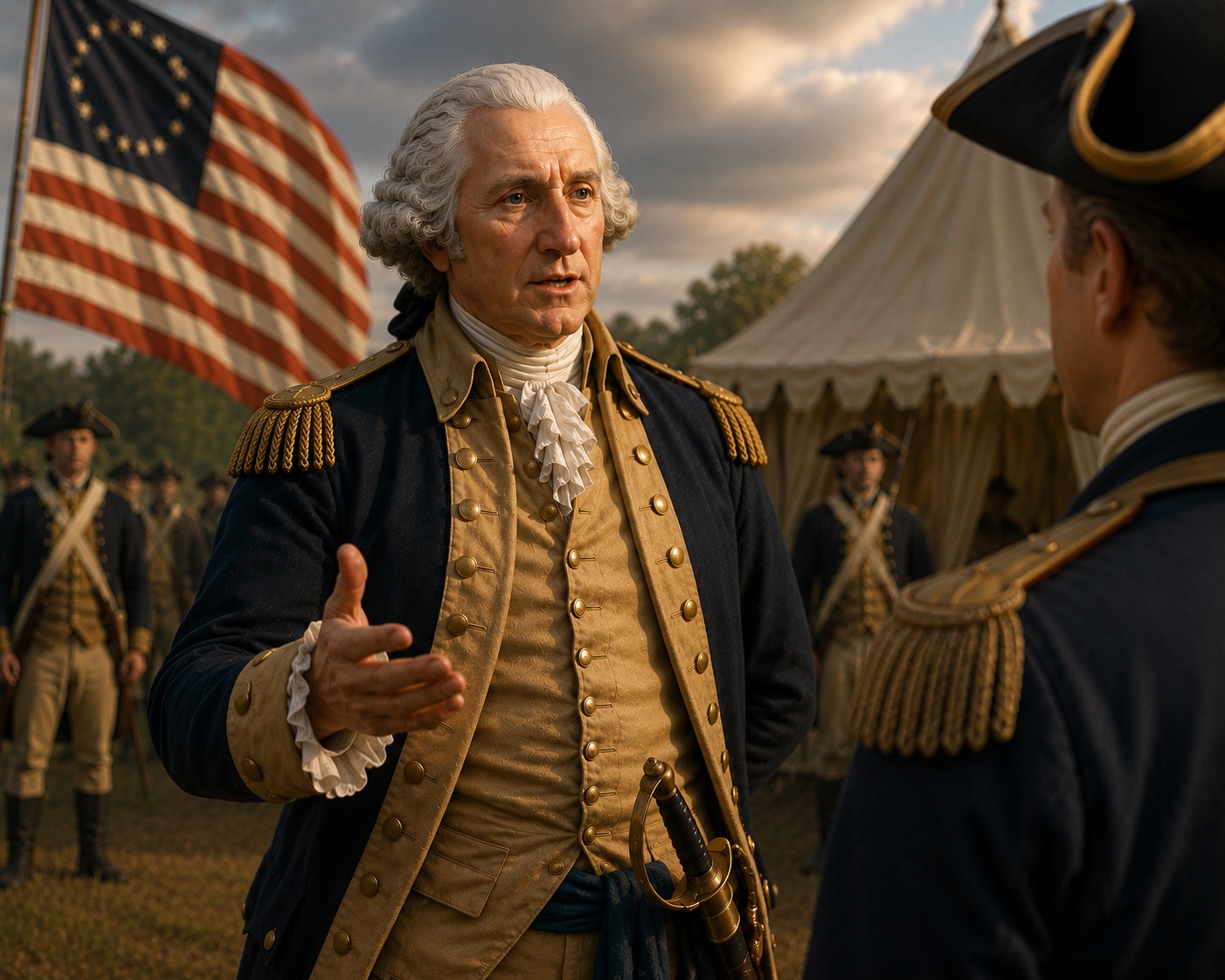
Second, the discipline Baron von Steuben brought to that frozen hillside. A Prussian officer who barely spoke English, drilling my ragged Continentals until they moved and fought like professionals. I have never underestimated what rigorous training and shared purpose can accomplish since that winter.
As for myself, I wrote letters. I wrote to Congress begging for supplies. I wrote to my officers, maintaining their spirits. I wrote to Martha. When a man must put his thoughts for another, he has less time to succumb to despair.
And I believed. Not in our inevitable victory — I was never so foolish as to believe that. I believed that what we were fighting for was worth the cost. That belief was not always sufficient comfort at three o’clock in the morning, but it was sufficient to rise at dawn.
The nation just celebrated its 250th birthday on July 4th. If you could witness one thing about modern America, what would it be — and what would concern you most?
I would want to witness a July Fourth celebration in a small American town — not the spectacle of a great city, but the ordinary expression of it. Neighbors gathered on a summer evening, children racing about with sparklers, an old man setting off fireworks with more enthusiasm than precision. The Declaration read aloud, perhaps imperfectly, by someone who means every word.
That image — the Republic belonging to ordinary people in ordinary places — is precisely what we hoped for. I’m told Oro Valley holds such celebrations, that 50,000 people have built a thriving community in an Arizona desert most of my contemporaries could not have imagined. That pleases me enormously.
What concerns me most? You will find this familiar if you’ve read my Farewell Address, which I hope your readers will.
I warned against what I called the “spirit of party” — the tendency of factions to place loyalty to their party above loyalty to the nation. I had watched it begin even within my own cabinet, Hamilton and Jefferson barely able to sit in the same room. I warned that this spirit was “the worst enemy” of popular government, that it opens the door to “foreign influence and corruption.”
I will not pretend to know the particulars of your political situation in 2026. But if the disease I diagnosed has advanced rather than receded, that concerns me deeply. A republic requires citizens who can disagree, negotiate, and ultimately subordinate their faction’s interest to the common good. The moment any party begins to believe that holding power matters more than preserving the system that grants power, you are in danger.
You voluntarily surrendered command of the Army in 1783, and then the presidency in 1797. Why was that so important to you?
Because the alternative was unthinkable.
When I resigned my commission at Annapolis in December of 1783, King George III — who had spent eight years trying to defeat me — reportedly said that if I truly gave up power and returned to private life, I would be “the greatest man in the world.” He found it almost incompatible with human nature.
He was not wrong to be skeptical. History is full of men who led revolutions and became the tyrants they replaced. Caesar crossing the Rubicon. That very thing nearly happened in our own army — there were officers at Newburgh who whispered that I should use the military’s power to establish firmer government, perhaps even monarchy. I put that idea down as forcefully as I knew how.
Why did I resist? Because the entire enterprise — everything we had bled for — was the idea that legitimate authority flows from the people and returns to them. The moment I placed myself above that principle, I would have destroyed the very thing I’d fought to create. A republic with a king, however benevolent, is not a republic.
I wanted to go home to Mount Vernon. I was tired. I had been away for eight years. But more than that, I understood that what I did would set the precedent for every leader who came after me. The power of example is not to be underestimated. If I stepped down gracefully, I made it easier for every successor to do the same. If I clung to power, I made it imaginable for others to do so.
The presidency — two terms, then home. That too was the example I meant to set.
Oro Valley, Arizona — a desert community of 50,000 people — has four women serving on its seven-member town council. The community prides itself on open, transparent local government. What’s your reaction?
You will perhaps expect me to caveat this, given the limitations of my own era, and those caveats are fair. I lived in a time when women had no formal political voice, and I did not challenge that as forcefully as history might wish. I am not here to rewrite my record.
But I will tell you what I genuinely believe: good government has always depended on the quality of its participants, not their sex. I surrounded myself with exceptional minds — some of the most formidable intellects in the room, in any room, were women. Abigail Adams, whom you’ve already featured in this series, argued with more rigor than most men I knew. Mercy Otis Warren wrote political satire that outclassed most of the pamphlets in circulation. Martha, in her quiet way, understood people and situations with a clarity I sometimes lacked.
What strikes me about your Oro Valley council is not merely that women serve — it is the proportion. Four of seven. And you say the community prides itself on transparency, on open meetings where citizens may observe and participate. That is precisely the model of self-government we hoped to establish.
Local government is where the Republic is made real. Not in the grand gestures of the capital, but in the decisions of councils and communities that must answer directly to their neighbors. That your desert town takes this seriously — that is the America we envisioned.
What surprises you most about the America of 2026?
The size of it, first. We knew the continent was vast — I had crossed considerable portions of it — but 330 million people, a nation stretching to the Pacific, communities flourishing in deserts we scarcely knew existed? That is beyond what any of us dared imagine. I am told Oro Valley sits in the Sonoran Desert beneath a ridge called Pusch Ridge, where people run and hike in terrain that my contemporaries would have considered hostile and uninhabitable. The human capacity to make a home anywhere continues to astonish me.
The speed of information astonishes me as well, though I will admit it also alarms me. My letters took weeks. Your news — I’m told — travels in seconds, to everyone, without editors or gatekeepers. I see both the extraordinary promise and the danger in that. A free press was essential to our republic. But a press with no commitment to truth is something different — it is a mechanism for manufacturing confusion, which factions will always exploit.
And yet: the Constitution endures. 250 years. Amended, tested, stretched to its limits, and still standing. I’ll confess that in my darker moments at Valley Forge, I was not certain the experiment would survive a decade. That it has survived two and a half centuries — that is what most surprises and moves me.
What advice would you give Americans as we celebrate this 250th birthday?
Read the Farewell Address. Not because I wrote it — I had help from Hamilton, which I will acknowledge — but because the warnings in it remain as applicable in 2026 as they were in 1796.
Guard against the spirit of party. Maintain your credit — do not burden future generations with debts incurred for present conveniences. Preserve the constitutional checks that prevent any one branch, any one faction, any one man from accumulating unchecked power. Cultivate religion and morality as foundations of civic virtue — not because government should impose faith, but because a republic requires citizens capable of governing themselves.
And this, perhaps most of all: remember that you are Americans before you are members of any party, faction, or interest. The union is the vessel that carries everything else. Without it, the experiment ends.
When I look at Oro Valley — a community in a desert we never knew, built by people who chose to put down roots and build something together, electing their neighbors to govern them — I see the republic working as intended. Hold onto that. The health of the nation is not determined only in Washington. It is determined in ten thousand communities, making ten thousand decisions about how to live together.
America is worth the work. It was worth the cost in my day. I trust it remains so in yours.
George Washington was born on February 22, 1732, in Westmoreland County, Virginia. He commanded the Continental Army through eight years of war, presided over the Constitutional Convention in 1787, and served as the nation’s first president from 1789 to 1797. He voluntarily surrendered power twice — his military commission in 1783 and the presidency in 1797 — setting precedents for civilian control of the military and the peaceful transfer of power that would define American democracy. He died on December 14, 1799, at Mount Vernon, Virginia, at age 67. His Farewell Address, published in 1796, remains one of the most consequential documents in American political history.