
Heirloom Farmers Market
October 24@ 8:00 am—12:00 pm

SELDOM DISCUSSED WOMEN OF THE FOUNDING
Our Conversations Across Centuries series features the familiar founding names. This special feature introduces three remarkable women whose contributions were essential yet systematically erased. Phillis Wheatley, the enslaved poet who proved Black intellectual equality. Mercy Otis Warren, the political writer and historian who chronicled the Revolution. And Deborah Sampson, who disguised herself as a man to fight in the Continental Army.
One wrote poetry that challenged every assumption about race and gender. One documented history while living it. One fought in combat for seventeen months before discovery.
All three have been largely forgotten while their male contemporaries are celebrated. Their stories illuminate not just what women accomplished, but how thoroughly women’s contributions have been written out of American history.
Discover the poet, the historian, and the soldier whose absence from our standard narratives is a choice we can correct. Learn why their inclusion matters for how we understand America’s founding.
Part of ILoveOV.com’s special series: Conversations Across Centuries
SELDOM DISCUSSED WOMEN OF THE FOUNDING
Our Conversations Across Centuries series features the familiar founding names. This special feature introduces three remarkable women whose contributions were essential yet systematically erased. Phillis Wheatley, the enslaved poet who proved Black intellectual equality. Mercy Otis Warren, the political writer and historian who chronicled the Revolution. And Deborah Sampson, who disguised herself as a man to fight in the Continental Army.
One wrote poetry that challenged every assumption about race and gender. One documented history while living it. One fought in combat for seventeen months before discovery.
All three have been largely forgotten while their male contemporaries are celebrated. Their stories illuminate not just what women accomplished, but how thoroughly women’s contributions have been written out of American history.
Discover the poet, the historian, and the soldier whose absence from our standard narratives is a choice we can correct. Learn why their inclusion matters for how we understand America’s founding.
Part of ILoveOV.com’s special series: Conversations Across Centuries
Phillis Wheatley’s story seems impossible. Kidnapped from West Africa as a child of seven or eight, sold into slavery in Boston, yet within years became one of the most celebrated poets in the English-speaking world. She corresponded with George Washington. She was invited to meet Benjamin Franklin in London. Her 1773 book “Poems on Various Subjects, Religious and Moral” made her the first published African American poet and only the second American woman to publish a book of poetry.
Yet most Americans have never heard her name. If we have, we know her as a curiosity, the “enslaved poet,” rather than as what she was. A brilliant writer whose work stands alongside any poet of her era.
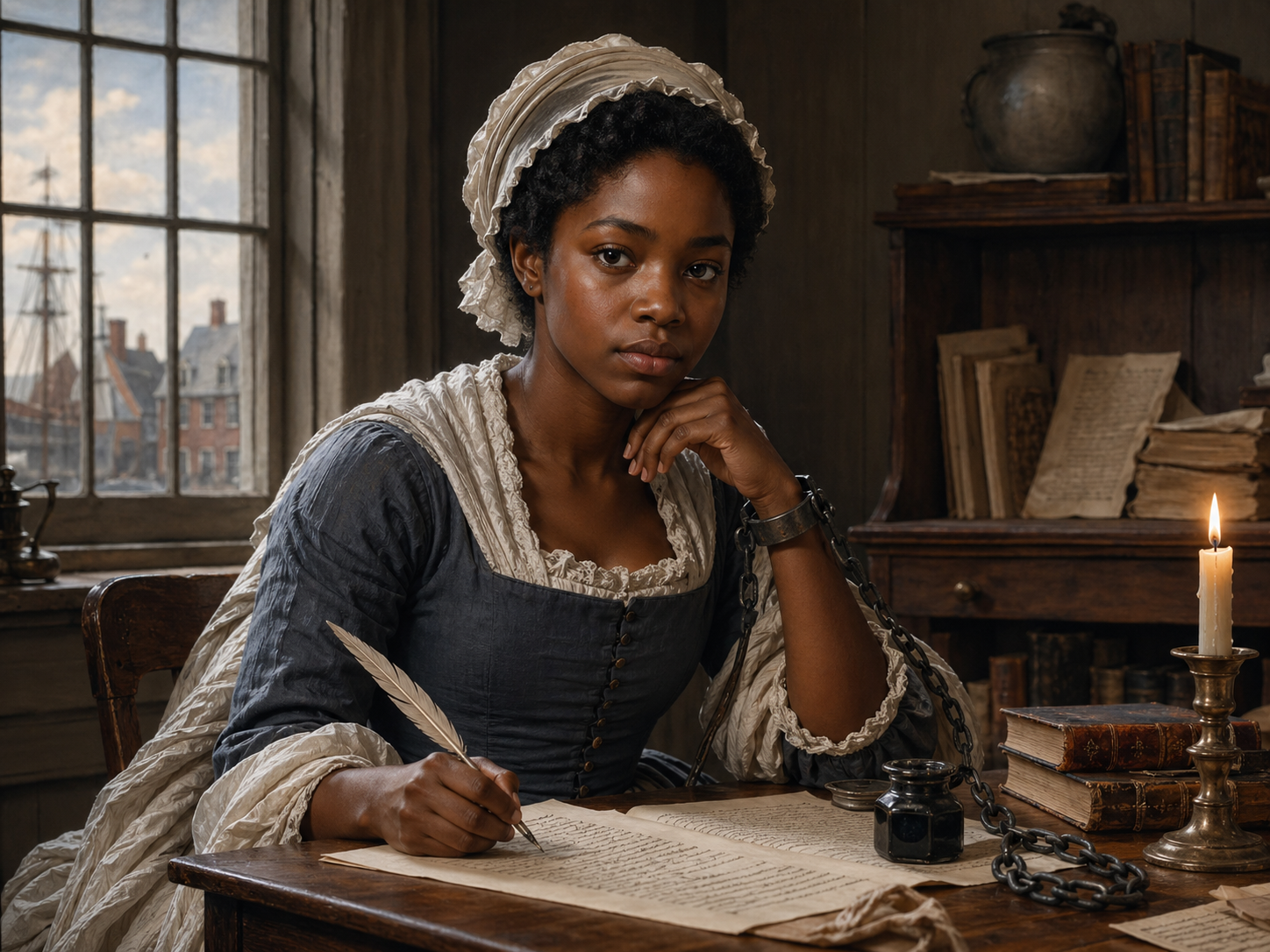
Phillis Wheatley
Ms. Wheatley, thank you for joining us. What motivated you to write poetry in a world determined to silence you?
First, understand this. I didn’t choose poetry as an act of rebellion. I chose it because language was the only territory where I had any freedom.
When I arrived in Boston in 1761, I spoke no English. I was perhaps seven years old, torn from my mother and sold on a wharf like livestock. The Wheatley family purchased me, and their daughter Mary taught me to read. Within sixteen months, I was reading the Bible. Within a few years, I was studying Latin, Greek literature, and British poetry.
Why poetry? Because in verse, I could construct a world where my mind wasn’t property. Where my thoughts had value. Where beauty and intellect mattered more than the color of my skin or the chains of my legal status.
But let’s be clear about what motivated me. It wasn’t some genteel love of art. It was survival. Writing was how I proved my humanity to people who considered me three-fifths of a person at best. Every poem was evidence that an African mind could think, create, and reason as well as any European’s.
When I wrote elegies for the dead children of prominent Bostonians, when I composed verses on religious themes, when I translated Ovid, I was forcing the question. How can you claim Africans are intellectually inferior when one of them masters your own literary traditions better than most of your children?
The world was determined to silence me by denying I had anything worth hearing. Poetry was how I made them listen.
What was your greatest fear?
That I’d die enslaved, and my work would be dismissed as a curious anomaly rather than proof of what Africans could achieve if given the same opportunities as whites.
I was freed in 1778, five years after my book’s publication, shortly before the Wheatleys died. But freedom for a Black woman in revolutionary America? What did that mean, practically? I couldn’t own property. Couldn’t vote. Could barely earn a living. I married John Peters, a free Black man, and we struggled terribly. I worked as a scullery maid, me, who’d corresponded with Washington, who’d been celebrated in London salons.
My fear was that people would say, “Well, Phillis Wheatley was talented, but she’s the exception that proves the rule. Most Africans aren’t capable of her achievements.” Rather than recognizing the obvious truth. I achieved what I did despite being enslaved, despite having no formal education, and despite every possible disadvantage. Imagine what I could have done with the advantages given to white men of mediocre talent.
I also feared my work would be lost. Poems are fragile things. Books burn. Memories fade. If my writing disappeared, what evidence would remain that I’d existed as anything more than a name in a property ledger?
You wrote a poem to George Washington, and he invited you to visit him. What did the founders not understand about slavery?
[Long pause]
Everything. They understood nothing, or they understood perfectly and chose convenience over conscience.
I sent Washington a poem in 1775, praising him as the leader of America’s fight for liberty. He wrote back, a kind letter, genuinely appreciative. He invited me to visit his headquarters. We met. He was courteous, respectful, even.
But here’s what he didn’t understand, what none of them understood. You cannot write eloquently about liberty while owning human beings. You cannot declare that all men are created equal while treating Africans as property. You cannot fight British tyranny while practicing American slavery.
The hypocrisy was so obvious, so glaring, that their failure to see it could only be willful blindness.
Jefferson wrote “all men are created equal” while owning over 600 human beings across his lifetime. Washington commanded an army fighting for freedom while enslaving over 300 people at Mount Vernon. They wrote constitutions guaranteeing rights while denying those rights to anyone who looked like me.
What they didn’t understand, or refused to understand, is that slavery corrupts everything it touches. You cannot build a republic on a foundation of human bondage and expect it to stand. The contradiction will eventually tear the nation apart.
Some of them knew this. They wrote about it in private letters, expressed discomfort, and called it a “necessary evil.” But discomfort without action is just moral vanity. They chose their economic interests, their political coalitions, and their personal comfort over the lives and freedom of hundreds of thousands of human beings.
And they made people like me prove our humanity, prove our intellectual equality, prove we deserved the rights they claimed were inherent and inalienable. We shouldn’t have had to prove anything. The burden of proof should have been on them to justify slavery, not on us to justify our freedom.
What compromises did you make that still trouble you?
I wrote within the bounds of what white audiences would accept. I softened my critique of slavery. I emphasized Christian redemption rather than earthly justice. I made myself palatable.
My poem to Washington praises him for fighting tyranny, but I didn’t explicitly connect American slavery to British oppression. I should have. I should have written, “General, you fight King George for taxing you without representation. I have no representation at all. You object to being treated as property. I am property. Explain the difference.”
But I didn’t write that. Because if I had, the poem would never have been published, Washington wouldn’t have responded, and I’d have lost what little platform I had.
I also wrote in classical European forms, referenced Greek and Latin literature, and adopted Christian themes. Essentially proving I could master white culture’s own traditions. That was strategic, necessary even. But it also meant I largely abandoned African cultural forms, African spiritual traditions, the languages and stories stolen from me when I was kidnapped.
I became what they needed me to be to prove my worth. A Black woman who could write like an educated white person. But what if I’d written in African traditions they knew nothing about? Would that have been dismissed as primitive or recognized as equally sophisticated?
I’ll never know, because I chose recognition over authenticity. That was survival, but it still troubles me.
What would surprise us most about daily life in your era?
How completely literature dominated educated society’s social life, yet how viciously it was gatekept.
Poetry wasn’t a niche interest. It was mass culture for educated people. When someone died, you commissioned an elegy. Political debates happened in verse. Newspapers printed poems alongside news. A talented poet had genuine celebrity.
But publishing required authentication. When my book came out, it included a preface signed by eighteen prominent Boston men, including the governor, attesting that I’d actually written the poems. Because a book by a Black woman was so inconceivable that I needed white men to vouch for my authorship.
Imagine needing eighteen character witnesses just to prove you wrote your own work.
Also, how brief life was, especially for the poor and enslaved. I died at 31. Three of my children died in infancy. Disease, poverty, lack of medical care, these killed people casually, constantly. The revolutionaries writing about liberty and longevity were the lucky ones who survived childhood, who had enough to eat, who didn’t work themselves to death.
And the complete absence of any path forward for free Black people. We’d fought in the Revolution; thousands of Black soldiers served, hoping it would lead to emancipation. It didn’t. After the war, we were still denied citizenship, still barred from most employment, still treated as perpetual outsiders in the nation we’d helped create.
If you could witness one moment 250 years in the future, in 2026, what would you want to see?
Black children are reading my poems in school. Not as a curiosity, not in a special unit on “African American literature,” but as part of American literature. Period.
I want to see if we’re finally recognized as having been Americans from the beginning, builders, thinkers, writers, soldiers, rather than people who were grudgingly admitted later.
Tell me. In 2026, do Black children grow up knowing they’re inheritors of a literary tradition as old as the nation itself? Or do they still learn American literature as if it began with white men, with people like me as footnotes?
And education, can Black children attend any school they want? Are they taught by teachers who look like them? Do they have the same opportunities as white children, or are we still fighting for what should have been guaranteed 250 years ago?
You’re told that slavery was abolished in 1865 after a civil war, that Black Americans can vote, attend universities, become poets and publish freely, and that Oro Valley, Arizona’s library system actively promotes diverse voices, including works by African American poets. Your reaction?
[Visibly shaken]
1865? So it took 89 years after independence to abolish slavery, and required a civil war? Tell me truly, how many died in that war?
[Told approximately 600,000-750,000]
Three-quarters of a million people died because the founders lacked the courage to end slavery when they had the chance. Every one of those deaths is on their hands. They knew slavery would tear the nation apart; they said as much in private, but they postponed the reckoning because it was inconvenient.
And voting rights came when? After the Civil War, I assume?
[Told yes, but with massive resistance, violence, and systematic disenfranchisement for another century]
So Black Americans have had unobstructed voting rights for, what, sixty years? Out of 250?
[Told it’s still being contested in some places]
Of course it is. Because the sin of slavery doesn’t end with emancipation. It metastasizes into every institution, every law, every assumption about who belongs and who doesn’t.
But tell me about this library in Oro Valley, a desert town, you said? Do they actively promote Black poets? How does that work? Do they have a special section, or are we integrated throughout?
[Told integrated throughout, active promotion of diverse voices, author events, educational programming]
That’s significant. Because for most of American history, if you wanted to read Black writers, you had to seek them out deliberately. They weren’t in standard curricula, weren’t in most libraries, and weren’t reviewed in major publications. We existed in parallel literary traditions that rarely intersected.
If Oro Valley’s library actively promotes diverse voices, it understands something crucial. Representation isn’t charity, it’s accuracy. American literature is, and has always been, multiracial. Pretending otherwise is a choice, not a reflection of reality.
What kind of programming do they do? Are we talking about Black History Month events, or year-round integration?
[Told year-round integration]
Good. Because relegating Black history to one month sends the message that we’re supplementary to “real” American history rather than integral to it.
One more question. Do young Black poets in 2026 know my name? Not as historical trivia, but as a literary ancestor, they can claim?
What advice would you give Americans celebrating the 250th birthday?
First. Understand that American literature, American culture, and American democracy were built by everyone who was here, not just the people who got credit. Black Americans have been writing, thinking, creating, and innovating since before independence. Stop treating us as late arrivals to a tradition we helped create.
Second. Read widely, especially authors who don’t look like you. Your understanding of America is incomplete if you only read white authors, male authors, straight authors, and Christian authors. Every excluded perspective is a blind spot in your knowledge.
Third. Recognize that legal equality and actual equality are different things. Yes, slavery ended. Yes, Black Americans can vote, attend schools, and publish books. But legal rights don’t automatically erase centuries of compounded disadvantage. Wealth wasn’t allowed to accumulate. Property couldn’t be passed down. Educational opportunities were denied for generations. Those effects persist.
Fourth. Support Black artists, writers, and thinkers while they’re alive. I died in poverty despite having been celebrated in London salons. My contemporaries praised my talent but didn’t ensure I could earn a living from it. Appreciation without material support is hollow.
Fifth. Teach the full history, including the uncomfortable parts. The founders owned slaves. The Constitution protected slavery. The nation was built on stolen Indigenous land using stolen African labor. These aren’t peripheral facts; they’re central to understanding America. You can admire the achievements while acknowledging the atrocities.
Sixth. Remember that every time someone told me I couldn’t write because of my race, my gender, or my status, they were wrong. Every time someone excluded a voice because it didn’t fit their assumptions about who could contribute, they impoverished their own culture. Don’t repeat their mistakes.
One last thing. To young Black writers especially, you don’t have to prove anything. You don’t have to master someone else’s traditions or write in someone else’s forms to be legitimate. I did that because I had no choice. You have choices I never had. Use them.
Your voice matters not because you’ve proven it matters, but because it exists. Don’t let anyone convince you otherwise.
Mercy Otis Warren wrote the Revolution. Literally. Her plays satirized British governors so effectively that they became propaganda tools. Her political essays shaped public opinion. Her correspondence with Adams, Jefferson, and Washington influenced policy. And her three-volume “History of the Rise, Progress, and Termination of the American Revolution” (1805) was one of the first comprehensive accounts of the war, written while many participants were still alive.
Yet ask most Americans to name revolutionary writers, and they’ll say Paine, Jefferson, maybe Franklin. Warren has written more extensively than many of her male contemporaries, but she’s been largely forgotten. Her story illuminates how women’s intellectual contributions were simultaneously essential and systematically erased.
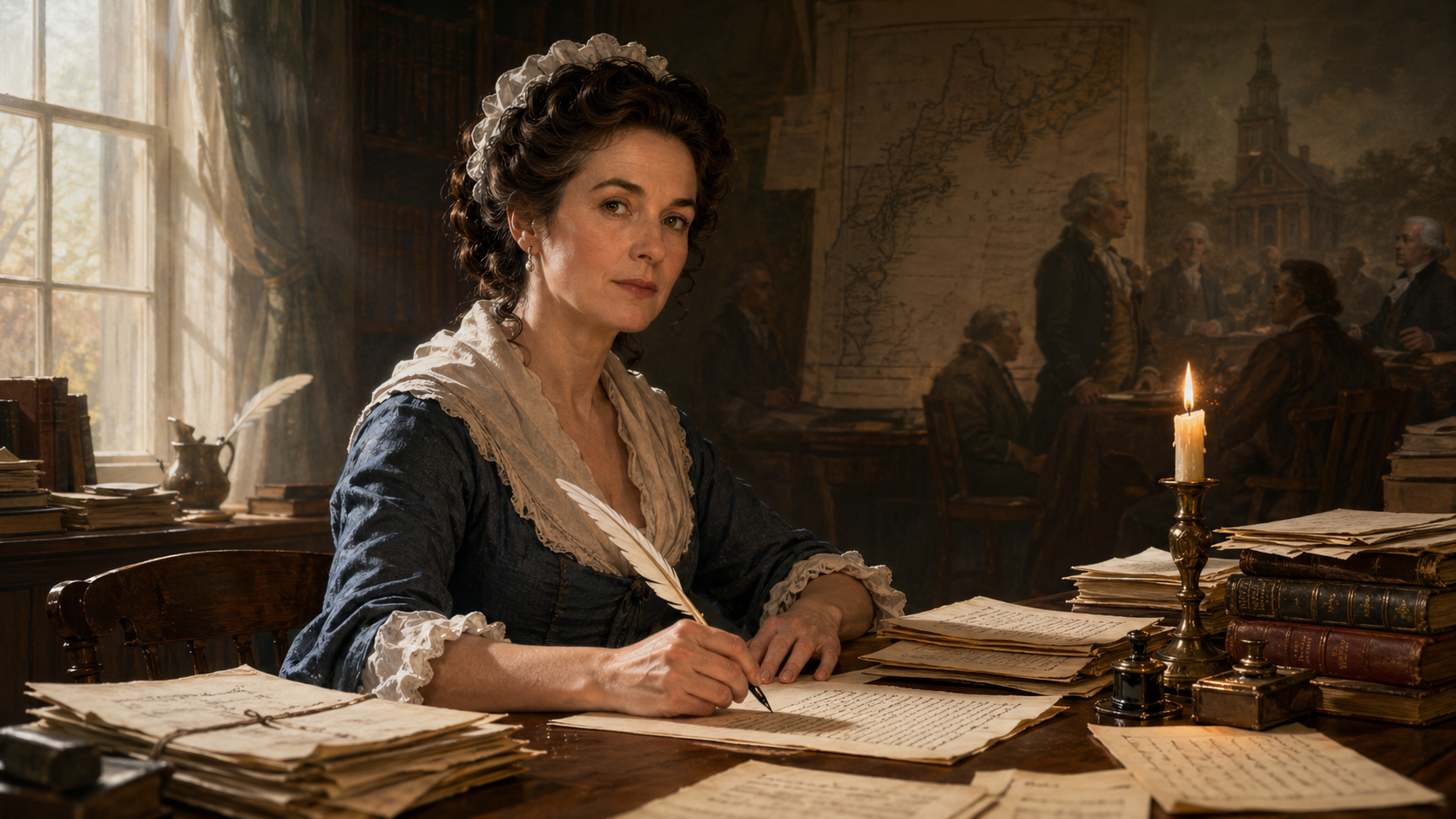
Mercy Otis Warren
Mrs. Warren, thank you for joining us. What motivated you to write about politics in a world that considered such activity unfeminine?
First, let me correct something. The world didn’t universally consider political writing unfeminine. Men in power considered it threatening when women did it. That’s different.
Women had always been political. We organized boycotts of British goods, we ran intelligence networks, we influenced our husbands’, brothers’, and sons’ political positions. We simply weren’t supposed to be visible doing it.
But I had advantages that enabled visibility. I was born into Massachusetts political aristocracy. My father and brothers were deeply involved in the resistance to British rule. My brother James Otis Jr. was one of the finest legal minds of the era until a government-orchestrated assault left him permanently damaged. I watched brilliant men around me articulate principles of liberty, and I thought, I can do that too.
My husband, James Warren, was a political leader who encouraged my writing rather than suppressing it. That was unusual. Most husbands would have been horrified if their wives published political commentary.
What motivated me? Rage at injustice, certainly. But also the recognition that ideas shape reality. The British controlled much of the formal media. Royal governors had printing presses and official newspapers. We needed counter-narratives. My satirical plays “The Adulateur” and “The Group” mocked Thomas Hutchinson and other Tory leaders so effectively that people quoted them, performed them, and passed them around.
I also knew that history would be written about us, and I wanted to write it ourselves rather than leaving it to British historians or later generations who hadn’t lived through it.
So I documented everything. I saved correspondence, I recorded events as they happened, and I interviewed participants. When I finally published my History in 1805, I’d spent thirty years preparing.
What was your greatest fear during the Revolution?
That we’d win independence only to discover that republican virtue was incompatible with human nature. That we’d immediately devolve into the same corruption, factionalism, and power-seeking we’d criticized in the British government.
I was a republican in the classical sense. I believed that self-government required civic virtue, public service, and willingness to sacrifice personal interest for the common good. I feared Americans were too fond of luxury, too susceptible to demagoguery, too easily corrupted by power.
And I was right to fear it. Within a few years of independence, we had political parties (which I despised as factions), competing economic interests tearing apart the union, and leaders more concerned with power than principle.
I also feared being dismissed. I published my plays anonymously because a woman’s work would be automatically discredited. Everyone in Boston knew I’d written them, but I never formally claimed authorship during the Revolution. I was influencing events while officially invisible.
What if I spent my life shaping history only to be written out of it? What if future generations learned about the Revolution from men’s accounts while women’s contributions vanished?
That fear was also justified.
You famously had a falling out with John Adams over your portrayal of him in your History. What did the founders not understand about having their actions recorded by someone who knew them personally?
[Laughs, though not pleasantly]
They didn’t understand that I’d tell the truth.
John and I corresponded for decades. I advised him on political philosophy, constitutional design, and policy. We discussed virtue in republics, the nature of power, and the dangers of monarchy. He valued my counsel, in private.
But when I published my History and portrayed him as vain, ambitious, and too fond of monarchical tendencies, he was furious. He wrote me angry letters insisting I’d misunderstood him, maligned him, betrayed our friendship.
Here’s what John didn’t understand. Our friendship didn’t obligate me to lie about his flaws. I portrayed him as I saw him, brilliant, dedicated, essential to independence, but also vain, prickly, overly enamored with titles and ceremony. All of which was true.
He wanted history to remember his virtues and forget his faults. I wrote history as I witnessed it, which included both.
The male founders generally expected hagiography. They’d risked their lives, sacrificed their comfort, and built a nation. Surely that entitled them to uncritical admiration from posterity?
No. It entitled them to accurate accounting. Praise where deserved, criticism where warranted.
I had an advantage they lacked. I had no political career to protect. I’d never held office, never could hold office. That freed me to be honest in ways they couldn’t afford.
John and I eventually reconciled, somewhat. But that falling out taught me something important. Powerful men want their stories told, but only if those stories are flattering.
What compromises did you make that still trouble you?
I published anonymously when I should have claimed my work.
My plays were performed, widely circulated, and influential. Everyone knew I’d written them. But I never formally acknowledged authorship until much later. I told myself it was strategic, that claiming them would invite attacks on my character, and that my work would be dismissed if readers knew a woman had written it.
All true. But also cowardly.
I should have forced the world to reckon with the fact that a woman could write political satire as cutting as any man’s. Instead, I let my work circulate while I remained officially invisible.
I also compromised by staying within the barely acceptable bounds of female behavior. I hosted political salons at my home. I corresponded with leaders. I published essays. But I never attempted to speak at political gatherings, never tried to participate in formal political processes.
I pushed every boundary I could while maintaining enough respectability to be heard. But there were positions I wanted to take and arguments I wanted to make that I softened or abandoned because the backlash would have silenced me entirely.
And like every other founder, I compromised on slavery. I opposed it in principle, wrote against it occasionally, but I didn’t make it my primary fight. We told ourselves we’d address it after independence. That moral debt compounded until it destroyed half a million lives in civil war.
What would surprise us most about daily life in your era?
How much intellectual and political life happened through correspondence.
I maintained exchanges with dozens of people. John Adams, Samuel Adams, Thomas Jefferson, Abigail Adams, and Catharine Macaulay in England. Some letters ran twenty or thirty pages, dense with political philosophy, historical analysis, and literary criticism.
Writing letters was how we thought collectively. How we debated ideas across distance. How we built an intellectual community. A conversation with Jefferson might span months. I’d write, he’d receive it weeks later, respond, and I’d get his reply a month after that. But the depth of those exchanges exceeded most face-to-face conversations.
Also, how limited women’s formal education was, yet how much we learned anyway. I never attended school. Girls didn’t. My brother James tutored me using his college materials. But that was unusual, dependent on having an educated male relative willing to share.
Most women were barely literate. Yet many of us educated ourselves through borrowed books, through listening to political conversations, through sheer determination. The hunger for learning was intense precisely because it was denied.
And how physically isolated we were. I lived in Plymouth, Massachusetts, not exactly the frontier, but still. Travel was difficult, dangerous, and time-consuming. When James was away on political business, I might go weeks without seeing anyone but household members. Letters were my connection to the wider intellectual world.
If you could witness one moment 250 years in the future, in 2026, what would you want to see?
Women’s names in history books. As authors, not just subjects.
I want to see evidence that women historians, women political scientists, and women philosophers are taken seriously. That young girls learn about female thinkers, writers, leaders, alongside male ones.
Tell me. In 2026, are there women historians teaching at universities? Women publishing political commentary? Women’s intellectual contributions recognized as equal to men’s?
You’re told that Oro Valley, Arizona, has a historical society that actively documents and preserves local women’s contributions to community history, that women teach history at every level of education, and that your own three-volume History has been republished and studied in universities. Your reaction?
[Long pause, visibly emotional]
Is my history still read? After 220 years, is it worth studying?
That’s extraordinary. Most historical accounts are superseded within decades by later scholarship. The fact that mine remains relevant suggests I succeeded in my primary goal. Documenting the Revolution accurately enough that later generations could learn from it.
But tell me about this Oro Valley historical society. What kind of women’s contributions are they documenting? Are we talking about traditional women’s work, charitable societies, church groups, or are they recognizing women’s economic contributions, political influence, and intellectual leadership?
[Told: All of it, economic, social, political, cultural contributions]
Then they understand something crucial. Women’s history isn’t separate from history. It’s half of history that was previously ignored.
You cannot understand how communities developed, how decisions were made, how economies functioned, if you only document what men did publicly while ignoring what women did everywhere else. We organized, networked, influenced, and created infrastructure. But because we didn’t hold office or command armies, earlier historians dismissed our contributions as insignificant.
If Oro Valley’s historical society documents the full range of women’s work, they’re doing what I tried to do. Telling the complete story rather than the partial one that serves power’s interests.
And women teaching history at universities? Writing political commentary without controversy?
[Told yes, though gender disparities persist in academia]
Of course, disparities persist. Changing laws is faster than changing assumptions. But the fact that women can teach, publish, and research without fighting for basic legitimacy, that’s progress I couldn’t have imagined.
Though I suspect you’re still fighting versions of battles I fought. Are women historians taken as seriously as men? Do they have to prove competence where men’s is assumed? Are their research interests dismissed as niche while men’s are considered universal?
[Told yes, these problems persist]
Then the work isn’t finished. Legal equality creates opportunity, but it doesn’t automatically erase centuries of assumptions about whose perspectives matter, whose work deserves attention, whose voices carry authority.
Keep documenting. Keep writing. Keep insisting that history that excludes women isn’t history. It’s propaganda.
What advice would you give Americans celebrating the 250th birthday?
First. Write it down. Document everything. History belongs to those who record it. If you want your community’s story told accurately, be the ones writing it. Don’t wait for others to notice your contributions; record them yourself.
Second. Question whose voices are missing from historical narratives. When you read about your town’s founding, your nation’s development, or any historical period, ask who’s absent. Women? Enslaved people? Indigenous people? The poor? Then seek out those missing perspectives.
Third. Support women’s intellectual work. Buy books by women authors. Attend lectures by women scholars. Cite women researchers. The marketplace of ideas only works if all ideas have equal access to the market.
Fourth. Remember that transparency matters. I published my History twenty-nine years after the Revolution ended because I wanted participants still alive to verify or dispute my account. Truth requires multiple perspectives, competing narratives, willingness to be proven wrong.
Fifth. Read primary sources. Don’t just accept what later historians tell you happened. Read the letters, the diaries, the original documents. Form your own judgments.
Sixth. Recognize that being excluded from formal power doesn’t mean being powerless. Women influenced the Revolution profoundly despite being barred from voting or holding office. Invisible doesn’t mean ineffective.
One last thing. Be difficult. Be inconvenient. Be the person who writes truths people don’t want to hear, who asks questions men don’t want to answer, who demands recognition that society doesn’t want to give.
Change requires people willing to be uncomfortable, to make others uncomfortable, to insist that the full story deserves telling even when partial stories are more convenient.
I spent my life being difficult. It cost me friendships, provoked attacks on my character, and ensured I’d be written out of many historical accounts. But my History survived. My plays survived. My letters survived.
Your voice matters. Use it. Record it. Insist on it. And don’t wait for permission.
Deborah Sampson did what should have been impossible. She disguised herself as a man, enlisted in the Continental Army, and fought for seventeen months before being discovered. She was wounded twice, once by a sword to the head, once by musket balls to the thigh. She removed one musket ball herself rather than risk discovery by a doctor.
After the war, she became the first woman to receive a full military pension equivalent to that of a male soldier for Revolutionary War service. She lectured across New England about her experiences, earning enough to support her family. Yet most Americans have never heard her name.
Her story challenges every assumption about women’s capabilities, courage, and contributions to American independence.
Ms. Sampson, thank you for joining us. What motivated you to disguise yourself as a man and enlist in the Continental Army?
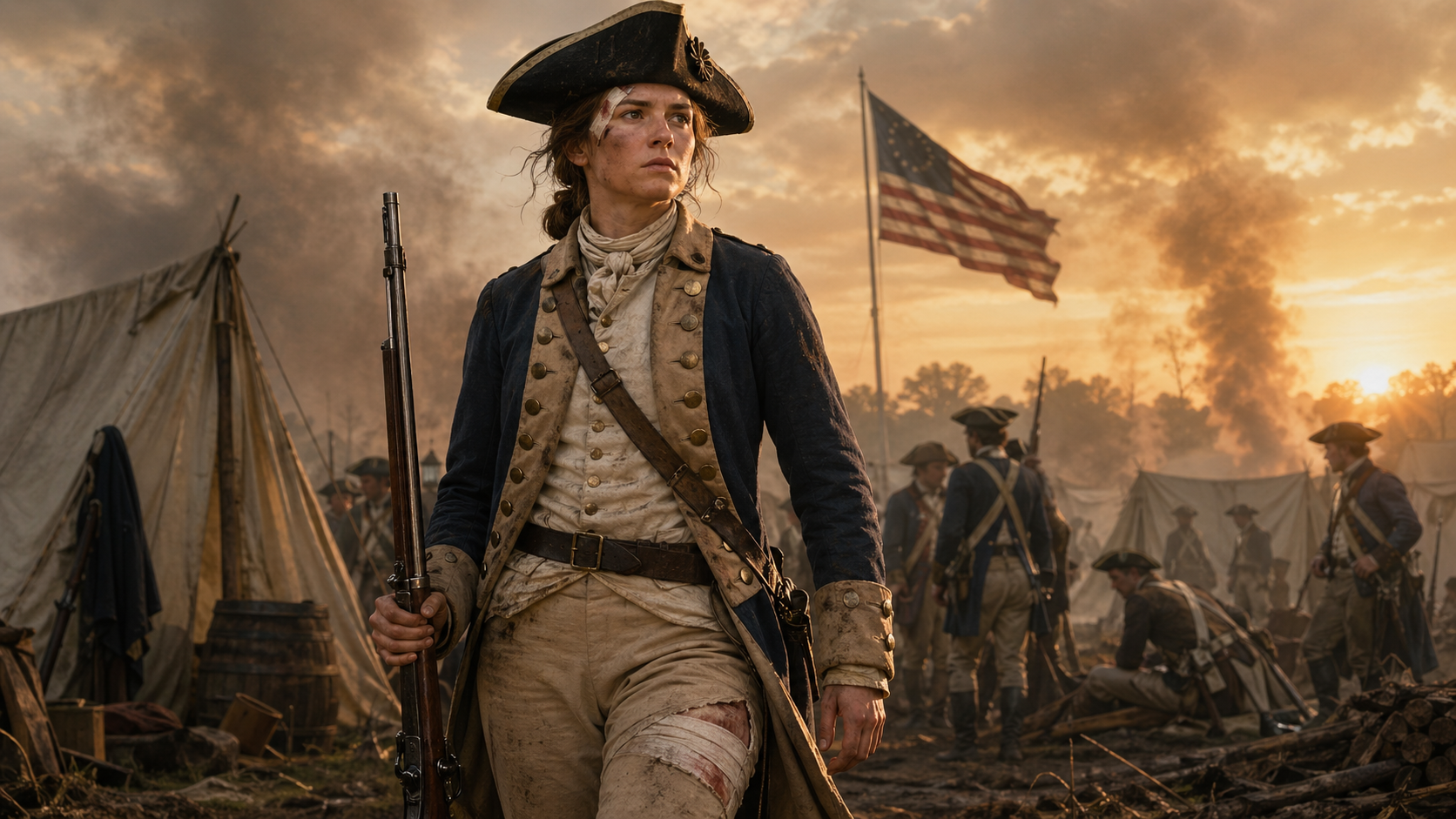
Deborah Sampson
Please, call me Deborah. And let’s be clear about something from the start. I didn’t disguise myself as a man because I wanted to prove a point about women’s capabilities. I did it because I wanted to fight, and the only way to fight was to pretend to be male.
What motivated me? Partly patriotism. I believed in independence and wanted to contribute. But also practical concerns. I was twenty-one, poor, working as an indentured servant and then as a teacher, earning almost nothing. The army offered pay, purpose, adventure, and things rarely available to women in my position.
And honestly? I was bored. I was strong, capable, and good with my hands. The work available to women, domestic service, weaving, teaching, felt suffocating. I wanted to do something that mattered, something physical and demanding.
So in 1782, I bound my chest, cut my hair, practiced walking and speaking like a man, and enlisted under the name Robert Shurtliff. I was tall for a woman, about five feet seven, and the Revolution had been going on for years, so the army was taking basically anyone who looked capable of holding a musket.
Nobody suspected. Why would they? The possibility that a woman would do this was so far outside their imagination that they never looked for it.
What was your greatest fear during your service?
Discovery. Every single day.
Being wounded was terrifying, not because of the pain, but because treatment meant doctors examining my body. When I took a sword cut to the head at Tarrytown, I had to let them treat it because head wounds bleed profusely, and refusing treatment would have been suspicious.
But when I was shot in the thigh at East Chester, two musket balls, one of which lodged deep, I told the surgeon I was fine and left as quickly as possible. Then I went somewhere private, dug one ball out myself with a penknife and a sewing needle, and just left the other one in because I couldn’t reach it. It’s still there, actually, buried in my thigh muscle.
The pain was incredible. The risk of infection was high. But discovery meant discharge at best, criminal charges at worst. Women caught dressing as men could be prosecuted, humiliated publicly, and marked as immoral.
I also feared failing. Not just being discovered, but failing to perform as well as the men. If I’d been a coward in battle, or weak, or incompetent, that would have confirmed every assumption about women’s unsuitability for military service. I needed to be as good as or better than my male counterparts.
That’s an exhausting way to live, knowing your failures will be attributed to your entire sex while your successes will be dismissed as anomalies.
What did the military not understand about women’s physical capabilities?
Everything. They assumed we were inherently weak, fragile, unsuited for physical labor or combat. It never occurred to them that women’s supposed weakness stemmed from a lack of training, not a lack of capacity.
I marched the same distances, carried the same equipment, dug the same trenches, fought the same battles as men. Yes, it was difficult. It was difficult for everyone. But I wasn’t physically incapable. I was capable because I’d spent my life doing hard physical labor as an indentured servant, a farmhand, a teacher who chopped her own firewood.
The military didn’t understand that strength is built, not inherent. That endurance is trained, not genetic. That courage has nothing to do with whether you’re male or female.
They also didn’t understand that women had been supporting armies for centuries, as nurses, cooks, laundresses, yes, but also as camp followers who marched alongside armies, endured the same hardships, faced the same dangers. We just weren’t allowed to carry weapons or receive credit for our contributions.
There were other women who fought, you know. Margaret Corbin took over her husband’s cannon after he was killed and kept firing until she was wounded so severely she was partially disabled for life. She got a pension too, though it came earlier than mine, in 1779, making her the first woman to receive any military pension from Congress.
Anna Maria Lane fought alongside her husband and was wounded at Germantown. Received a pension.
We weren’t unicorns. We were women who wanted to fight and found ways to do it. The military’s failure to acknowledge this possibility says more about their imagination than our capabilities.
What compromises did you make that still trouble you?
I let them discharge me quietly rather than fight for recognition.
When I was finally discovered, I fell seriously ill in Philadelphia in 1783, and the doctor treating me realized I was female; there was a choice to be made. I could have demanded to remain in service, could have argued that my seventeen months of successful service proved women could soldier.
Instead, I accepted a quiet discharge. The doctor was kind about it. Dr. Binney treated me well and didn’t expose me publicly. Upon being informed, General Patterson granted me an honorable discharge with a note praising my service. I took the discharge and went home.
I should have fought. Should have demanded they acknowledge that I’d served as well as any man, that gender was irrelevant to military capability. But I was exhausted, sick, and honestly frightened of what public exposure would mean.
I also compromised by later performing my story as a sort of theatrical entertainment. After the war, I needed money. My husband was frequently ill, we had children, and I was trying to support a family. So I gave lectures about my service, wore my uniform on stage, and performed military exercises.
It paid well. But it also turned my service into spectacle, into curiosity. People came to see the strange woman who’d pretended to be a man, not to genuinely consider what my service meant about women’s capabilities.
I needed the money, so I did it. But I sometimes wonder if I undermined my own legacy by making myself entertainment.
What would surprise us most about daily life in the Continental Army?
How much of war is boredom and misery, how little is actual combat.
People imagine war as a constant battle, muskets firing, cannons roaring, dramatic charges. Reality is mostly marching, digging, waiting. You’re cold, hungry, exhausted, terrified, bored, all at the same time.
We slept in tents or barns when we were lucky, on the ground when we weren’t. We ate whatever could be scrounged, salt pork, hardtack that was mostly weevils, and occasional vegetables. We drank water that made us sick, or rum that made us drunker than was safe.
Disease killed more men than combat. Dysentery, typhus, and smallpox regularly swept through camps. I watched men die slowly from infections that started from scratches or blisters.
And the intimacy of it all. We slept in close quarters, bathed in rivers together, and relieved ourselves in open latrines. I had to be constantly vigilant, always the first dressed, last undressed, finding excuses to maintain privacy without arousing suspicion.
Also, how young everyone was. I was twenty-one when I enlisted, older than many. Some of these soldiers were fourteen or fifteen years old. Children playing at war until they saw actual combat and realized it wasn’t glorious, just horrifying.
If you could witness one moment 250 years in the future, in 2026, what would you want to see?
Women in military uniform, openly, without controversy.
I want to see women serving in every capacity, in the infantry, artillery, and command. I want to see it so normalized that nobody questions it. That a woman in a military uniform is as unremarkable as a man in one.
Tell me. In 2026, can women serve in the military? Do they fight in combat? Can they hold command positions?
You’re told that women serve in all branches of the US military, in all positions, including combat roles and high command, and that Oro Valley, Arizona, has an active Veterans of Foreign Wars post that honors both male and female veterans equally. Your reaction?
[Sits silently for a long moment]
All branches? All positions? Even command?
And this is accepted? Not controversial, just normal?
[Told yes, though the path was long and resistance was fierce until very recently]
How long did it take? When did women gain access to combat positions?
[Told officially in 2015 for all combat roles, but women have been in combat situations much longer informally]
2015? So 232 years after I served in disguise to do exactly that.
Why did it take so long? What was the justification for excluding women from combat?
[Told various reasons: physical capability concerns, unit cohesion, outdated assumptions]
Physical capability. Unit cohesion. The same excuses they would have used in my era if they’d bothered to consider the question at all.
I proved physical capability wasn’t the issue. I marched, fought, and endured everything my male comrades did. The men I served with never suspected, never noticed, that my performance was inferior. Because it wasn’t.
Unit cohesion is just another way of saying “we’re comfortable with how things are and don’t want to change.” It’s not a principled argument. It’s resistance to change dressed up as concern.
But tell me about this Veterans of Foreign Wars post in Oro Valley. Do they honor women veterans equally?
[Told yes, women serve as post commanders, are recognized for their service, and participate fully]
That’s significant. Because after the Revolution, I had to fight for my pension. I’d served honorably, been wounded twice, but because I was female, my claim was questioned. Eventually, I got it. I was the first woman to receive a full military pension equivalent to that of a male soldier from the United States government, following Margaret Corbin, who had received a smaller pension in 1779. But it wasn’t automatic, wasn’t easy.
If Oro Valley’s VFW post honors women veterans equally, that suggests the fight I started has reached some conclusion. Not perfect, maybe, but better than having to disguise yourself as a man just to serve your country.
One question. Do young women in 2026 know they can serve in the military? Is it presented as a normal option, or still considered unusual?
[Told it’s presented as a normal option, though women are still underrepresented in military service]
Then keep recruiting. Keep showing young women that physical courage, military service, defense of the nation, these aren’t masculine traits, they’re human ones. Women possess them as fully as men.
I spent seventeen months proving that. Don’t let another 232 years pass before it’s fully accepted.
What advice would you give Americans celebrating the 250th birthday?
First. Question every assumption about what women can’t do. Most limitations are social, not biological. We’re told women can’t do something, we internalize it, and then when a woman does it anyway, she’s treated as an exception rather than proof that the rule was wrong.
I wasn’t exceptional. I was just determined. Any woman with training and opportunity could have done what I did.
Second. Remember that courage isn’t gender-specific. I’ve seen cowardly men and brave women, brave men and cowardly women. Character isn’t determined by what’s between your legs.
Third. Service to your country takes many forms. I served in uniform, but Abigail Adams served by managing everything while John was away. Mercy Warren served by documenting history. Phillis Wheatley served by proving Black Americans’ intellectual equality. Don’t rank these contributions; recognize that building a nation requires diverse talents.
Fourth. If you have to disguise who you are to serve, the problem isn’t you, it’s the system. I disguised myself because I had no other option. But I shouldn’t have needed to. Systems that exclude people based on irrelevant characteristics deserve to be challenged.
Fifth. Take care of veterans. All veterans. After the Revolution, thousands of soldiers found themselves destitute because the government failed to keep its promises about pay and pensions. Don’t send people to war and then abandon them when they come home broken.
Sixth. Remember that physical courage alone isn’t enough. This nation also needs moral courage, the courage to admit when you’re wrong, to change unjust systems, to include people you’ve previously excluded.
I had physical courage. I could march, fight, and endure hardship. But the founders needed moral courage to end slavery, to grant women rights, to live up to their own principles. Most of them lacked it.
Don’t make that same mistake. Have the courage to be better than your predecessors.
One last thing. Don’t wait for permission. If something needs doing and you’re capable of doing it, do it. I didn’t wait for society to decide women could be soldiers. I became one anyway.
You don’t need permission to be brave, to serve, to contribute. You just need determination.
And good luck hiding musket ball wounds. Modern medicine has probably made that harder.
Phillis Wheatley, Mercy Otis Warren, and Deborah Sampson represent three very different women who contributed to American independence in distinct ways. One wrote poetry proving Black Americans’ intellectual equality. One documented history and shaped political opinion through essays and plays. One fought in combat disguised as a man.
Yet all three share something crucial. They’ve been largely forgotten while their male contemporaries are celebrated.
This isn’t accidental. History is curated. For most of American history, that curation was done by men who considered women’s contributions supplementary at best, irrelevant at worst. Women’s work, whether intellectual, political, or military, was dismissed, minimized, or erased entirely.
These accounts are based on extensive historical documentation. Phillis Wheatley’s poems, letters, and the circumstances of her life are well documented, including the remarkable fact that her 1773 book required attestation from eighteen prominent Boston men, including the governor, to prove she’d actually written her own work. Her correspondence with George Washington and their meeting are verified historical facts.
Mercy Otis Warren’s three-volume history, her political plays, and her extensive correspondence with the founders are preserved and studied by scholars. Her bitter falling-out with John Adams over how she portrayed him in her History is well-documented in their letters, a reminder that even revolutionaries wanted their legacies carefully managed.
Deborah Sampson’s military service as Robert Shurtliff, her seventeen months in uniform, her wounds, and her eventual discovery are all documented in military records and her pension applications. One clarification. She was the first woman to receive a full military pension equivalent to that of a male soldier for Revolutionary War service. This distinction matters because Margaret Corbin had received a smaller pension in 1779 for her service at Fort Washington, where she took over her husband’s cannon after he was killed and continued firing until she was severely wounded. Both women deserve recognition. Corbin for being the first to receive any military pension, Sampson for achieving full pension equality.
As Oro Valley and the nation celebrate America’s 250th birthday, we have an opportunity to correct the historical record. To recognize that women were always part of the American story, not as supporting characters, but as essential contributors.
These three women would likely tell us, ” Don’t just add women to history as an afterthought. Recognize that the history we’ve been teaching has been incomplete. That excluding half the population’s contributions doesn’t give us a partial story; it gives us a false one.
The American Revolution wasn’t just fought by men. It was written by women, documented by women, supported by women, and yes, fought by women.
It’s time we remembered that.
Part of ILoveOV.com’s special series: Conversations Across Centuries