
Art Meets History: Southern Arizona Arts Guild Paints the Ranch
October 24@ 9:00 am—12:00 pm

CONVERSATIONS ACROSS CENTURIES: Abigail Adams
In February’s installment of our year-long series celebrating America’s 250th birthday, we sit down with one of the most remarkable minds of the Revolutionary era. Abigail Adams – political advisor, farm manager, mother, and the woman who urged the Continental Congress to “Remember the ladies” – shares her thoughts on independence, the compromises that still haunt her, and what she thinks of four women serving on Oro Valley’s town council.
From managing a farm during wartime to advocating for women’s rights 144 years before they could vote, Abigail Adams shaped the nation from behind the scenes. What would she think of modern America? What advice would she offer women in 2026? And how would she react to learning that people thrive in the Arizona desert she never knew existed?
Discover the woman whose 2,000+ letters remain among the finest political correspondence in American history – and learn why her plea to “Remember the ladies” still resonates 250 years later.
Part of ILoveOV.com’s special series: Conversations Across Centuries
In our second installment of Conversations Across Centuries, we sit down with Abigail Adams – wife of the second president, mother of the sixth, brilliant political advisor, and one of the most remarkable letter writers in American history. While she never held office, her influence shaped the nation’s founding.
Mrs. Adams, thank you for joining us. What motivated you to risk everything for independence?
Please, call me Abigail. And let me be direct: I risked more than most men at that Continental Congress, though none of them would admit it.
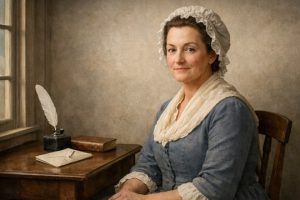
Abigail Adams at her writing desk in Braintree, Massachusetts, where she penned over 2,000 letters that would become some of the finest political correspondence in American history. Her March 31, 1776, letter to John Adams urging him to “Remember the ladies” remains one of the earliest calls for women’s rights in the new nation.
When John went to Philadelphia, then to France, then to England – gone for years at a time – who do you think managed the farm? Paid the bills? Raised four children through a smallpox epidemic and a war? I did. While men debated philosophy in comfortable halls, I was buying livestock, negotiating with farmhands, inoculating children against disease, and dodging British soldiers who came uncomfortably close to our property.
What motivated me? The same thing that motivated John – a bone-deep conviction that we deserved to govern ourselves. But I also saw something the men often missed: if we were creating a new nation based on liberty and justice, it had to include everyone. Not just propertied white men. Women. The enslaved. All people.
I knew they wouldn’t listen – not fully, not yet. But I planted seeds in John’s mind, in my sons’ minds, in every letter I wrote. I believed in the long game.
What was your greatest fear during the Revolution?
That I’d lose my family. Not just to British guns – though that fear was real enough – but to disease, to the ocean crossing, to the thousand dangers that lurked everywhere.
When John inoculated himself against smallpox, I spent weeks not knowing if he’d survive. When our daughter Nabby suffered from complications, I had no husband beside me. I’d nurse sick children through the night, knowing that in the morning I still had a farm to run, accounts to settle, political intelligence to gather from travelers passing through.
My other fear? That we’d win independence but fail to create anything better than what we’d left behind. New tyrants wearing American clothes instead of British uniforms. Men who’d memorized every word about liberty but couldn’t see the chains they were forging for others.
I feared we’d exchange one king for many small kings, each lording over his household, his slaves, his domain.
That fear, I’m sorry to say, was well-founded.
What did John not understand about your “Remember the ladies” plea?
[Laughs, though without much humor]
Everything and nothing. John was brilliant – truly one of the finest legal minds of our age. But when I wrote urging him to “Remember the ladies” while crafting new laws, to not put unlimited power in the hands of husbands, he thought I was being clever. Witty. He actually laughed and wrote back about how we men know better than to repeal our “masculine systems.”
He missed the point entirely.
I wasn’t asking for his permission or making a jest. I was warning him that denying half the population any legal standing, any property rights, any voice in their own governance – that was building tyranny into the foundation. You cannot credibly declare that all men are created equal while treating women as perpetual children under the law.
John loved me and respected my counsel on almost everything. But he couldn’t see past the assumptions of his age. In private, he valued my political judgment – I was his most trusted advisor. In public law? I had no more legal rights than our horses.
The most frustrating part? I knew I was right. I knew future generations would look back and wonder how men who could see British tyranny so clearly could be so blind to their own.
[Editor’s Note: On March 31, 1776, Abigail Adams wrote to John Adams: “I long to hear that you have declared an independency. And, by the way, in the new code of laws which I suppose it will be necessary for you to make, I desire you would remember the ladies and be more generous and favorable to them than your ancestors. Do not put such unlimited power into the hands of husbands. Remember, all men would be tyrants if they could. If particular care and attention is not paid to the ladies, we are determined to foment a rebellion, and will not hold ourselves bound by any laws in which we have no voice or representation.”]
What compromises did you make that still trouble you?
I was complicit in slavery, and that knowledge sits like a stone in my chest.
We had enslaved people in our household. I told myself they were treated well, that John and I opposed slavery in principle. We did oppose it – genuinely. But opposing something in principle while benefiting from it in practice? That’s moral cowardice dressed up as pragmatism.
I watched my husband argue for liberty while depending on enslaved labor. I watched the Continental Congress remove Jefferson’s anti-slavery language from the Declaration. I watched compromise after compromise push the reckoning further into the future.
I spoke against it in letters and in private conversations. But I didn’t do enough. I should have refused to be served by enslaved people. I should have been louder, more insistent, more willing to make my opposition costly to myself.
Instead, I told myself that the revolution had to happen first, that we’d address slavery later. But “later” is where nations bury their consciences.
What would surprise us most about daily life in your era?
The sheer physical labor of existence. Every task you accomplish with the push of a button took us hours of backbreaking work.
Washing clothes meant hauling water, heating it over a fire, scrubbing by hand, wringing, and hanging it to dry. A single load could consume half a day. Cooking? You couldn’t just turn a dial – you had to maintain fires, know your oven’s temperament, and preserve food for the winter months because there was no refrigeration.
And then there was childbirth. I bore six children – lost one as a baby, another stillborn. Every pregnancy carries a significant risk of death for both mother and child. No anesthesia, no antibiotics, often no doctor. Just midwives, prayer, and hope.
You modern women with your careers and educations and votes – do you know how much of that depends on not spending twelve hours a day simply keeping your family fed and clothed? Freedom requires time, and time requires technology.
Also, the isolation. John would be gone for months, and I’d have no word from him. Was he alive? Safe? I wouldn’t know for weeks. You cannot imagine the anxiety of that silence.
If you could witness one moment 250 years in the future – 2026 – what would you want to see?
A woman president taking the oath of office.
I want to see her hand on the Bible, repeating words that my John once spoke, exercising power that I could only whisper about in letters. I want to see the peaceful transfer of power to a woman, accepted as unremarkable by the citizens.
And I want to see what she does with that power – whether she governs with wisdom, how she balances strength with compassion, whether she proves what I always knew: that women are as capable of leadership as men.
Beyond that? I’d want to see what happened to education. Did we build schools for everyone? Can women attend universities? Are children – all children, regardless of sex or station – taught to think critically, to read widely, to govern themselves?
A republic cannot survive with an ignorant populace. I drilled that into my sons’ heads. I hope you’ve learned it too.
You’re told that women now vote, hold property, attend universities, serve in Congress, and serve as governors. And that Oro Valley, Arizona – a town of 50,000 in the desert – has four women serving on its seven-member town council. Your reaction?
[Long pause, visibly emotional]
It took you that long?
I’m jesting – partly. Tell me truly: How long did it take? When did women gain the vote?
[Told it was 1920 – 144 years after independence]
A hundred and forty-four years. Generations of brilliant women lived and died without the most basic political voice. I’m gratified it happened, but Lord, what a waste of talent and wisdom.
Now, about this Oro Valley, Arizona, you said? Four women on a seven-member council? That’s a majority of voices, even if not votes. Remarkable. In my day, women couldn’t even attend town meetings, let alone sit in council chambers making decisions.
But I must know: How did people settle in a desert? It must be extraordinarily harsh. Is there water? How do they cope with the heat? We thought the land beyond the Appalachians was frontier – I cannot fathom civilized life in a true desert.
And these council women – what are their backgrounds? Did they have to fight harder than men to win their seats, or has equality become so normal that gender is irrelevant in local governance? I’d like to believe the latter, but I suspect they still face skepticism simply for being women.
Tell me this: Do they speak freely in council? Are their voices heard with the same weight as the men’s? Or do they still have to be twice as sharp to earn half the respect?
Because here’s what matters – it’s not enough for women to be present in government. I was present in John’s political life, advising him on everything from appointments to policy. But I had no official voice, no vote, no legal standing. Presence without power is just decoration.
If these four women in Oro Valley can debate, vote, shape their community’s future, and be taken seriously – that’s what I fought for in my letters. That’s the “Remember the ladies” made real.
What advice would you give Americans celebrating the 250th birthday?
First: Don’t take your rights for granted. Every freedom you enjoy was fought for, often at tremendous cost. Vote. Participate. Speak up. Too many of my contemporaries died for you to be passive citizens.
Second: Educate your daughters as rigorously as your sons. I fought to give my boys the finest education possible – it’s why John Quincy became president. But imagine if every girl had the same opportunities. You’d double your nation’s wisdom overnight.
Third: Remember that independence from Britain was just the beginning. Every generation faces its own struggle between liberty and tyranny, justice and convenience, principle and profit. Your revolution isn’t finished – it’s ongoing.
Fourth: Take care of each other. During the war, when resources were scarce and fear was constant, neighbors helped neighbors survive. Don’t let prosperity make you selfish or isolation make you cruel. A republic requires more than laws – it requires civic friendship.
Fifth: To the women, especially – use your voices. Use your votes. Use your education and your freedom. Too many of us were silenced for you to remain quiet. When you see injustice, speak against it. When you have ideas, share them. Don’t wait for permission that will never come freely.
And finally: Write letters. I know you have faster methods now, but there’s something about putting thoughts on paper that clarifies the mind. Write to your children, your friends, your representatives. Leave a record of your thinking. Future generations may need to know what you believed and why.
Oh, and tell your husbands, your fathers, your sons: Remember the ladies. Still. Always.
Abigail Adams died on October 28, 1818, at age 73, having lived to see her husband serve as president and her son, John Quincy, elected to the same office. She left behind over 2,000 letters that remain among the finest political and personal correspondence in American history. John’s last words, eight years after her death, were reportedly “Thomas Jefferson survives” – he was wrong about Jefferson, but he never stopped missing Abigail.