
Freebird Shoppe Grand Opening
November 01@ 10:00 am—7:00 pm

As America marks its 250th birthday, ILoveOV continues its year-long series imagining conversations with the founders who built this nation, brought forward in time to sit across the table from us in Oro Valley. These installments are grounded in each figure’s own writings and documented positions, then imagined forward into today’s questions.
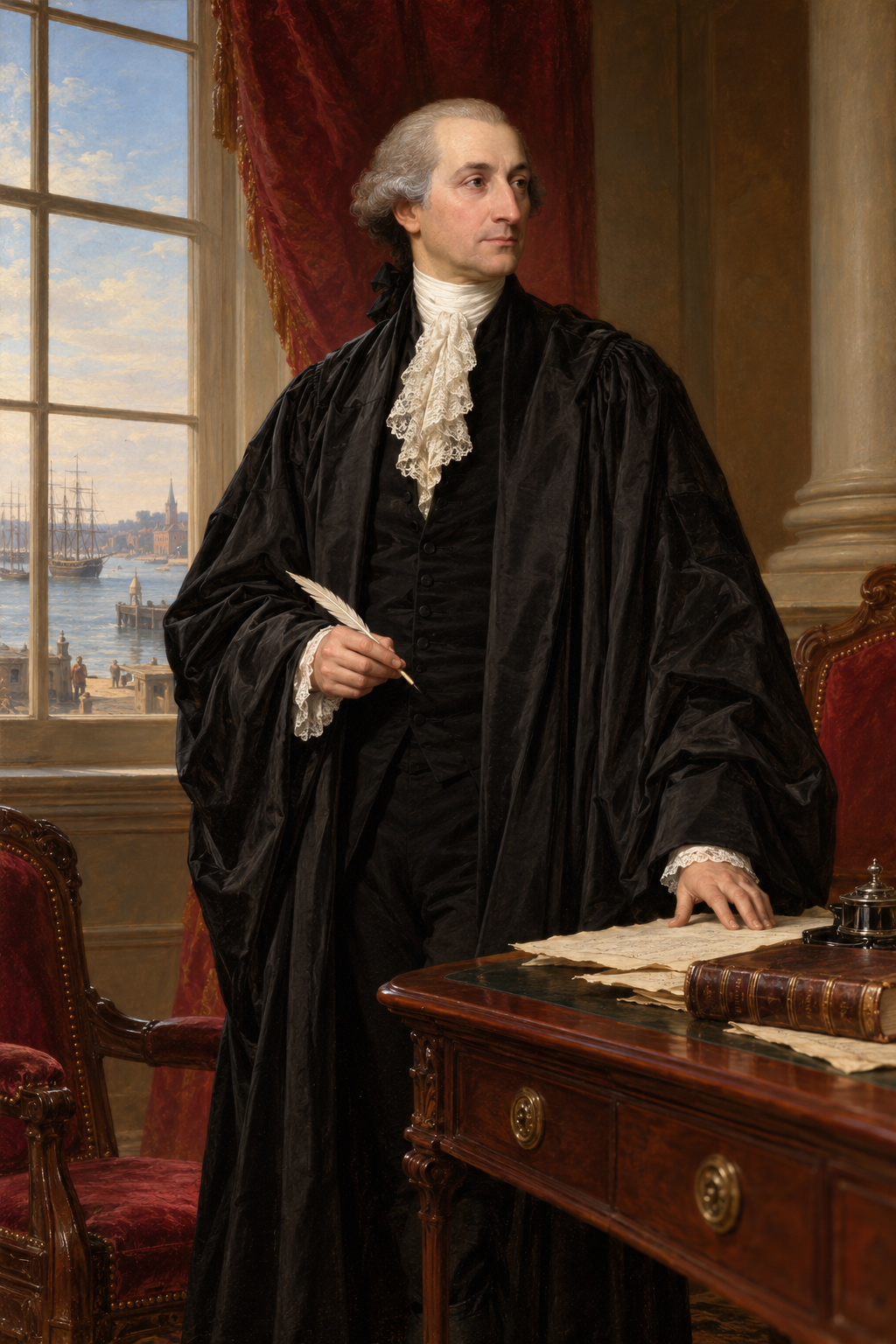
John Jay
He arrives without a sound, as Jay does most things. He wears dark, plain clothes, and his face is grave, courteous, and slightly tired, like a man who has read every page of a long document before signing it. He crosses to the window and studies Pusch Ridge as it catches the late light. “Valley of Gold,” he says quietly. “Someone chose that name with care.” Then he turns to the table, looks at the chairs, and almost smiles. “Mr. Morris warned me to expect a courtroom. I see a coffee table. I believe I can manage.” He sits, folds his hands, and waits for the first question the way he once waited out the French ministry: patiently, and without volunteering anything he wasn’t asked.
The man in the background of most of the paintings, I suppose. I won’t pretend that bothers me much. I was never fond of being looked at.
I was born in New York City in 1745, the son of a merchant. My family were Huguenots, Protestants who fled France when the king stopped tolerating them, so I grew up with a plain understanding of what it costs to live under a government that can take your faith or your home. We moved to a farm in Rye when I was a baby. I entered King’s College at fourteen, studied law, and practiced in New York when the quarrel with Britain grew serious.
I was slow to favor independence. I wanted reconciliation, and I said so. When it became clear Britain would not meet us halfway, I committed fully and looked no further back. In 1777, I helped draft New York’s first constitution and became the state’s first chief justice. After that came Congress, Spain, Paris, the Federalist essays, and the Court. When President Washington took office, I’m told he let me pick my own post. I picked the bench, because I trusted it to outlast the men who sat on it.
As for why you don’t know me, I’d offer a theory. Nobody writes songs about the man who reads the treaty twice.
That the war was not won by battles alone. The committee was created in 1776 to inquire into and defeat plots against American liberty, and there were plenty. New York was full of loyalists, and the army was camped in the middle of them. Over its life, the committee handled hundreds of cases involving disloyalty, spying, and sabotage. We uncovered a scheme that reached into General Washington’s own guard, and one of his guardsmen, Thomas Hickey, was hanged for it. We also pursued counterfeiters flooding the country with false paper money to ruin the army’s credit.
I did not run the famous spy ring. Major Tallmadge ran that, working with General Washington. My brother James, a physician, developed an invisible ink that several of those networks used. I asked a question I have never stopped asking: how do you protect a free people from its enemies without becoming the thing you are protecting them from? We insisted on hearings, on evidence, and on giving the accused a chance to answer. Some of my colleagues thought that was slow. I thought it was the whole point.
Now, to your question. I am told Veterans Day marks the hour the guns fell silent in 1918, the eleventh hour of the eleventh day of the eleventh month. I know that quiet. In 1783, I helped write the paper that ended our war, and the people who made it possible were not in the room. They were the soldiers who stayed in the field, the sailors, the surgeons, and those who gathered intelligence without a uniform or a name. The nation owes each of them a debt that is paid in remembering, not in speeches. Find a veteran in your neighborhood this week. Ask where they served. Then let them talk as long as they like.
Because I had spent two years in Spain watching how a friendly power behaves when its own interests are at stake. I arrived in Paris convinced that our French allies would support us until supporting us stopped being useful to them. Congress had instructed us to follow the French ministry’s guidance. I judged that following those instructions to the letter would cost us land, fisheries, and perhaps our independence in everything but name.
So I insisted on two things. First, that Britain treat with us as an independent nation before the talks began, not as a prize to be granted at the end. Second, that the three of us proceed directly with Britain, and not hand the French our drafts for editing. Mr. Franklin hesitated, for he loved France and the French loved him. Mr. Adams agreed readily, and I found his company a comfort. In the end we did it, and we got terms better than anyone expected: recognition of independence, a western boundary at the Mississippi, and fishing rights off Newfoundland. The treaty was signed on September 3, 1783.
I will tell you the lesson I took from it, since you live beside a river that several states and a foreign nation all claim a share of. The party that knows what it cannot give up and is honest about what it can wins a negotiation. Everyone leaves the room a little dissatisfied. That is usually the sign that the deal will hold.
First, that I won’t tell them how to vote. It is their town and their ballot. I can only say what I learned from the work.
My Federalist essays focused on one idea: Americans are one people with one fate and are far safer together than apart. I wrote the second through fifth, and the sixty-fourth, which dealt with treaties. Then my health failed me, and Mr. Hamilton and Mr. Madison carried the rest of the project. I argued that foreign powers would invite a divided country into quarrels, and that our liberty would depend on staying together. I believed it in 1788, and I still believe it.
The Court taught me the second half. We began with six justices, no courthouse of our own, no precedents, and little respect. I resigned in 1795 to serve as governor, and when President Adams offered me the chair again in 1801, I declined. I judged the Court then lacked the energy, weight, and dignity it needed. I was mistaken about its future, and I say so happily. Chief Justice Marshall made it what I could not.
So here is my advice for the week of the election. Read the measure, not the slogan. Vote for the town you want to live in a decade from now. Then, on the morning after, greet your neighbor who voted the other way as the neighbor he still is. A republic survives its elections only if its people can remain friends afterward.
I don’t answer it well, and I won’t pretend otherwise. I’ll give you the facts, then my explanation, and you can judge whether the explanation is worth anything.
The facts are these. When we drafted New York’s first constitution in 1777, I wanted slavery to end, and I was overruled. In 1785, I became president of the Manumission Society. In 1787, we helped establish the African Free School, which educated the children of free Black New Yorkers, and I supported it with my own money for years. As governor, I signed the Act for the Gradual Abolition of Slavery in 1799. It freed children born to enslaved mothers after the Fourth of July that year, though it still bound them to years of service until age twenty-five for girls and twenty-eight for boys. The last enslaved people in New York were freed in 1827.
The other facts are also mine. I owned human beings over many years, eight of them in 1798, the year before I signed that law. My explanation then was that I bought people to free them, once their faithful service had earned a fair price. I also believed that abolition had to come gradually, because a legislature full of slaveholders would not pass anything faster. I thought that was practical. It was also convenient, and I knew it was convenient. When you tell yourself justice must wait, you ought to check whether the waiting costs you anything. It cost me very little. It cost them everything.
I will add one more thing, because it fell to me in London. When I negotiated the treaty of 1794, I dropped the Southern demand that Britain pay for enslaved people carried off during the war. That made me unpopular in half the country, and I would do it again.
What I want you to take from my life is this. Gradualism is sometimes the only road, and sometimes an excuse. The difference is whether the person urging patience is willing to pay for it.
That year was an odd one. I came home from London, where I had negotiated a treaty with Britain that half the country hated, and I found that New Yorkers had elected me governor in my absence. Then yellow fever struck the city. People fled, ships were quarantined, and Pennsylvania cut off travel with us. When the epidemic finally eased, I thought the state ought to say thank you, so in November I proclaimed a day of thanksgiving for the sixteenth.
No civil officer had ever done this in New York. New England had its customs, but ours had no such practice or law. My opponents in the press called the proclamation a party production and accused me of hypocrisy. A friend wrote, half joking, that I had trespassed on the clergy’s business. He added that he meant to attend church on the appointed day and hoped to see me there.
The previous year’s treaty was a similar story. The Jay Treaty settled lingering disputes with Britain and secured the withdrawal of British troops from our western forts. It was thoroughly unpopular, and it delayed another war with Britain until 1812. I was burned in effigy for it, or so they tell me. I did not choose it for applause. I chose it because the country was too weak to fight, and veterans of the last war had earned a chance to go home and plant crops.
So here is what I think gratitude asks. It asks you to say thanks out loud and not to wait for the cause to be popular. It asks you to remember who paid for the peace you enjoy. It also asks you to be generous to the people not at your table. In 1826, too ill to attend the city’s Independence Day celebration, I wrote that I hoped the country’s leaders would recommend a general and public return of praise and thanksgiving. I meant that as an invitation to every household. Set an extra chair on the 26th.
Keep your word, and be honest about the times you couldn’t.
A republic runs on promises: a treaty kept, an oath honored, a debt paid, a vote counted. The founders broke some of theirs, as you’ve heard from my colleagues this year, and each broken promise cost the country something it is still repaying. I’d ask you to do better in the ordinary places. Show up when you say you will. Read before you sign. Admit it plainly when you’ve been wrong, and then fix it. Those habits aren’t glamorous, and they’re what hold a free people together.
He rises slowly and looks once more at the ridge, where the last light has turned the rock the color of old gold. “I never expected to see this country at two hundred and fifty,” he says. “I expected to see it fail, at least twice. That it hasn’t is the work of a great many people who never had their names on anything.” At the door he pauses, and the corner of his mouth lifts. “Mr. Knox is next, I’m told. He will want to talk about cannon. Be patient with him. He earned it.” And then he is gone, as quietly as he came.
John Jay (1745-1829) was born in New York City and entered King’s College (now Columbia University) at fourteen. He served in New York’s Provincial Congress, headed the state’s Committee for Detecting and Defeating Conspiracies, helped draft New York’s first constitution, and became the state’s first chief justice. He served in the Continental Congress, including as its president, was minister to Spain, and joined Benjamin Franklin and John Adams in negotiating the Treaty of Paris of 1783. He wrote five of the Federalist essays, served as the first Chief Justice of the United States from 1789 to 1795, and negotiated the Jay Treaty with Britain in 1794. As governor of New York from 1795 to 1801, he signed the 1799 Act for the Gradual Abolition of Slavery. He declined reappointment as Chief Justice in 1801, retired to his farm in Westchester County, and died on May 17, 1829. This interview draws on Jay’s correspondence, the Federalist essays, and the historical record, imaginatively projected into a conversation set in present-day Oro Valley.
¹ Manumission is the formal act of an enslaver freeing an enslaved person, often by deed or will. The New York Manumission Society, which Jay led as its first president, took its name from that practice.
These pages were found by search and are worth a quick open before publishing. Items marked “verify” come from general knowledge and weren’t confirmed against a source.

;>)
;>)
;>)