

Wine Not Wednesday
September 02@ 8:00 am—5:00 pm

“The advice nearest my heart is that the union of the states be cherished and perpetuated.” — James Madison, Father of the Constitution, imagined in conversation in Oro Valley this month.
As America marks its 250th birthday, ILoveOV continues its year-long series imagining conversations with the founders who built this nation — brought forward in time to sit across the table from us in Oro Valley. These installments are grounded in each figure’s own writings and documented positions, then imagined forward into today’s questions. This month, we sit down with James Madison: chief architect of the Constitution, co-author of the Federalist Papers, and principal author of the Bill of Rights — the quiet strategist whose theory of factions still shapes how Americans think about self-government. His warnings about union and division speak directly to a country and a town still learning to govern themselves well.
He arrives quietly, almost apologetically, a slight man in an unassuming blue, and takes in the room with careful, watchful eyes before he speaks. “Mr. Hamilton was here last month, I understand,” he says, settling into his chair with the stillness of a man who prefers listening to being heard. “We rarely occupied a room so companionably in life. I hope you found him instructive. I intend to be exact, if somewhat less entertaining.”
You are remembered as the “Father of the Constitution,” though by your own account you were a small, sickly man who rarely raised his voice in public. How does a man like that become the architect of a nation’s founding document?
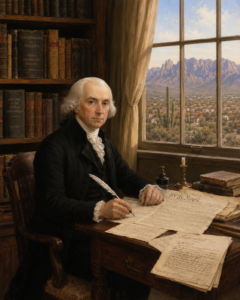
James Madison at his writing desk, quill still in hand over the Constitution’s opening words. Behind him, volumes on ancient confederacies that shaped his thinking at the Convention; through the window, Pusch Ridge and Oro Valley — 250 years and two thousand miles from where he wrote them.
I was never robust, sir. I suffered episodes as a young man that some called falling sickness, and I doubted at times I would live to see thirty, let alone eighty-five. What I lacked in constitution — the bodily kind — I made up for in preparation. Before I ever set foot in Philadelphia, I had spent a year studying every confederacy of ancient and modern history I could obtain: the Amphictyonic League, the Swiss Cantons, the United Netherlands. I wished to understand precisely how each had failed, so that ours might not.
I did not persuade the Convention by force of voice. Patrick Henry could fill a hall with thunder; I could barely be heard past the third row. I persuaded by arriving with the argument already built, in writing, before the debate began. As for “Father of the Constitution” — I have always thought the title too generous and slightly false. It was, as I wrote to a correspondent late in life, the work of many heads and many hands, not the offspring of any single brain.
The Virginia Plan you brought to Philadelphia became the framework for the entire debate. What problem were you actually trying to solve, and does your argument in Federalist 10 still hold up?
The problem was faction — a term I used for any group, majority or minority, pursuing an interest adverse to the rights of others or the good of the whole. Every republic in history had eventually died of it. The conventional remedy was to keep a republic small, where shared interest might hold factions in check. I argued the opposite: that a small republic is the most dangerous kind, because a single faction can too easily become a majority and oppress the rest. Extend the sphere — take in a greater variety of interests, parties, and sects — and no one faction can easily dominate the others. The very size and diversity that skeptics feared would doom a large republic was, I believed, its salvation.
Two hundred and fifty years on, I will say the argument holds better than I sometimes did. Your nation has not been torn apart by a single tyrannical faction seizing the whole government, as I feared. But I confess I did not anticipate national parties organizing themselves so thoroughly across your whole extended sphere that they could act, at times, almost as if the sphere had never been extended at all. I built a machine to prevent one problem. I did not foresee every ingenuity by which men would find new ways to sort themselves into two camps regardless of geography.
You initially argued a Bill of Rights was unnecessary — even dangerous — and then became its principal author in the First Congress. What changed your mind?
Vanity would have me say I saw the wisdom of it all along, but that would not be exact, and I promised you exactness. I believed the Constitution’s structure — the separation of powers, the checks between branches — was protection enough, and I worried that any list of specific rights would be read as the only rights the people possessed, with all others forfeit by omission. Colonel Mason and the Virginia opposition thought otherwise, and so, I came to learn, did a great many ordinary citizens whose support I needed to secure ratification.
Mr. Jefferson wrote to me from Paris and pressed the point further than anyone: that a bill of rights is what the people are entitled to against any government, and that it gives the judiciary a legal text to stand on when a government forgets itself. I was elected to the First Congress on a promise to pursue amendments, and I kept it — I sorted nearly two hundred proposals from the state ratifying conventions down to a workable list, defended them on the floor against colleagues who thought the matter closed, and saw ten of them ratified in 1791. I still consider it among the more useful acts of stubbornness in my career, though it began as a concession I did not particularly want to make.
You and Alexander Hamilton wrote the Federalist Papers together under a single pen name, yet within a few years you were bitter political rivals. What split you apart?
His bank, principally, and everything the bank represented. I stood beside him through ratification because we agreed the Constitution needed defending against its enemies. I broke from him once we disagreed about what the Constitution permitted among its friends. He proposed a national bank in 1791 and argued the government held powers beyond those written, so long as they served a legitimate end. I could find no such bank in the document I had helped draft, and I did not think a document should mean whatever a clever advocate could make it mean five years after its ratification.
Underneath the legal argument was a larger one about the nation’s character. He wanted a commercial republic built on credit, manufacturing, and a strong moneyed interest tied to the federal government. Mr. Jefferson and I wanted a republic of farmers and freeholders, wary of concentrated financial power precisely because such power had corrupted the Parliament we had just finished escaping. We were both partial in our vision, as he told you himself, I expect, if you asked him plainly. But it was that disagreement, more than any personal offense, that put us on opposite sides of what became your first political parties — his Federalists, and my old friend Jefferson’s and my Republicans.
As president, you led the country through the War of 1812 and watched the British burn the very capital you had helped design. Looking at American politics now, what troubles you most?
Little wounds a man’s pride so completely as watching his own capital burn from a hilltop in Virginia while his wife rescues a portrait of General Washington from the flames — that credit belongs to Mrs. Madison entirely, and she has never let me forget it was hers. The war itself was a near catastrophe of my own contriving, undertaken with an army and treasury far too weak for the ambition behind it. I do not defend its conduct, only the cause.
What troubles me now is not war but something I warned against in my final years, in a note I asked to be read only after my death: that the Union is cherished and perpetuated. I had watched South Carolina men argue that a single state might nullify a federal law it disliked, and I spent what strength I had left writing against them, because I recognized in their argument a corruption of ideas I myself had once written, twisted past anything I intended. I am told your union survived a war over that very question and others graver still. I would only observe that the habit of treating a fellow citizen’s politics as a foreign threat, rather than a disagreement within one family, is precisely the seed nullification grew from. Guard against the seed, not merely the men who plant it.
What would you say to Oro Valley — a town of some fifty thousand people governed by a council of seven, four of them women, meeting where any resident may walk in and watch?
That you have built, without quite intending a monument to political theory, a working answer to a smaller version of the problem I spent my life on. A town council is nearer to the small republics I worried over than to the extended one I designed — seven people, one chamber, decisions made in a single room. What protects such a body from the tyranny of a passing faction is not distance or size, which you do not have, but transparency: that every citizen may attend, may see the reasoning, may object before a vote is final rather than discover it after. That is Federalist 10 practiced at a scale I never had occasion to test.
I will add, since exactness requires it, that no woman sat in any deliberative chamber I attended, and I did not write the Constitution imagining one would. I do not claim foresight I lacked. I will only say that a chamber more representative of the people it governs is a chamber more likely to guard against the very faction I feared — and that seems to me the principle working itself out further than I extended it, which is the best any of us can hope our ideas will do.
If you could leave the country with one instruction, what would it be?
The same one I left in the note found among my papers after I died, meant for exactly this kind of moment. The advice nearest my heart, and deepest in my convictions, is that the union of the states be cherished and perpetuated. Let the open, honest attachment to the whole always be maintained against the innovations of those who would sacrifice it to a local or a selfish or a factious spirit. I did not mean that disagreement should cease — I built an entire government on the expectation that it would not. I meant only that disagreement should never curdle into the belief that your fellow citizen belongs to a different country than you do.
He rises slowly, the way a man rises who has learned not to trust his own legs entirely, and pauses at the door. “Mr. Hamilton found your mountains astonishing, I’m told,” he says. “I find myself more struck that you have kept a republic running this long. Neither of us was entirely certain you would.” And then he is gone.
James Madison (1751–1836) was born in Port Conway, Virginia, and educated at the College of New Jersey (now Princeton) under John Witherspoon. He drafted the Virginia Plan that shaped the Constitutional Convention of 1787, co-authored the Federalist Papers with Alexander Hamilton and John Jay, and, as a member of the First Congress, wrote the amendments that became the Bill of Rights. He served as Secretary of State under Thomas Jefferson and as the fourth President of the United States from 1809 to 1817, leading the country through the War of 1812. He married Dolley Payne Todd Madison in 1794 and later helped found the University of Virginia. He died at his Montpelier estate on June 28, 1836, at age 85, the last surviving signer of the Constitution. This interview draws on his Convention notes, Federalist essays, and correspondence, imaginatively projected into a conversation set in present-day Oro Valley.
