Karake
October 04@ 4:00 pm—8:00 pm

Johnny Appleseed doesn’t look like a man who’s spent 250 years walking barefoot across a continent — but he swears the desert is easier on the feet than people assume. The wandering nurseryman, missionary, and folk legend stopped by Steam Pump Ranch in the last stretch of monsoon season to talk about planting things that outlast you, the business of generosity, and why late summer is the most honest season there is.
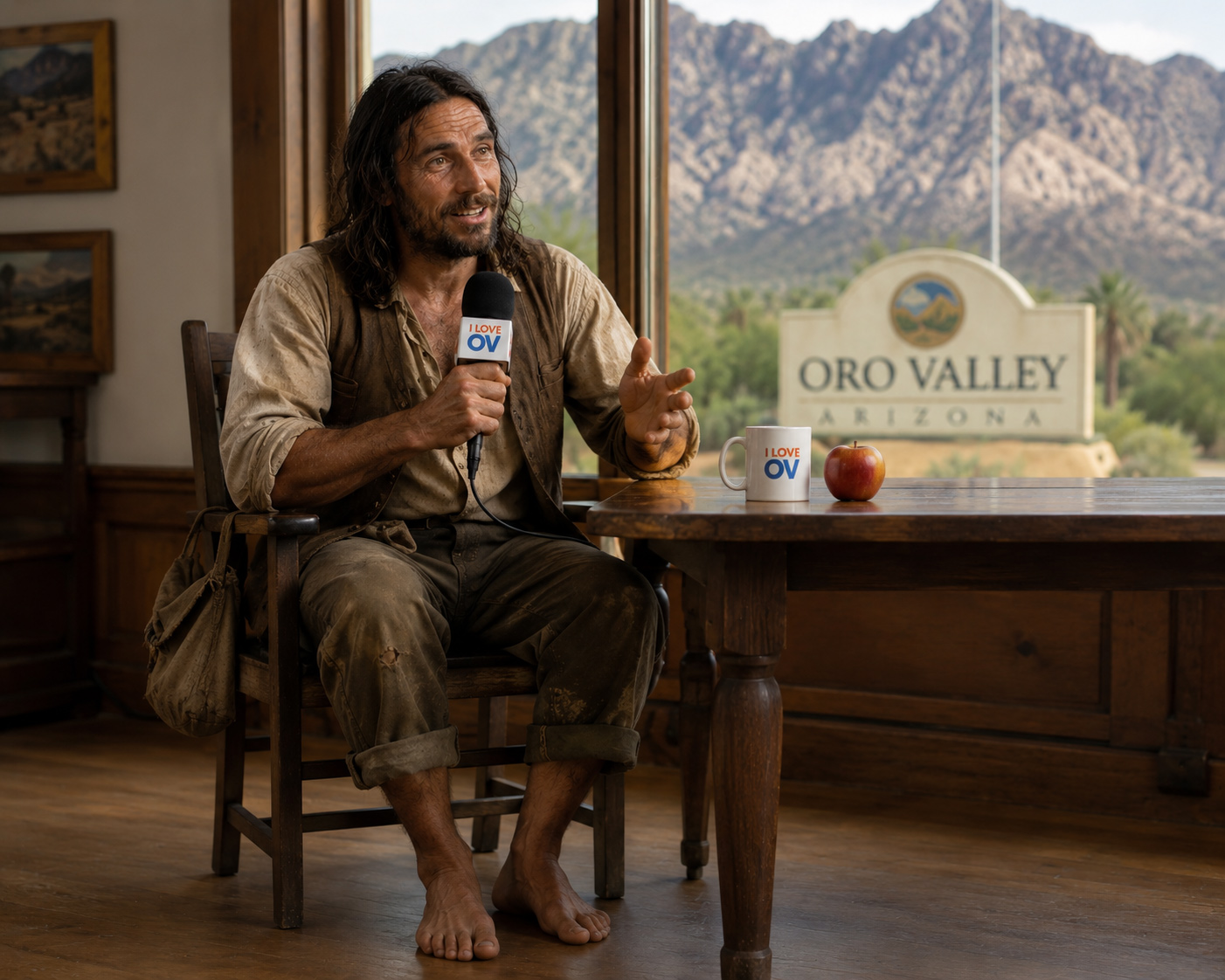 He Wants YOU to Plant Something: Johnny Appleseed Sits Down with ILoveOV
He showed up on foot, as he does, tin pot balanced on his head and a burlap sack slung over one shoulder, sometime around 8 a.m. before the heat had fully committed to the day. No shoes. A few passing walkers at the ranch did a visible double take, but he waved like an old neighbor and settled cross-legged in the shade of a mesquite, unbothered by the ground. He’d apparently already toured the historic buildings and grounds on the property and had opinions.
ILoveOV: You’ve been walking this country for two and a half centuries. What brings you to the Sonoran Desert, of all places?
Johnny Appleseed: Curiosity, mostly. I spent my working life in Pennsylvania, Ohio, Indiana — soil that wanted to grow things, rain that showed up when you expected it. This is a different kind of teacher. I looked at those saguaros on my walk in and thought, now there’s a tree that took its time and didn’t apologize for it. A saguaro won’t grow its first arm for sixty, seventy years. I planted orchards I never lived to see fruit from, so I understand that kind of patience. We’d get along, the saguaro and I.
ILoveOV: There’s a popular image of you scattering seeds at random as you wandered. Is that accurate?
Johnny Appleseed: [laughs] It’s a nice story, and I won’t begrudge anyone their nice story, but no. I was a businessman. I’d go ahead of the settlers, plant a nursery on land I’d claimed or leased, fence it, tend it for a few years, then sell the orchard and the improved land once families arrived and needed it. I owned better than a thousand acres across three states by the time I was through. People like the idea of a man tossing seeds into the wind because it feels generous. What I actually did was plan five years ahead for people I hadn’t met yet. That’s a different kind of generosity, but it’s the one that actually feeds a town.
ILoveOV: You did give a great deal away, though.
Johnny Appleseed: I did. Nearly as many trees as I ever sold, if my ledgers were honest, which they mostly were. But giving something away and giving something away thoughtlessly aren’t the same act. I gave to people who needed a start and couldn’t yet afford one. That’s not charity in the sense of a handout — that’s an investment in a neighbor you’re betting on. Oro Valley strikes me as a town that understands the difference. I hear you’ve got food pantries, mentorship programs, folks teaching kids to read at the library on their own time. That’s the same math I was doing with apple seeds. You plant in someone before you know how they’ll turn out.
ILoveOV: August is an odd month here — the tail end of monsoon, school starting back up, everyone a little tired of the heat. What do you make of it?
Johnny Appleseed: I think it’s an honest month, which is more than you can say for most of them. Spring lies to you — everything blooms and you think the hard part’s over. August doesn’t lie. It’s still hot, the rain’s unreliable, and everyone’s tired. But look closer and the mesquites are dropping their pods, the desert marigold’s still going, and every kid in this town is walking into a classroom carrying a backpack full of who they’re about to become. That’s planting season, whether the calendar agrees or not. I’ve always thought the back-to-school photos on everyone’s porches around here look a lot like the nursery rows I used to walk — a whole line of small things about to do something enormous, if somebody’s patient with them.
ILoveOV: You’re famous for going barefoot and wearing that tin hat. Any regrets about the wardrobe?
Johnny Appleseed: None. Though I’ll admit the tin hat gets uncomfortably warm out here by ten in the morning — a lesson your desert has taught me in real time. I never dressed for comfort or for show. I dressed for the work, and the work didn’t require shoes half the time. I’ll say this for your townspeople: I’ve seen more sensible sun hats and water bottles on that one walking trail behind me than I saw in forty years on the frontier. You’ve adapted better to your climate than I ever adapted to mine. That’s wisdom, not vanity.
ILoveOV: You were known for treating animals with real gentleness — even insects — at a time when that wasn’t common. Where did that come from?
Johnny Appleseed: My faith, mostly. I believed, and still believe, that every living thing carries something worth respecting, and that cruelty to the smallest creature says something true and unflattering about a person. I gave up meat for the better part of my life over it. Out here, in this desert, I’d extend the same thought to the land itself. This is not empty country, whatever the old maps said. The Hohokam farmed this valley for a thousand years before anyone else showed up with opinions about it. Respect for a place and respect for the creatures on it aren’t two different virtues. They’re the same one, wearing different clothes.
ILoveOV: What advice would you give Oro Valley heading into a new school year, a new season?
Johnny Appleseed: Plant something you won’t see finished. That’s the whole trick, and it’s harder than it sounds in a world that wants results by Friday. Volunteer for something whose payoff is ten years out. Mentor a kid you won’t get credit for raising. Put a native tree in the ground on your property instead of something thirsty and decorative — your water table will thank you, and so will whoever’s living in this house in thirty years. I never once ate an apple from most of the trees I planted. I planted them for strangers. A town works the same way. You’re not really building it for yourself. You’re building it for the people standing in line behind you, the ones you’ll never meet.
ILoveOV: Last question. Any apple varieties you’d recommend for a desert climate, hypothetically?
Johnny Appleseed: [grins] Now that’s the first practical question anyone’s asked me in a century. Honestly? Not many apples want what your soil and your July have to offer — I’d point a hopeful gardener toward Anna or Dorsett Golden, the low-chill varieties, and even then I’d tell them to be patient and water-wise about it. But if you want my real advice, plant what this land already knows how to grow. A mesquite, a palo verde, a desert willow. I spent my whole life planting apples because that’s what the country I walked needed. Yours needs something else, and it already told you what. Listen to it.
Johnny Appleseed rose without brushing off the dust, shouldered his sack, and set off on foot toward the trailhead rather than the parking lot — barefoot, unhurried, already looking at the ground like he was deciding where something ought to grow.