

Wine Not Wednesday
September 02@ 8:00 am—5:00 pm

Mother Nature sits down with ILoveOV to discuss May’s transition from spring to summer in the Sonoran Desert. She shares advice on monsoon preparation, native landscaping, water conservation, and respecting the desert’s power as temperatures climb. From wildfire safety to sustainable growth, discover why working with the desert’s natural rhythms is far easier than fighting against them.
As May temperatures climb and Oro Valley residents eye the sky for signs of early monsoon moisture, we sat down with Mother Nature herself at the edge of Honey Bee Canyon. With summer approaching and the desert landscape shifting from spring bloom to survival mode, she offered a perspective on living in harmony with the Sonoran Desert’s rhythms, respecting her power, and preparing for the dramatic weather ahead.
ILoveOV: Thank you for meeting with us during what must be a busy transition period. May feels like a turning point in the desert.
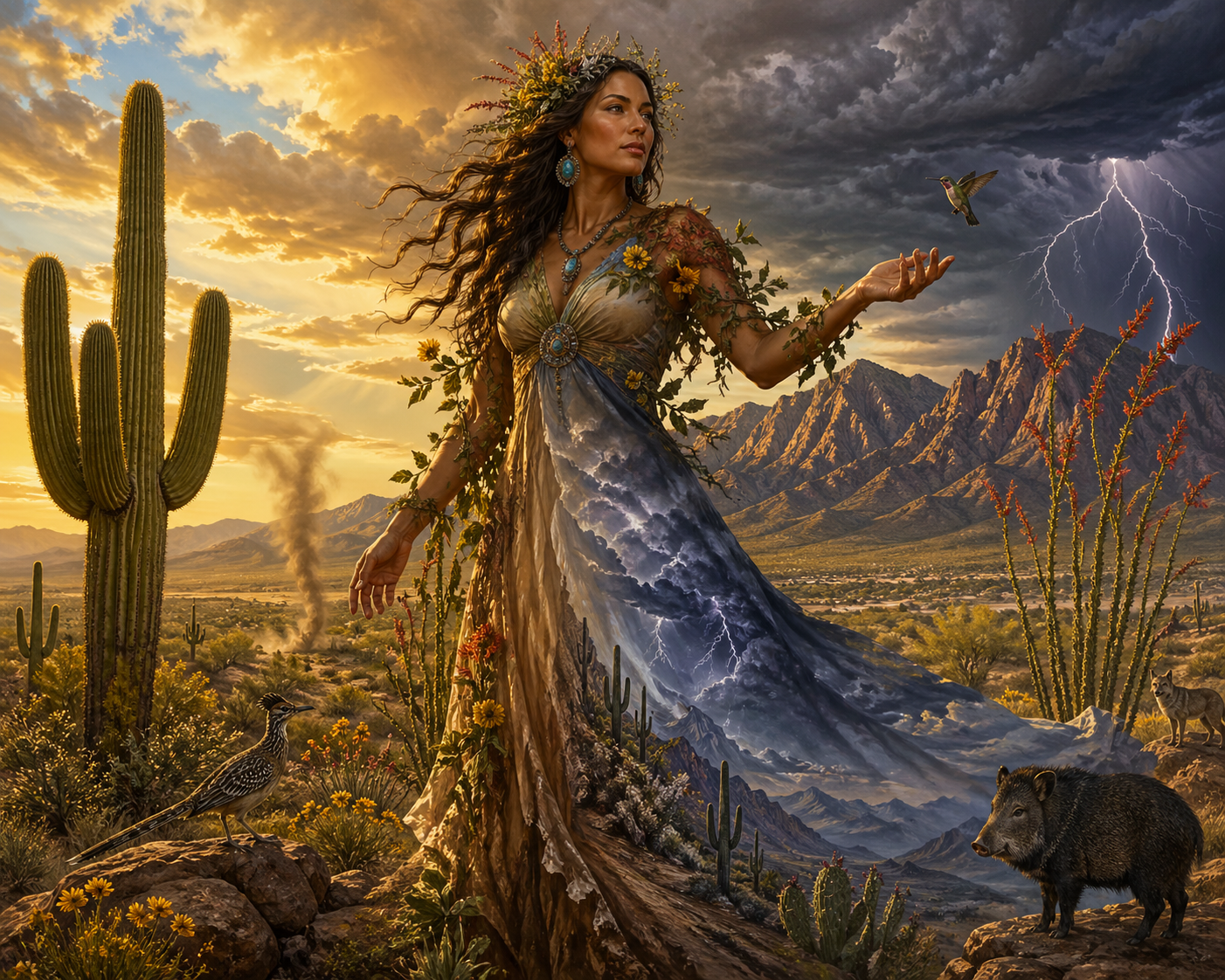
Mother Nature: Desert Living in Oro Valley
Mother Nature: It absolutely is. May is when I start reminding Oro Valley residents that the Sonoran Desert isn’t just beautiful – it demands respect. Those pleasant spring mornings are getting shorter. Afternoons are pushing past comfortable into serious heat. The wildflowers have mostly faded, and the desert is entering what I call its endurance phase. Everything out here – the saguaros, the desert tortoises, the javelinas – is preparing for what’s coming. Smart humans do the same.
ILoveOV: What should residents be doing right now to prepare?
Mother Nature: First, check your irrigation systems before the real heat hits. I’ve watched too many desert gardens suffer because someone waited until June to discover a broken drip line. Second, look at your trees and shrubs. Native plants are designed for this climate, but even palo verdes and mesquites appreciate deep watering before summer stress. Third, and this is critical – prepare for monsoon season. Clean your gutters, check your drainage, and make sure water flows away from your foundation. I’m going to send some impressive storms your way come July, and I’d rather not flood anyone’s garage.
ILoveOV: You mentioned monsoon season. What can Oro Valley expect this year?
Mother Nature: You know I don’t like to make promises about specific seasons – too many variables, climate patterns shifting, ocean temperatures playing their role. But I can tell you this: when monsoons arrive, they arrive with purpose. Lightning that illuminates the entire Catalina range, winds that remind you I’m in charge, rain that can drop an inch in thirty minutes. It’s spectacular, and it’s dangerous. Respect both qualities. Don’t drive through flooded washes. Don’t stand under palo verdes during lightning storms. And for heaven’s sake, don’t try to get that perfect storm photo from your golf course when thunder’s cracking overhead.
ILoveOV: It sounds like you’re frustrated with how some people interact with the desert.
Mother Nature: Frustrated isn’t quite the right word. Concerned, maybe. I see people who moved here for the sunshine and mountain views but don’t really understand the environment they’re living in. They plant grass lawns that require gallons of water daily in an area that gets 10 inches of rain a year. They’re surprised when coyotes come through their neighborhoods – where do they think coyotes lived before the houses were built? They want my beauty without accepting my terms. The Sonoran Desert has sustained life for thousands of years, but it does so on its own conditions, not human convenience.
ILoveOV: What would you like Oro Valley residents to understand about desert living?
Mother Nature: That working with me is so much easier than working against me. Plant native species and watch them thrive with minimal water. Landscape with decomposed granite and rock instead of grass. Create shade with ramadas and desert-adapted trees rather than fighting the sun with air conditioning set to arctic temperatures. Harvest rainwater when monsoons come instead of letting it all run off. The desert teaches efficiency, adaptation, and resilience. Those aren’t just survival strategies – they’re good life principles.
ILoveOV: You mentioned native plants. What’s your take on Oro Valley’s landscaping trends?
Mother Nature: I’m seeing improvement, honestly. More xeriscape designs, more ocotillos and agaves, and fairy dusters in front yards. The Town’s been good about using native plants in public spaces – have you walked the trails at Naranja Park lately? That’s desert landscaping done right. But I still see too many properties trying to recreate suburban Phoenix or, worse, trying to look like Southern California. You live in one of my most distinctive ecosystems on the planet. Why would you want it to look like anywhere else?
ILoveOV: Speaking of distinctive ecosystems, what makes the Sonoran Desert special to you?
Mother Nature: The diversity, hands down. People think desert means barren, but the Sonoran Desert hosts more plant and animal species than almost any other desert on Earth. You’ve got saguaros that can live two hundred years, hummingbirds that migrate thousands of miles to be here, and trees that bloom gold in the harshest conditions. The desert tortoise survives by digging burrows and waiting out extremes – that’s engineering I didn’t have to teach, it’s just evolution doing its remarkable work. This landscape is proof that life finds a way, even in challenging conditions. That should inspire anyone who lives here.
ILoveOV: May also bring increased wildfire danger. What’s your message about fire safety?
Mother Nature: Fire is part of my toolkit – it clears deadwood, returns nutrients to soil, resets ecosystems. But in a community like Oro Valley, where homes meet wildland, fire becomes everyone’s concern. Create defensible space around your property. Clear dead brush, especially after a wet winter that produced extra growth. Don’t let vegetation touch your house. And please, never toss cigarettes from car windows or leave glass bottles on trails – yes, glass can focus sunlight and start fires. I provide the conditions, but humans often provide the spark. Let’s all be smarter about that.
ILoveOV: As summer approaches, what’s your advice for enjoying the outdoors safely?
Mother Nature: Respect the heat. I’m not being dramatic when I say June through August can be life-threatening if you’re careless. Hike early – I’m talking sunrise, not nine o’clock. Carry more water than you think you need. Know the signs of heat exhaustion. Tell someone where you’re going. The Pusch Ridge trails will still be there at six in the morning, and they’re infinitely more pleasant then than at noon when the rocks are radiating stored heat and the temperature’s pushing one hundred ten. I love that Oro Valley residents want to experience the desert, but experience it on terms that keep you safe.
ILoveOV: You’ve seen Oro Valley change significantly over the decades. How do you feel about the growth?
Mother Nature: Growth is natural – I’m literally in the business of growth. But sustainable growth requires balance. I appreciate that Oro Valley has preserved open space, protected mountain views, and maintained trail access. Those decisions matter. Every time development preserves a wash or protects a wildlife corridor, that’s working with me, not against me. Every time the community chooses water-wise landscaping requirements or protects desert vegetation, that’s understanding we’re partners here, not adversaries. The challenge is maintaining that balance as more people discover how special this place is.
ILoveOV: What gives you hope about Oro Valley’s future?
Mother Nature: The people who get it. The families teach their kids to identify saguaros from ocotillos. The gardeners are choosing native plants. The hikers who pack out their trash and stay on designated trails. The residents who celebrate monsoon storms from their covered patios rather than complain about the weather. The community members who show up for environmental initiatives and water conservation efforts. Those people understand that living in the Sonoran Desert is a privilege that comes with responsibility. As long as that perspective keeps growing, Oro Valley and I will continue getting along just fine.
ILoveOV: Any final thoughts as we head into summer?
Mother Nature: Embrace what makes this place unique. You live somewhere that transforms dramatically with the seasons – spring wildflowers, summer monsoons, fall color in the cottonwoods, winter snow on the peaks. You have sunsets that stop traffic and skies so clear you can see the Milky Way. You share space with roadrunners, bobcats, and Harris’s hawks. That’s not ordinary. So yes, the summer heat is coming, and yes, it’s going to be intense. But it’s also temporary, and it’s part of the cycle that sustains this desert ecosystem. Work with me, respect the conditions, and I promise you’ll find beauty even in the harshest months. The Sonoran Desert has been thriving for millennia. Let me show you how.
As Mother Nature departed, a dust devil spun across the far hills, and a cactus wren called from a nearby saguaro. May in Oro Valley was indeed a transition – from the gentle abundance of spring to the fierce reality of desert summer. Those who heeded her advice would weather it well.
