
Wine Not Wednesday
October 14@ 5:30 pm—9:00 pm

What does it actually look like to win a seat on the Oro Valley Town Council — and then show up on Monday morning? Council Members Elizabeth Robb and Mary Murphy sat down with ILoveOV to talk about the learning curve, the homework, the surprises, and what they wish every resident understood about the job.
Two Oro Valley Council Members reflect on 20 months of learning, serving, and discovering what the job really looks like from the inside.
Election night is one thing. The Monday morning after is another.
When Elizabeth Robb and Mary Murphy won their seats on the Oro Valley Town Council in November 2023, they did so from very different starting points. Murphy had served on the Town’s Board of Adjustment and had attended enough council meetings to know the landscape going in. Robb was a vendor at the Oro Valley Farmers Market at Steam Pump Ranch, whose neighbors essentially talked her into running. She had no political background at all.
Twenty months later, both women sat down with ILoveOV to talk about what surprised them, what challenged them, what they’ve come to love about the work, and what they wish more residents understood about what goes on between council meetings.
Council Members: Mary Murphy – third from the left, and Elizabeth Robb – second from the right. Along with Oro Valley American Legion and Oro Valley VFW, along with Officer Guerrero – first on the left, OVPD, who recently was the recipient of “2026 Law Enforcement Officer of the Year”
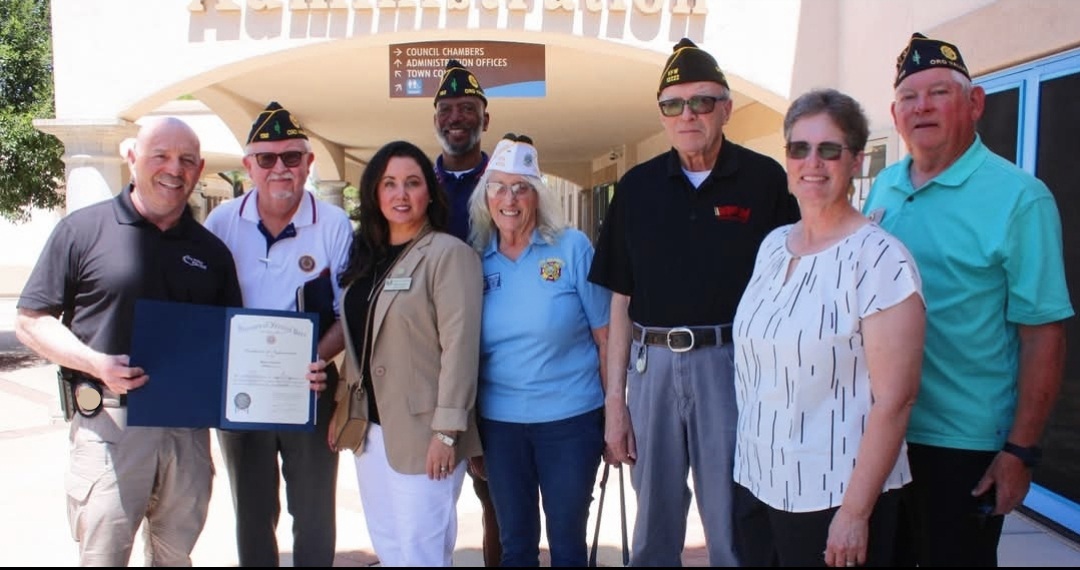
Oro Valley American Legion and Oro Valley VFW, along with Officer Guerrero, first on the left, OVPD who recently was the recipient of “Officer of The Year”
Robb’s path was almost the opposite. A former Army officer, PTO mom, search and rescue volunteer, former Boy Scout leader, longtime resident and vendor at the Oro Valley Farmers Market at Steam Pump Ranch, she had spent her years in town with her head down, focused on family and community — not politics.
“Basically, my arm got twisted by a neighbor,” Robb said. “I had lost my Boy Scout job because everybody Eagled out, the troop was done, and my boys had graduated, so my PTO stuff was done. I had a little bit of free time. I got talked into it. I said, I do care about the neighborhood, I care about Oro Valley, I think I could do the job, so okay, I’ll run. I won’t get elected, but I’ll run.”
“Winning was a complete shock. I did not — I didn’t expect to get elected,” Robb said. “I’d never done anything political before.”
Murphy, who had a head start on understanding the role, still found that the actual experience didn’t match what she expected. Her own campaign brought a different kind of surprise — the personal cost of putting herself forward publicly, including hostility from people who didn’t know her.
“What I wasn’t fully prepared for was some of the nastiness that came my way when I was campaigning,” Murphy said. “Some things that weren’t true that were written about me, talked about me on social media, by people who didn’t know me at all. I had never really had people sling mud my way, so I wasn’t prepared for that.”
She found strength in reframing it. The loudest critics, she came to believe, represented a small, politically engaged faction — not the broader community she was elected to serve.
“The 99 percent of the other residents, they deserve somebody who’s going to be better than that,” she said. “And that’s what they got in me.”
Both council members used the word “homework” more than once. What neither of them had fully anticipated was how much of it there would be.
“It was a fire hose,” Robb said, describing the onboarding process the town put new council members through before they were sworn in. The town brought incoming members in roughly six weeks early for department-by-department briefings — a kind of accelerated Citizens Academy. “They each gave us basically a class on what each department does in the town. We got to meet all the different people. It was an absolute fire hose of information, turned up high. But it was very helpful.”
“I am not a name-to-face type person. I can’t do names, and so it makes it very challenging for me,” Robb said. “They actually gave me a list of all the different names with their department and a picture. That was huge.”
Murphy, who came in with greater familiarity with the town’s structure, hit a different wall: the formal chain of communication between the council and staff.
“I thought I could reach out to department heads if I had a question,” she said. “Very quickly, I was informed that no — you go to the town manager, and the town manager handles the staff side of things, and then the town manager reports to us.”
She made the mistake of reaching out to staff directly a couple of times early on. It’s the kind of thing that seems intuitive — and isn’t, once you’re in the seat.
“In a normal career, that’s typically how it’s been handled for me,” she said. “But this is a new job. This is something I have never encountered before. There’s a lot in government, and I’m still learning some of it to this day.”
If there’s one thing both women came back to repeatedly, it’s the gap between what residents see and what happens between meetings.
Murphy described the constraint that surprised her most and still frustrates her: how little council members can discuss with one another outside public meetings. Arizona’s Open Meeting Law restricts informal discussion among a majority of council members on matters of public business, so most members avoid talking policy with one another except on the dais.
“If open meeting law didn’t exist, I still believe that I would choose to do things publicly and transparently,” Murphy said. “To me, trust is the most important thing.”
Robb said the same restriction was the most surprising thing she learned about the job and called it one of the most frustrating parts of the role.
“You can’t talk to the other council members, particularly — and that’s, I think, wrong, but it’s what open meeting law is, and I can’t change that,” Robb said.
The result, both noted, is that the long public discussions in open session that residents sometimes sit through aren’t theater. They’re often the first time council members genuinely work through a question together, in real time, in front of everyone.
Robb said she now schedules her time around whatever the council calendar demands of her — typically from a half hour before a meeting starts until midnight.
Murphy, whose background is in biomedical research, said she leans into preparation by design. She frames her questions on the dais not just as her own, but as a service to the residents watching. She takes seriously the scale of who she answers to.
“Your answers are only ever going to be as good as your questions,” she said. “I’m not asking them necessarily for myself. I’m asking them so that my 50,000 bosses will know the answers that we know.”
“I take the responsibility of having 50,000 bosses seriously,” Murphy said. “I can’t reach out to 50,000 bosses, but I sure can answer if they do reach out to me.”
Murphy described a similar shift in how residents approach her. Where people once simply mentioned a problem in passing, they now ask her to resolve it directly.
“People are a lot more comfortable asking me to actually be a fixer now,” Murphy said, recalling a recent example: an illegally placed sign attached to utility poles on La Cañada, in violation of town policy, that a constituent had flagged for her. She drove by, confirmed the resident’s complaint, and made a call. “It got fixed.”
Robb, a longtime vendor at the Oro Valley Farmers Market at Steam Pump Ranch, said she gets approached there many Saturday mornings by constituents who want to talk.
“I’m at the farmers’ market every Saturday. Never made a secret of that,” she said. “I have people come up and talk to me, and I have no problems with that. I actually usually enjoy it very much.”
Not every vote is simple. Both council members described moments where the public-facing version of a decision didn’t capture how complicated the underlying situation was.
Murphy pointed to a vote on a stoplight near Naranja Park, where she found herself at odds with some colleagues over whether to prioritize a safety committee’s recommendation.
“I felt like, to err on the side of safety, which is what the safety board was saying to us — we need this light there,” she said. “We can’t in good conscience not do it when we have a safety committee charged with keeping residents and children safe at a park where literally a young lady’s life was taken.”
The council ultimately reached consensus, with one member abstaining rather than voting no. Murphy said the experience reflected something she has come to value about this council: disagreement without lasting friction.
“We were all very respectful. We can move right on to the next agenda item,” she said.
Murphy also pointed to executive sessions as the kind of decision residents most misunderstand. When legal counsel is involved, council members can’t disclose what was discussed, so constituents sometimes receive no explanation for a decision that may have been based on complex legal reasoning.
“You come out of executive session and get people emailing you angrily, saying, ‘Why did you do this? Why didn’t you do that?’ And you can’t respond. You can’t tell them,” Murphy said.
Robb pointed to a recent change in state law: development plans that meet code now receive administrative approval and no longer come before neighborhood meetings early in the design phase, Planning and Zoning, or the council for a vote.
“That part is a little terrifying for a lot of people. It should be terrifying for a lot of neighbors,” Robb said. “As long as it meets code, they can do anything they want, and the public isn’t made aware of what is going on early in the process, so they can express their opinions. They just get informed: this is what’s being built.”
Twenty months in, both women have moved from orientation to ownership. Each has found a lane and leaned into it.
For Murphy, it was economic development and tourism. One of her first acts in office was to propose creating Oro Valley’s first Tourism Advisory Commission, which she saw as a direct way to address the town’s long-term revenue picture.
“Our town happens to be the most beautiful, in my biased opinion, in Arizona. Let’s start focusing on tourism,” she said. The commission now holds monthly open meetings, working with the town’s economic development director to identify opportunities to draw outside spending into the community. “My goal is not power. My goal is to make sure that I’m doing everything I can to set us up for 5, 10, 15, 20 years down the road.”
She’s also looking for the town to push more aggressively to annex existing revenue-generating businesses just outside the town limits, rather than undeveloped land. It’s a conversation she said she raised in her very first meeting with the town manager. She also learned during this year’s public strategic planning session that Councilmember Nicolson had wanted to explore this same concept several years earlier, though it never gained traction at the time. She’s excited that the council has now directed the town manager to begin examining it as a serious option.
For Robb, the passion project has been closer to the ground: food accessibility. Her years as a farmers’ market vendor, including through the height of the COVID pandemic, showed her that food insecurity exists in Oro Valley in ways many residents don’t see.
“There are citizens in our town who are struggling,” Robb said. She pointed to seniors on fixed incomes who don’t qualify for low-income housing, but whose Social Security checks don’t stretch to cover the rising cost of living. She has been working to make sure the town’s general plan and code don’t inadvertently create barriers to food distribution programs, farmers’ market nutrition assistance, or community gardens. “I want our citizens to be able to continue to live where they want to live.”
Robb pointed residents interested in learning more about local food assistance to Heirloom Farmers Market, the nonprofit that runs the Oro Valley Farmers Market at Steam Pump Ranch and administers Supplemental Nutrition Assistance Program (SNAP), WIC, and senior nutrition program benefits there each week.
Both interviews ended with some version of the same question: what should someone considering a run for council know before they decide?
Robb’s answer was direct.
“Why do you want to do it? Do you have the time and the temperament?” she said. “There’s a lot more homework than I thought there would be. And you’ve got to be willing to talk to people, have people disagree with you, have people be happy — and have a thick enough skin to handle the ones who are not going to be happy.”
Murphy emphasized something she has come to value about the current council’s culture: members who disagree without letting it become personal.
“This council, we very often will say, ‘Wow, this is such a refreshing group of people. There’s no drama,'” Murphy said. “We’re very respectful of each other, and we understand where the others are coming from, even when we vote differently.”
What both seem to have found, coming from such different starting points, is that the job is bigger, stranger, and more time-consuming than they imagined — and that they’re glad they’re doing it.
Robb, who has met hundreds of residents through campaigning, ribbon cuttings, and town events over the past 20 months, said the people are what make the role worthwhile. “You get to meet the most amazing people, you really do,” she said.
Murphy, who has now lived in Oro Valley longer than anywhere else in her life, put it simply: “I just love Oro Valley. It’s backyard politics, which are arguably the most important kind.”
Elizabeth Robb and Mary Murphy represent Oro Valley at-large on the Town Council. Both were elected in November 2023.