Trivia at the Community Center
September 20@ 4:00 pm—6:00 pm


Patrick Donovan had everything an artist was supposed to need—technical skill, years of training from the prestigious School of the Art Institute of Chicago, and endless determination. But after twelve years of struggle, his paintings felt like beautiful lies, and his family was barely surviving on his teaching income and his wife’s web design work.
Then a reluctant vacation to visit his retired parents in Arizona’s Oro Valley changed everything.
The first sunrise over the Catalina Mountains shattered Marcus’s artistic world. Colors he’d never seen, light that seemed to pulse with its own energy, and a landscape that spoke a visual language his soul had been searching for his entire career.
What began as a “paint-free” family vacation became a complete artistic transformation. In just two weeks, Marcus created more authentic work than in the previous year—abstract paintings that captured not what the desert looked like, but what it felt like to be alive in its presence.
“Finding Light: A Desert Awakening” is the story of an artist’s journey from desperate struggle to authentic success, a family’s courage to embrace radical change, and the transformative power of finding where you truly belong.
A tale of artistic discovery that will inspire anyone who has ever wondered if their authentic path is still waiting to be found.
Patrick Donovan stood before his easel in the cramped studio apartment that doubled as his workspace, staring at yet another canvas that felt like a beautiful lie. The oil painting before him—a moody landscape of Lake Michigan’s shoreline—was technically proficient, even moving in its own way. But it wasn’t his.
“It’s gorgeous, honey,” Sarah said from behind him, her laptop balanced on her knees as she worked on a client’s website design. Their daughter Emma was sprawled on the floor nearby, sketching in her notebook, while ten-year-old Jake practiced violin in the bedroom. The thin walls of their Logan Square apartment meant privacy was a luxury they couldn’t afford, in more ways than one.
Patrick had graduated from the School of the Art Institute of Chicago twelve years ago, filled with the kind of burning ambition that only comes from believing you’re destined for something extraordinary. He’d been talented then—his professors had said so, his classmates had envied his technical skill, and he’d even sold a few pieces during the student exhibitions. But talent, he’d learned, was like having a beautiful singing voice without knowing what song to sing.
The Chicago art scene was unforgiving in its sophistication. He’d made the rounds countless times: the galleries in River North with their polished concrete floors and intimidating white walls, the experimental spaces in Pilsen where emerging artists gathered to drink cheap wine and debate the death of painting, the pop-up shows in converted warehouses where collectors hunted for the next big thing. Gallery owners would study his work with practiced expressions, offering the kind of polite feedback that felt like a slow death.
“You have real skill,” they’d say, “but we’re looking for something more… distinctive. Something that feels uniquely you.”
The problem was that Patrick didn’t know who the “you” was supposed to be. He’d tried everything: hyperrealistic cityscapes that looked like photographs, abstract expressionist pieces that felt like therapy sessions, even a brief foray into conceptual art that had left him questioning why he’d become a painter in the first place. Each style felt like wearing someone else’s clothes—well-tailored, perhaps, but fundamentally wrong.
The rejection from the Chicago Cultural Center still stung. His series of paintings depicting the city’s changing seasons had been dismissed as “competent but forgettable.” The curator’s words echoed in his mind: “Chicago has a thousand painters who can capture our skyline. What we need is someone who can show us something we’ve never seen before.”
Financial pressure had become a constant companion. Sarah’s web design business kept them afloat, but barely. They’d had to move twice in the past three years, each apartment smaller than the last. Patrick taught art classes at a community center three days a week and worked weekend shifts at an art supply store, watching younger artists buy expensive materials with the kind of confidence he’d lost somewhere along the way.
“Maybe I should just accept it,” he said, setting down his brush. “Maybe I’m meant to be a teacher, not an artist.”
Sarah looked up from her laptop. “Patrick Donovan, don’t you dare give up now. We’ve sacrificed too much for your dreams to quit before you find your breakthrough.”
But what if the breakthrough never came? What if he were simply one of thousands of competent painters who would never find their unique voice? The thought terrified him more than poverty.
His parents had been calling more frequently lately, worried about the family’s financial stress, which they could hear in his voice. When they’d invited the whole family to visit them in Oro Valley, Arizona—their retirement paradise in the Sonoran Desert—Patrick had initially resisted. Two weeks away from his studio felt like two weeks away from the possibility of finally creating something meaningful.
“I need every moment I can get in front of a canvas,” he’d argued.
“That’s exactly why you need to step away,” Sarah had countered. “When was the last time you painted something that excited you? When was the last time you even looked at the world instead of just looking at other paintings?”
She was right, though he hated to admit it. His recent work had begun to feel like visual quotes from other artists—a little Diebenkorn here, some Rothko there, borrowed techniques and borrowed emotions that never quite felt authentic. He’d been so focused on finding success that he’d stopped seeing the world with his own eyes.
Emma looked up from her drawing. “Dad, can we see where Grandma and Grandpa live? Mom showed me pictures, and it looks like Mars.”
Patrick smiled despite his mood. “It’s not quite Mars, sweetheart. But it is different from here.”
Different. Maybe that was exactly what he needed. He walked to the window and looked out at the familiar grid of Chicago streets, the reliable geometry of buildings, and the predictable palette of urban life. He’d painted this view a hundred times in a hundred different styles, but none of it had ever felt like home on canvas.
“Alright,” he said finally. “But I’m declaring this a paint-free vacation. No easel, no brushes, nothing. Just family time.”
Sarah grinned. “You won’t last three days without creating something.”
“Watch me,” Patrick said, though even as he spoke the words, he wasn’t entirely convinced. His hands were already twitching for a brush, even as he tried to imagine two weeks of creative silence. Perhaps that silence was exactly what his overcrowded mind needed.
As he began researching flights to Tucson, Patrick couldn’t shake the feeling that this trip would either break him completely or save him. There was no middle ground left.
The airplane descended toward Tucson International Airport just as the sun was setting, and Patrick pressed his face to the small window like a child seeing snow for the first time. Below them stretched an alien landscape that seemed to belong to another planet entirely—a vast expanse of desert punctuated by mountain ranges that rose from the earth like sleeping giants.
“Look at those colors,” Sarah whispered, leaning across him. The desert floor wasn’t the monochromatic brown he’d expected, but a complex tapestry of sage greens, dusty purples, and warm ochres that shifted in the fading light.
Emma and Jake were equally mesmerized. “It really does look like Mars,” Jake announced with authority.
An hour later, they were driving north on Oracle Road toward Oro Valley in his father’s SUV, the Catalina Mountains growing larger with each mile. Patrick’s father, David, pointed out landmarks with the enthusiasm of someone who’d found paradise in retirement.

Just a typical day of clouds over Pusch Ridge. Not every day, but many.
“Wait until you see sunrise over Pusch Ridge,” he said. “Your mother sits out on the patio every morning with her coffee, watching the light change. She says it’s better than television.”
Patrick’s mother, Linda, laughed from the passenger seat. “Better than any art museum, too. Every morning it’s a completely different painting.”
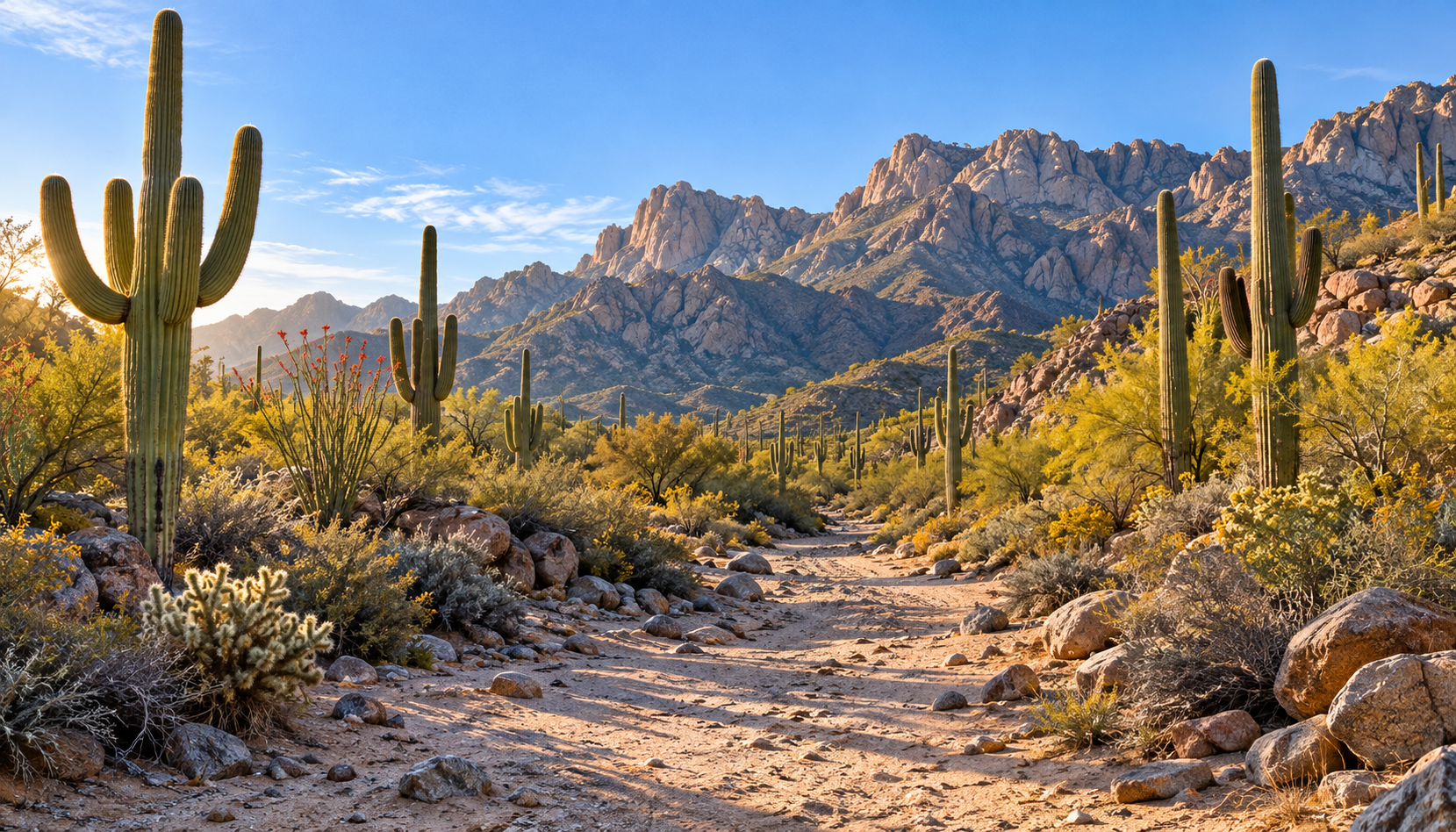
They turned into the Oro Valley Country Club area as darkness settled over the desert. Patrick caught glimpses of saguaro cacti standing sentinel in the landscape, their arms raised against a sky still painted with the last traces of orange and pink. The silence was profound after Chicago’s constant urban hum—no traffic, no sirens, just the vast quiet of the desert settling into night.
His parents’ house sat on a ridge with an unobstructed view of the Catalina Mountains. As they unloaded luggage, Patrick found himself repeatedly stopping to stare at the silhouette of peaks against stars more numerous than any he’d seen since childhood camping trips.
“The guest room has the best view,” his mother said, leading them inside. “We set up the kids in the media room—they’ll love the big screen—and you and Sarah get the sunrise suite.”
The guest room’s floor-to-ceiling windows faced east toward a landscape that looked mythical in the moonlight. Pusch Ridge rose in a series of dramatic peaks and valleys, its rocky faces catching silver light in ways that suggested hidden depths and ancient secrets.
“This is incredible,” Sarah said, settling into bed. “I can already feel my stress melting away.”
But Patrick lay awake long after his family had fallen asleep, watching shadows shift across the mountain faces as clouds drifted overhead. There was something about the quality of light here, even moonlight, that felt different from anything he’d ever experienced. In Chicago, light was functional—it illuminated buildings, streets, and people going about their business. Here, light seemed to be in conversation with the landscape itself, creating a dialogue between earth and sky that changed moment by moment.
He’d promised himself no painting, no artistic analysis, no searching for inspiration. This was supposed to be a vacation from all of that. But as he watched the mountains transform in the shifting light, his mind couldn’t help but work like an artist’s, seeing colors, compositions, and possibilities.
When dawn began to break the next morning, Patrick was already awake. He slipped quietly out of bed and onto the back patio, carrying a cup of coffee his mother had left ready in the kitchen. The eastern sky was beginning to show the faintest hint of color, and he settled into one of the patio chairs to watch whatever was about to unfold.
What happened next took his breath away.
The light didn’t simply appear—it emerged, layer by layer, like watercolors bleeding into wet paper. First came the palest pearl-white along the horizon, so subtle he almost missed it. Then rose gold began to seep upward, followed by streaks of coral and soft orange that seemed to emanate from behind Pusch Ridge itself.
But it was the way the light hit the mountains that stopped his heart. The rocky faces didn’t just reflect the dawn colors—they seemed to generate them, as if the stone itself was luminous. Purple shadows filled the canyons and crevices, while the peaks caught fire with warm gold and salmon-pink hues. The entire ridge became a living canvas, shifting and breathing with the advancing light.
And then the sun crested the ridge.
Patrick set down his coffee cup with trembling hands. In that moment, he saw something he’d never seen before—not just a landscape, but a visual language he’d been searching for his entire artistic life. This wasn’t about painting what he saw. This was about capturing the feeling of light itself —the way color could exist not just as pigment on canvas, but as pure energy, as emotion, as the very essence of life force.
“Beautiful, isn’t it?” his mother said softly, appearing beside him with her own coffee.
Patrick couldn’t speak. His mind was already racing, seeing compositions that had nothing to do with literal representation and everything to do with the energy he’d just witnessed. Not landscapes in any traditional sense, but abstractions that captured the essential spirit of this light, this color, this impossible beauty that made his chest tight with recognition.
“I think,” he said finally, his voice barely a whisper, “I think I just found what I’ve been looking for.”
His mother smiled. “The desert has a way of showing people what they need to see. Your father says I’ve been different since we moved here—more myself, somehow.”
Patrick nodded, understanding exactly what she meant. For the first time in years, he felt like himself, too. Not the struggling artist trying to fit into Chicago’s art scene, not the father worried about providing for his family, not the graduate student still searching for his professor’s approval.
Just Patrick, standing in the presence of something magnificent, finally ready to paint not what he thought he should paint, but what his soul was demanding he paint.
The paint-free vacation was officially over.
Patrick lasted exactly eighteen hours.
By the second morning, as he watched another transformative sunrise paint Pusch Ridge in colors that seemed to exist nowhere else on earth, the need to capture something—anything-of what he was experiencing became physically unbearable. His hands actually ached with the desire to hold a brush.
“I have to go buy some supplies,” he announced over breakfast, causing Sarah to nearly choke on her orange juice.
“So much for your artistic cleanse,” she said, grinning.
“This is different,” Patrick insisted, and it was. In Chicago, painting had become a burden, a desperate grasping for something always just out of reach. Here, the urge felt like breathing—necessary, natural, inevitable.
His father offered to drive him to the art supply store in Tucson. This forty-minute journey took them through more of the desert landscape, which was rapidly expanding Patrick’s visual vocabulary. They passed through different microclimates and elevations, each offering new color combinations: the silver-green of sage against red rock, the shocking yellow blooms of palo verde trees, the deep purple shadows that pooled in mountain crevices even in full daylight.
At the art store, Patrick found himself selecting colors he’d never used before—quinacridone magenta, dioxazine purple, various earth tones that seemed to glow with inner fire. He bought a small canvas, just 16×20, telling himself this was just an experiment.
“Planning something?” the store clerk asked, ringing up brushes and medium.
“I have no idea,” Patrick answered honestly. “I’m just following instinct.”
Back in Oro Valley, he set up his easel on his parents’ back patio as the afternoon light began its daily show. But instead of trying to paint what he saw, he found himself closing his eyes and painting what he felt—the sensation of light moving across stone, the emotional impact of color relationships that existed nowhere but in this specific place at this specific time.
His brush moved almost without conscious direction, laying down broad strokes of color that had nothing to do with literal representation. Coral bleeding into gold, purple emerging from shadow, green that pulsed with life force. He wasn’t painting Pusch Ridge—he was painting the feeling of being alive in the presence of Pusch Ridge.
“Daddy, that doesn’t look like the mountains,” Emma observed, appearing at his elbow.
“You’re right,” Patrick said, not stopping his work. “It looks like how the mountains make me feel.”
Hours passed unnoticed. The actual sunset blazed across the sky, setting the ridge on fire with colors that exceeded anything his palette could capture, but Patrick barely glanced up. He was too busy chasing something on the canvas—an energy, a rhythm, a visual music that was finally, finally starting to feel like his own voice.

Editor’s Note: We don’t know what Patrick’s canvas reveal. This is our guess.
When he finally stepped back, the canvas held something he’d never created before. It wasn’t a painting of a place—it was a painting of light itself, of energy made visible, of the emotional landscape that existed in the space between observer and observed. Broad swaths of color flowed and merged in ways that suggested mountain forms without replicating them, capturing the essence of desert light without attempting to duplicate it.
“Oh my god,” Sarah breathed, appearing behind him. “Patrick, this is…”
“Different,” he finished.
“It’s you,” she said. “For the first time, this actually looks like you painted it.”
That night, Patrick couldn’t sleep. His mind was buzzing with possibilities, with color combinations and compositional ideas that felt both completely foreign and deeply familiar. He’d stumbled onto something—not a technique or a style, but an approach, a way of seeing that translated the physical world into pure emotional experience.
By the fourth day, he’d completed three more canvases, each one pushing further into abstraction while remaining grounded in the specific character of Sonoran Desert light. Word had somehow gotten around the small retirement community, and neighbors began stopping by to see what the artist from Chicago was creating.
“I’ve lived here fifteen years,” said their neighbor, Mrs. Patterson, studying one of the canvases. “This is the first time I’ve seen someone capture what it actually feels like to live with this light.”
Patrick was beginning to understand something crucial: he hadn’t just found a new subject matter. He’d found his visual language, the thing that had been missing from all those technically accomplished but emotionally hollow paintings he’d created in Chicago. The desert hadn’t taught him how to paint—it had taught him how to see with his own eyes instead of through the filter of art history and market expectations.
Each morning brought new revelations. The light here didn’t just change throughout the day—it told stories, created emotional narratives that shifted from serene to dramatic to transcendent and back again. And Patrick found he could translate those narratives into paint, creating works that were simultaneously abstract and deeply rooted in place.
On the fifth morning, as he watched the sun emerge from behind Pusch Ridge and begin its daily transformation of the landscape, Patrick realized he was no longer visiting the desert. The desert was visiting him, changing him from the inside out, showing him who he’d always been beneath all those layers of borrowed technique and borrowed vision.
For the first time since graduating from art school, Patrick felt like he was exactly where he belonged.
On the seventh morning of their stay, Patrick woke before dawn with an electric certainty in his chest. Today would be different. He could feel it in the quality of air, in the way his hands moved as he prepared his palette, in the particular clarity of his mind as he arranged his brushes.
The sky was already showing the first hints of color when he positioned himself on the patio. Still, this time he’d moved his easel to face not just Pusch Ridge, but the entire panoramic sweep of the Catalina Mountains. He’d prepared a larger canvas—24×36—and mixed colors that seemed to glow even in the pre-dawn light.
As the sun began its emergence from behind the ridge, Patrick started painting before the light show had even begun. His brush moved with unprecedented confidence, laying down broad strokes of deep purple and indigo that would anchor the composition. But instead of painting what he saw, he was painting what he anticipated, what he knew was coming based on a week of careful observation.
The light appeared gradually, and Patrick painted its arrival not as a series of static colors but as a living progression. Coral emerged from purple, and gold bled into coral. Green fire sparked to life in the lower portions of the canvas. His brush moved in flowing, gestural strokes that captured the movement of light itself—not light as illumination, but light as pure energy, as the visible manifestation of the earth’s rotation, of cosmic forces made intimate and personal.
But something else was happening as he painted. The colors on his canvas began to take on a life of their own, suggesting forms that were neither quite mountains nor quite abstract—something in between, something that captured the essential character of the desert landscape without being bound by its literal appearance. Spires of color that might have been saguaro cacti or might have been flames, flowing forms that suggested the rolling foothills or might have been musical notes made visible.
“Jesus,” he whispered, stepping back as the actual sunrise reached its crescendo behind him. On the canvas, he’d somehow captured not just the visual experience of desert dawn, but the emotional and spiritual experience of being present for this daily miracle.
Sarah appeared with coffee, took one look at the canvas, and set the cup down so abruptly it sloshed. “Patrick. What is this?”
“I don’t know,” he said, and it was the truth. He’d never painted anything like this before. The work seemed to exist in its own category—not landscape, not abstract expressionism, not anything he could name. It was simply itself, completely and unapologetically.
The painting pulsed with energy. The colors seemed to move even though they were static, creating optical effects that drew the viewer deeper into the composition. It was bold in a way that his previous work had never been, confident in its own visual language rather than apologetic about not fitting established categories.
His father emerged onto the patio, saw the canvas, and stopped mid-step. “Holy hell, son. That’s… that’s something else entirely.”
Word spread quickly through the retirement community. By noon, a small crowd had gathered on the patio, neighbors and friends drawn by curiosity about the artist from Chicago who was apparently creating something unprecedented.
“I’ve never seen anything like this,” said Tom Rodriguez, a retired gallery owner from Phoenix. “This isn’t just desert art—this is something completely new. You’re painting light itself, not just lit objects.”
Patrick found himself explaining his process, though he wasn’t entirely sure he understood it himself. “I’m trying to capture the emotional experience of being here,” he said. “Not what the desert looks like, but what it feels like to be alive in this landscape.”
An older woman named Margaret, who’d been studying the canvas in silence, finally spoke. “I’ve lived in Arizona for thirty years, and I’ve seen thousands of desert paintings. Most of them are pretty, but they’re just pictures. This…” she paused, searching for words. “This makes me feel like I’m experiencing sunrise for the first time all over again.”
That evening, as the family gathered for dinner, Patrick couldn’t stop talking about the day’s work. Ideas were flowing faster than he could process them—visions of entire series exploring different times of day, different weather conditions, different emotional responses to the desert’s ever-changing character.
“I think I want to try something bigger tomorrow,” he said. “Maybe 30×40. And I want to explore what happens when clouds are involved—the way they filter and scatter the light creates completely different color relationships.”
Sarah reached across the table and squeezed his hand. “I haven’t seen you this excited about painting since we first met.”
Jake looked up from his plate. “Dad, are you going to paint here forever?”
The question hit Patrick like a physical blow. In just one week, he’d created more authentic work than in the previous year combined. The thought of returning to Chicago, to the gray winter light and the familiar but fruitless struggle to find his artistic voice, felt like contemplating artistic suicide.
“I don’t know, buddy,” he said. “But I know I’m not done here yet.”
That night, he lay awake long after his family had fallen asleep, watching shadows shift across the mountain faces as clouds drifted overhead. There was something about the quality of light here, even moonlight, that felt different from anything he’d ever experienced. In Chicago, light was functional—it illuminated buildings, streets, and people going about their business. Here, light seemed to be in conversation with the landscape itself, creating a dialogue between earth and sky that changed moment by moment.
He’d promised himself no painting, no artistic analysis, no searching for inspiration. This was supposed to be a vacation from all of that. But as he watched the mountains transform in the shifting light, his mind couldn’t help but work like an artist’s, seeing colors, compositions, and possibilities.
The breakthrough wasn’t just about finding a new style—it was about finding himself as an artist, discovering that his authentic voice had been waiting all along for the right landscape to call it forth.
Outside the window, Pusch Ridge stood patient and eternal under the stars, holding secrets of light that would take a lifetime to explore.
By the tenth day, Patrick had completed seven canvases, each one pushing the visual language he was developing further. His parents’ patio had been transformed into an outdoor gallery, with paintings drying in the desert air while new ones emerged on the easel.
Each work was different, but they shared a common DNA—a way of translating the desert’s emotional impact into pure color and form. His sunrise paintings pulsed with gentle energy, all soft corals and warming golds that seemed to breathe on the canvas. His sunset pieces were more dramatic, slashes of magenta and orange that captured the daily spectacle of light igniting the western sky and reflecting off the Catalina Mountains in waves of color.
But it was his cloud studies that surprised him most. When storm systems moved through the valley, creating dramatic weather patterns over Pusch Ridge, Patrick found himself painting not the clouds themselves but the way they transformed light—filtering it, scattering it, creating color relationships that existed nowhere else. These paintings were more abstract than his others, pure explorations of color interaction that somehow still felt grounded entirely in place.
“You’re developing something unique here,” said Elena Vasquez, a curator from the Tucson Museum of Art who’d driven up to see his work after Tom Rodriguez had called her. She moved slowly from canvas to canvas, studying each one with the kind of attention Patrick had always hoped for but rarely received. “This isn’t Southwest art as we typically see it. This is something entirely new—a way of painting place that’s more about energy than appearance.”
Patrick watched nervously as she examined his latest piece, a 30×40 canvas inspired by a dramatic monsoon sunset three days earlier. Towering clouds had built up over the mountains all afternoon, creating a light show that seemed to last for hours as the sun moved toward the western horizon. The painting captured none of the literal elements—no identifiable cloud forms, no mountain silhouettes—but somehow conveyed the entire emotional experience of standing witness to that vast display of natural power.
“The color relationships are extraordinary,” Elena continued. “You’re working with combinations I’ve never seen before, but they feel completely authentic to this place. How long have you been developing this approach?”
“About ten days,” Patrick admitted.
Elena stopped and looked at him sharply. “Ten days? This level of sophistication usually takes years to develop.”
“I’ve been painting for twelve years,” Patrick said. “But this… this just started happening when I got here.”
That afternoon, Elena arranged for a Phoenix gallery owner named David Koerner to drive down from the Metroplex. Koerner ran one of the most respected contemporary galleries in the Southwest, and Elena thought he needed to see Patrick’s desert work.
Patrick spent the afternoon in a state of nervous energy, cleaning brushes and rearranging canvases. At the same time, his family explored nearby hiking trails. When Koerner arrived just before sunset, Patrick was in the middle of starting a new piece. This one was inspired by the way late afternoon light created a golden rim around the entire ridge line.
“Don’t stop,” Koerner said, settling into a patio chair to watch Patrick work. “I want to see your process.”
For the next hour, as the real sunset unfolded against the mountains, Patrick painted its emotional equivalent. His brush moved in flowing, confident strokes, building up layers of color that seemed to generate their own light. He wasn’t copying the sunset—he was translating it into his own visual language, a language that was becoming more fluent with each passing day.
“This is remarkable,” Koerner said when Patrick finally stepped back. “You’re painting light the way jazz musicians play rhythm—not literally, but essentially. This captures something about desert light that photography never could.”
They spent the evening discussing Patrick’s journey, his frustrations in Chicago, and his unexpected artistic awakening in the desert. Koerner examined each canvas multiple times, asking questions about technique and inspiration that showed he understood precisely what Patrick was attempting.
“I’d like to propose something,” Koerner said finally. “Give me six months to plan a proper exhibition. Create fifteen to twenty pieces in this new direction—really explore what you’ve discovered here. I think we could generate significant interest, not just locally but nationally. This work deserves a wider audience.”
Patrick felt his heart racing. “You really think there’s a market for this?”
“Patrick, I’ve been in this business for twenty-five years. What you’re doing here is special. It’s rooted in place but universal in its emotional impact. Someone in New York or Los Angeles doesn’t need to know the Sonoran Desert to feel what these paintings are expressing. You’re painting light and energy and the feeling of being alive—that translates everywhere.”
That night, Patrick called his best friend and fellow artist from Chicago, David Johnson, to share the news. David had been one of the few people who’d continued to believe in Patrick’s potential even during the darkest periods of doubt.
“So let me get this straight,” David said. “You go on vacation, discover your artistic voice, and land a gallery exhibition all in ten days?”
“I know how it sounds,” Patrick said. “But David, I’m painting things I’ve never been able to paint before. It’s like I’ve been trying to speak in a foreign language my whole career, and I finally found my native tongue.”
“Send me photos of the work,” David said. “I need to see this transformation you’re describing.”
When Patrick emailed images of his desert paintings to David later that night, his phone rang within minutes.
“Holy shit, Patrick. This is you? This is really you?”
“It’s me,” Patrick said, feeling tears spring to his eyes. After twelve years of struggle, someone was finally seeing his authentic artistic voice.
“These are going to sell,” David said with certainty. “But more than that, these are going to matter. You’ve found something here that other artists are going to wish they’d found first.”
As Patrick lay in bed that night, listening to the profound silence of the desert and watching moonlight transform the familiar outline of Pusch Ridge once again, he realized he was facing the biggest decision of his life. He could return to Chicago with his newfound artistic voice and try to translate it back into his old life. Or he could follow this discovery wherever it led, even if it meant leaving everything familiar behind.
The desert, he was learning, didn’t just inspire new art—it demanded new life.
With only three days left in Oro Valley, Patrick found himself painting with desperate intensity, as if he could somehow capture enough of the desert’s energy to sustain him through a Chicago winter. He’d completed twelve canvases, each one revealing new possibilities within the visual language he’d discovered.
The work was becoming bolder and more confident. His latest piece—inspired by a dramatic afternoon storm that had rolled across the valley—pushed his color relationships to their limits. Deep purples and electric blues clashed and merged with sudden bursts of gold and coral, creating a sense of movement and energy that seemed to vibrate off the canvas.
“It’s like you’re painting weather itself,” his mother observed, watching him work. “Not just what storms look like, but what they feel like.”
Elena Vasquez had returned with exciting news. She’d shown images of Patrick’s work to several colleagues, and the response had been uniformly enthusiastic. The Museum of Contemporary Art in Scottsdale wanted to include one of his pieces in an upcoming group exhibition of emerging Southwestern artists.
“The thing is,” Elena said carefully, “they want to know if you’re staying in Arizona. The art world is small, and collectors like to know they can visit an artist’s studio and develop a relationship. The desert art market is growing rapidly, and there’s a real opportunity here for someone with your vision.”
Patrick had been avoiding this conversation with Sarah, but that evening, as they sat on the patio watching what had become their ritual sunset, he finally broached the subject.
“I know this sounds crazy,” he began, “but what if we didn’t go back?”
Sarah was quiet for a long moment, watching the last light fade from Pusch Ridge. “I’ve been wondering when you’d say that,” she finally replied.
“You have?”
“Patrick, I’ve watched you this past week and a half. You’re a different person here. Not just as an artist—as a father, as a husband, as a human being. You’re relaxed in a way I haven’t seen since before Emma was born.”
They talked late into the night, examining the practical realities. Sarah’s web design business was entirely remote—she could work from anywhere with a reliable internet connection. The kids would have to change schools, but both were adaptable and had already fallen in love with the adventure of desert living. Patrick’s parents were delighted by the possibility of having family nearby.
The financial picture was surprisingly encouraging. David Koerner had already sold one of Patrick’s pieces to a private collector for $3,200—more than he’d made from any single painting in Chicago. With the lower cost of living in Oro Valley and the growing interest in his work, they might actually achieve the financial stability that had eluded them for so long.
“There’s something else,” Sarah said as they prepared for bed. “I’ve been happier here, too. In Chicago, I felt like we were always just surviving. Here, it feels like we could actually build something.”
The next morning, Patrick tackled his most ambitious canvas yet—a 36×48 piece inspired by the whole panorama of the Catalina Mountains at sunrise. Instead of focusing on a single peak or section of ridge, he wanted to capture the entire sweep of the range, the way the light moved across multiple peaks and valleys in a symphony of color and shadow.
He worked for six hours straight, barely pausing for water breaks. The painting evolved organically, with broad horizontal sweeps of color that suggested the layered ridges while maintaining complete abstraction. Deep purples and blues in the shadow areas gave way to warm golds and corals where the light struck the stone. At the same time, the sky became a complex orchestration of yellows, oranges, and pinks that seemed to dance with their own energy.
When he finally stepped back, exhausted and paint-covered, he knew he’d created something extraordinary. The canvas captured not just a moment but an entire experience—the feeling of standing small and grateful before something vast and eternal, the sense of being alive in the presence of beauty that exceeded human understanding.
Jake and Emma had been playing in the yard during his marathon painting session, but they stopped to stare when they saw the finished piece.
“Dad,” Emma said in a small voice, “that painting makes me feel happy and scared at the same time.”
“Scared?” Patrick asked.
“Not bad scared. Like when you’re on a really high swing and you’re flying, but you know you’re safe. Like the feeling is too big for your body.”
Patrick looked at his eight-year-old daughter with new respect. She’d just articulated something about his work that he’d been struggling to understand himself. His paintings weren’t just visual experiences—they were emotional events, carefully orchestrated to create specific feelings in the viewer.
Sarah appeared with coffee, took one look at the canvas, and set the cup down so abruptly it sloshed. “Patrick. What is this?”
“I don’t know,” he said, and it was the truth. He’d never painted anything like this before. The work seemed to exist in its own category—not landscape, not abstract expressionism, not anything he could name. It was simply itself, completely and unapologetically.
His father emerged onto the patio, saw the canvas, and stopped mid-step. “Holy hell, son. That’s… that’s something else entirely.”
That afternoon, David Koerner called with news that changed everything. A collector from Santa Fe had seen images of Patrick’s work and wanted to commission a large piece for a new resort. The commission alone would cover six months of living expenses.
“But here’s the thing,” Koerner said. “He wants to work with the artist in person, wants to visit your studio and see where these paintings are born. He’s not just buying art—he’s buying into your story, your connection to this place.”
After dinner, the family gathered on the patio one last time to watch the sunset together. Patrick had set up his easel for what might be his final Oro Valley painting during this visit, but found himself simply standing with his wife and children, his parents beside them, all of them silent before the daily miracle that had changed his life.
“We’re going to do it, aren’t we?” Sarah said quietly.
Patrick nodded, feeling a certainty he hadn’t experienced in years. “I think we have to. I don’t know how to go back to painting gray light after this.”
Emma tugged on his shirt. “Does this mean we get to live with the real-life Mars?”
“Even better,” Patrick said, picking her up so she could see over the patio railing to the vast desert stretching toward the mountains. “We get to live with magic.”
The next morning, their last in Oro Valley, Patrick painted one final canvas—not as an ending, but as a promise. He chose a small 16×20 canvas, the same size as his very first desert painting two weeks earlier, positioning himself to capture the sunrise over Pusch Ridge one more time.
But this painting was different from all the others. Where his early work had been hesitant, exploratory, this piece moved with complete confidence. His brush strokes were bold and sure, laying down color relationships that had become as natural to him as breathing. The composition flowed with an effortless energy that spoke of an artist who had found his authentic voice and knew exactly how to use it.
As he painted, neighbors gathered one final time to watch the artist from Chicago create his magic. Mrs. Patterson brought her visiting daughter, who worked for a gallery in Los Angeles. Tom Rodriguez had invited a friend who collected contemporary art. Even the UPS driver, who’d been following Patrick’s progress all week, stopped to watch the painting emerge.
When Patrick finally stepped back, the canvas held something that felt like a visual poem—all the energy and emotion of a desert sunrise distilled into pure color and form. It wasn’t a painting of Pusch Ridge; it was a painting of what Pusch Ridge did to the human soul.
“This one’s not for sale,” he announced, causing a few disappointed murmurs from the small crowd.
“This one,” Sarah said, understanding immediately, “is staying with us. No matter where we hang it, it’ll always bring us back to this moment.”
As they packed the car for the airport, Patrick carefully wrapped thirteen paintings—more than he’d ever completed in any two weeks of his life. Twelve would go back to Chicago temporarily, while he and Sarah made arrangements for the move. The thirteenth, the final sunrise painting, would hang in their new home once they found it.
On the plane back to Chicago, Patrick stared out the window as the Arizona landscape disappeared beneath clouds, but he wasn’t worried about losing his connection to the desert. The visual language he’d discovered there was now part of him, as integral to his artistic identity as his ability to mix colors or hold a brush.
“What are you thinking about?” Sarah asked.
“I’m thinking,” Patrick said, “that we’re not just moving to Arizona. We’re moving toward the life we’re supposed to be living.”
Emma, coloring in her notebook, looked up with the wisdom of an eight-year-old. “Sometimes you have to go far away to find out who you really are.”
Patrick smiled at his daughter, realizing she’d just articulated the essence of his entire artistic journey. The desert hadn’t changed him—it had revealed him, stripped away everything that wasn’t essential, and shown him the artist he’d always been beneath the struggle and doubt.
As Chicago’s familiar skyline came into view through the airplane window, Patrick felt no sadness about leaving it behind. He was returning not as the same frustrated artist who’d gone two weeks earlier, but as someone who’d finally found his light. And in three months, when the Arizona desert welcomed him back permanently, that light would guide him toward a future he could finally paint with confidence.
Six months later, Patrick stood in the main room of what would become the Donovan Studio and Gallery, watching the morning light stream through floor-to-ceiling windows that perfectly framed Pusch Ridge. The 2,400-square-foot space had once housed a furniture showroom. Still, Patrick and Sarah had transformed it into something that felt both professional and intimately connected to the desert landscape.
The transition from Chicago had been smoother than anyone had expected. Their Logan Square apartment had sold quickly to a young couple who appreciated the bohemian neighborhood. Jake and Emma had adapted to their new school with remarkable ease—Jake had joined the mountain biking team, and Emma had discovered a talent for desert photography that complemented her artistic sketching.
“It’s like we were always meant to be here,” Sarah said, adjusting the lighting system she’d designed to showcase Patrick’s paintings. “Even the kids seem more themselves.”
The gallery space showcased twenty-five of Patrick’s desert paintings, including several new pieces he’d completed during brief return visits to Oro Valley while wrapping up their life in Chicago. Each painting represented a further refinement of his visual language—the way he captured light had become even more sophisticated, with subtle gradations and color interactions that seemed to make the canvases glow from within.
David Koerner had been right about the momentum. The art world had embraced Patrick’s work with an enthusiasm that still surprised him. His pieces were now represented in galleries in Santa Fe, Scottsdale, and Los Angeles. A collector in New York had commissioned a series of four large paintings for a corporate headquarters, specifying that he wanted “those incredible desert light paintings that make you feel like you’re standing in the middle of pure energy.”
But it was the teaching component of his new venture that brought Patrick the deepest satisfaction. The workshop program he’d developed attracted artists from around the world who wanted to learn his approach to translating landscape into emotional abstraction. Weekend intensive sessions had evolved into week-long residencies, with visiting artists staying in nearby accommodations and spending their days painting in the desert under Patrick’s guidance.
“The secret,” he would tell his students as they set up easels in various locations around Oro Valley and the broader Sonoran Desert, “isn’t to copy what I do. It’s about finding your own authentic response to a place. The desert will teach you things about light and color that no art school can, but only if you’re willing to abandon what you think you know and really see.”
One of his most successful students was Janet Wilson, a photographer from Seattle who’d been struggling to transition into painting. After a week working with Patrick, she’d developed her own approach to capturing the Pacific Northwest’s misty light using techniques adapted from his desert methods.
“You didn’t teach me to paint the desert,” she told him on her last day. “You taught me to paint my relationship with the landscape. Now I can go home and see the Northwest with completely new eyes.”
The business had grown beyond anything Patrick had imagined. The gallery portion generated steady income from both original paintings and limited-edition prints. The workshop program was booked six months in advance. He’d even begun accepting a few private commissions from collectors who wanted works inspired by specific desert locations or times of day.
But perhaps most importantly, Patrick was painting better than ever. His recent work showed an artist completely at ease with his chosen visual language, pushing the boundaries of what abstract landscape could achieve. His latest series, inspired by the way different weather patterns transformed desert light, had attracted attention from the Venice Biennale committee.
“I keep expecting to wake up and discover this was all a dream,” Patrick confessed to his father as they sat on the patio one evening, watching the sunset paint Pusch Ridge in the colors that had launched his career.
“Dreams don’t require this much work,” his father replied pragmatically. “What you’ve built here is real. You found your place, and you’ve created something meaningful from that discovery.”
Emma appeared beside them, now nine and carrying a small canvas she’d been working on—her own interpretation of desert sunset, painted in the expressive style she’d developed under her father’s informal guidance.
“Dad, when I grow up, do you think I’ll find my special place too?”
Patrick studied his daughter’s painting, seeing in it the same fearless authenticity that had taken him decades to develop. “I think you’re already finding it, sweetheart. The secret is learning to trust what you see with your own eyes, not what other people tell you to see.”
Sarah joined them on the patio, carrying Jake’s latest photograph—a stunning capture of morning light filtering through a saguaro forest that showed remarkable compositional sophistication for a ten-year-old.
“Look at what our kids are creating,” she said. “I think this place is teaching all of us who we really are.”
As the sun set and the mountains began their nightly transformation from gold to purple to deep blue, Patrick felt a contentment he’d never known was possible. He’d achieved more than artistic success—he’d built a life that felt authentic in every dimension.
The struggling Chicago artist was gone, replaced by someone who woke each morning eager to see what the desert light would teach him next. His paintings no longer felt like desperate attempts to prove himself, but like conversations with a landscape that had become his artistic partner.
Tomorrow would bring new students, new colors, and new possibilities for pushing his work in directions he couldn’t yet imagine. But tonight, surrounded by his family in the place that had given him everything he’d been searching for, Patrick felt grateful.
He’d finally come home.
Ten years after that first transformative sunrise over Pusch Ridge, Patrick Donovan had become one of the most recognizable names in contemporary landscape abstraction. His work hung in major museums worldwide, and his innovative approach to capturing the emotional essence of place had influenced a generation of younger artists.
The Donovan Studio and Gallery had expanded into a complex that included multiple exhibition spaces, artist residency studios, and an education center where Patrick taught master classes to advanced students. But the heart of it all remained the same: his personal studio with its eastern windows, where every morning still began with coffee and the daily miracle of light emerging from behind the Catalina Mountains.
Jake, now twenty, was studying environmental science at the University of Arizona while pursuing his own artistic practice in photography and video installation. Emma, eighteen, had been accepted to several prestigious art schools but had chosen to spend a gap year working in her father’s gallery and developing her own unique voice as a painter.
“I want to find my own desert,” she’d told Patrick. “Not literally, but my own place that speaks to me the way this place speaks to you.”
Sarah had built her web design business into a boutique agency specializing in arts organizations and creative professionals. The family’s financial struggles were a distant memory, replaced by the kind of abundance that comes from doing work you love in a place that nourishes your soul.
But for Patrick, the greatest success wasn’t measured in sales or recognition. It was the deep satisfaction of waking each morning knowing he would spend his day creating work that was utterly and authentically his own, in conversation with a landscape that continued to surprise and inspire him after a decade of close observation.
His latest series, inspired by the way climate change was subtly altering desert light patterns, had just opened at the Museum of Modern Art in New York. Critics were calling it his most ambitious work yet—paintings that captured not only the beauty of the Sonoran Desert but also its vulnerability and the urgent need to preserve landscapes that nourished the human soul.
On the morning of his forty-fifth birthday, Patrick stood in his studio holding a brush loaded with the exact shade of coral that Pusch Ridge turned in the first moments after sunrise. The canvas before him was blank, full of possibility, waiting for him to translate another day’s worth of desert magic into the visual language that had become as natural to him as speaking.
Outside his window, the light was beginning its daily dance across the mountains, creating color relationships that would inspire him for the rest of his life. He’d found his place, his voice, his way of seeing the world. Now every sunrise was a gift, every painting an opportunity to share that gift with others who might be searching for their own authentic light.
Patrick smiled, lifted his brush to the canvas, and began to paint.

;>)
;>)