

Musical Trivia & AtEase Cookz Food Truck
February 03@ 8:00 am—5:00 pm


How a chance meeting over coffee led to a 300-member arts organization that’s been supporting local artists for more than two decades.
When Diane Loving arrived in Oro Valley in October 1999, she brought with her a passion for art history, a gift for teaching, and an artist’s eye for beauty. What she didn’t expect was that a simple conversation with a fellow artist would spark the creation of one of Southern Arizona’s most vibrant arts organizations.
Today, as founder of the Southern Arizona Arts Guild (SAAG), Diane is part of a 300-member nonprofit that provides community, education, and exhibition opportunities for artists across all media. But the journey from that first casual coffee meeting to a thriving arts organization with a professional gallery reveals much about both Diane’s vision and Oro Valley’s supportive creative community.
Diane’s path to Oro Valley began in the Seattle area, where she was contemplating a change. Her sister had already moved to Southern Arizona and was encouraging Diane to join her. “It’s a grand adventure,” Diane thought at the time, and she’s never looked back.
 “I still return to the northwest to feel rain on my skin and open my pores,” Diane admits with a laugh, “but I got involved right away here.” Within weeks of arriving, she was teaching art history at Pima Community College, where she would spend years inspiring students with her infectious enthusiasm for creativity.
It was through teaching that Diane met Dick Eggerding, who has been dubbed “the Muse” of Oro Valley.” Dick recruited her to serve on the Visual Arts Committee of the Greater Oro Valley Arts Council, which would later become part of Art State Arizona. Through that work, she connected with then-Mayor Paul Loomis, and together they established an annual art competition where the city would purchase the first-place piece.
“The art in this town is phenomenal,” Diane recalls of those early competitions. “I was blown away at the start. There’s a lot of talent right in this area.”
The seed for the Southern Arizona Arts Guild was planted during one of those coffee meetings between artists. Diane and a fellow artist were discussing the isolation that comes with creative work. “Being an artist can be lonely,” she explains. “You’re working on your own, in a vacuum. The only input you have is really your own.”
They decided to place a small, four-line notice in the Oro Valley Explorer inviting any artists who wanted to connect to meet at Millie’s Pancake House in Casas Adobes Plaza on a Saturday morning.
 Forty people showed up.
“We were packed,” Diane remembers. By the second meeting, people brought friends. By the third meeting, they had outgrown Millie’s, and the group was saying they should form a guild.
“I’m doing research on how to start a guild. What are the bylaws?” Diane recalls. “I’m cobbling together bylaws and stuff.” In April 2002, the Southern Arizona Arts Guild officially formed.
From the beginning, Diane recognized that artists had different needs. “About a third of them were just interested in socializing. They wanted to share the sacred communion of other artists. About a third were interested in education—they wanted to learn more about technique or teach classes. And about a third wanted an art gallery.”
Her philosophy was simple: “We can be all things to all artists. If you volunteer, we can do it.”
The guild’s first gallery opened in a tiny space in Casas Adobes Plaza. When they outgrew it, they moved to La Encantada, where they spent five years upstairs before moving to a larger downstairs space. Throughout their time there, they hosted events, offered classes, and created community programs, including the popular Art Fest, held on the third Saturday of each month with complimentary art projects for the public.
“We tried to be very viable and valuable there,” Diane says. But as a nonprofit, they couldn’t afford market rates, and when La Encantada needed the space for commercial tenants, SAAG had to find a new home.
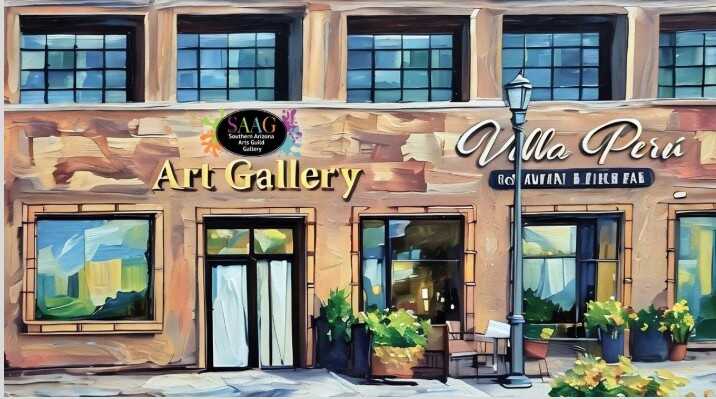
Fortunately, Town West Development, which owns La Encantada, also owns Joesler Village at Campbell and River. “God bless them,” Diane says. “They’re so happy to have us there.” The guild recently moved into its new space next to Villa Peru restaurant, joining six other restaurants in the village.
The new location offers a bigger workroom for workshops and classes, though Diane acknowledges they’ll miss the walk-by traffic of La Encantada. “You’re not going to get that walk by traffic. You’re just going to be destination driven,” she admits. But SAAG is working hard to make it a destination worth visiting, with its grand opening scheduled for late January.
Today, SAAG offers far more than exhibition space. The organization provides:
“We’re always looking for places to exhibit,” Diane notes. Current shows at the Overlook and in the fitness center downstairs showcase the range and quality of work produced by SAAG members.
The gallery operates on a jury system to ensure variety and quality. Artists submit applications and samples of their work, and a rotating jury committee reviews them. “We’re always looking for something we haven’t seen before,” Diane explains. “If you’re doing gold necklaces and we’ve got a gold necklace maker in there, chances are you won’t get in, because then you compete with each other and everybody loses.”
Each artist gets their own space—a section of wall or shelf—for six months. The guild takes a percentage of sales to help keep the organization running. Membership fees are modest—just $50 a year, prorated for those who join mid-year—and no one is turned away for financial reasons.
“Anybody’s welcome,” Diane emphasizes. “We even have some members who just appreciate art. They dabble with classes, but they love to hang out with artistic types.”
 Art as Community Service
Beyond supporting individual artists, SAAG maintains a benevolent mission. The organization awards scholarships to budding artists, recently shifting its focus from high school to college students after finding greater engagement among older students. Several scholarship recipients from Pima Community College have gone on to become gallery members themselves.
The guild also partners with other organizations. Members demonstrate at Art State Arizona festivals, and SAAG has a strong connection with the downtown Tucson Gallery, which represents five or six SAAG artists.
Unlike some galleries that require exclusivity, SAAG encourages its artists to show their work wherever they choose. “We want you to be in all the galleries you can,” Diane says. “You look good, we look good. You belong to SAAG, you’re part of our organization.”
This generous philosophy extends to how SAAG operates. The executive board is entirely volunteer, with only one part-time paid employee—the gallery manager. “If they were working, first of all, they wouldn’t want the job, and there wouldn’t be enough money to do what they do,” Diane laughs.
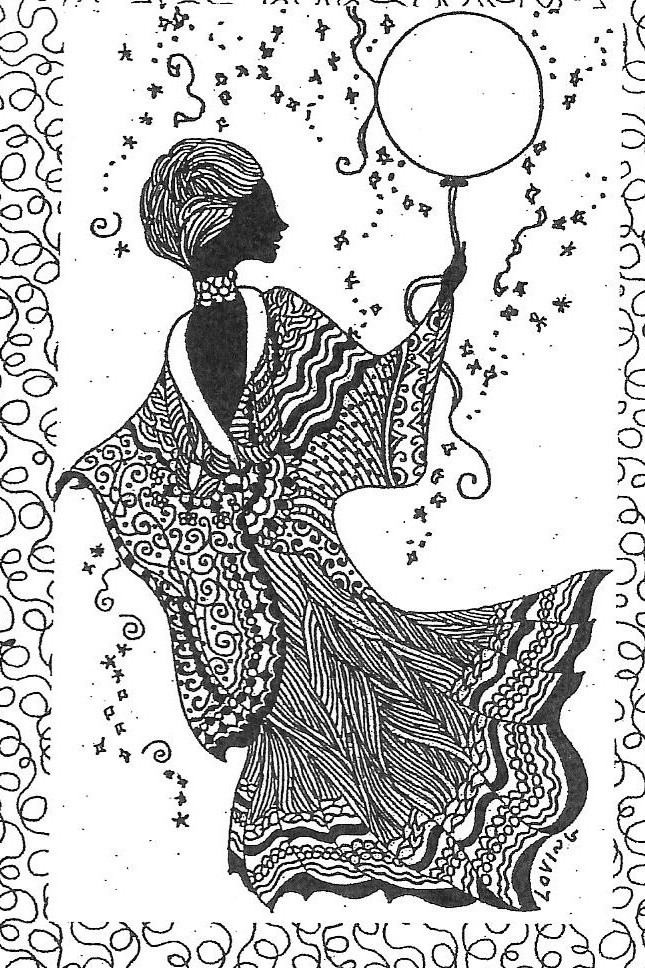
As an artist herself, Diane finds constant inspiration in Oro Valley’s dramatic landscape. She works in two distinct styles: encaustic painting (using melted wax cut into flower shapes) and pen-and-ink filigree featuring women with stories to tell. Her work is sold as cards in the gallery.
“You have to keep creating,” she says simply.
Her backyard opens onto Pusch Ridge, and on mornings when she doesn’t have time for a full canvas, she’ll sit on the patio with a small piece of paper and colored pencils or pastels, capturing the mountain at different times of day from different perspectives. “Sometimes I’ll play with it—maybe I’ll add a peak, or maybe I’ll say I’m going to make this look like a Van Gogh painting or a Matisse painting.”
She’s created so many of these small studies that she’s grouped them together. They hang in her powder room, where she can enjoy them daily.
This practice connects to her teaching philosophy about perspective. “What always strikes me is somebody who’s looking at it from a different perspective, or who tweaks it a bit,” she says. “Beauty is lost in repetition.”
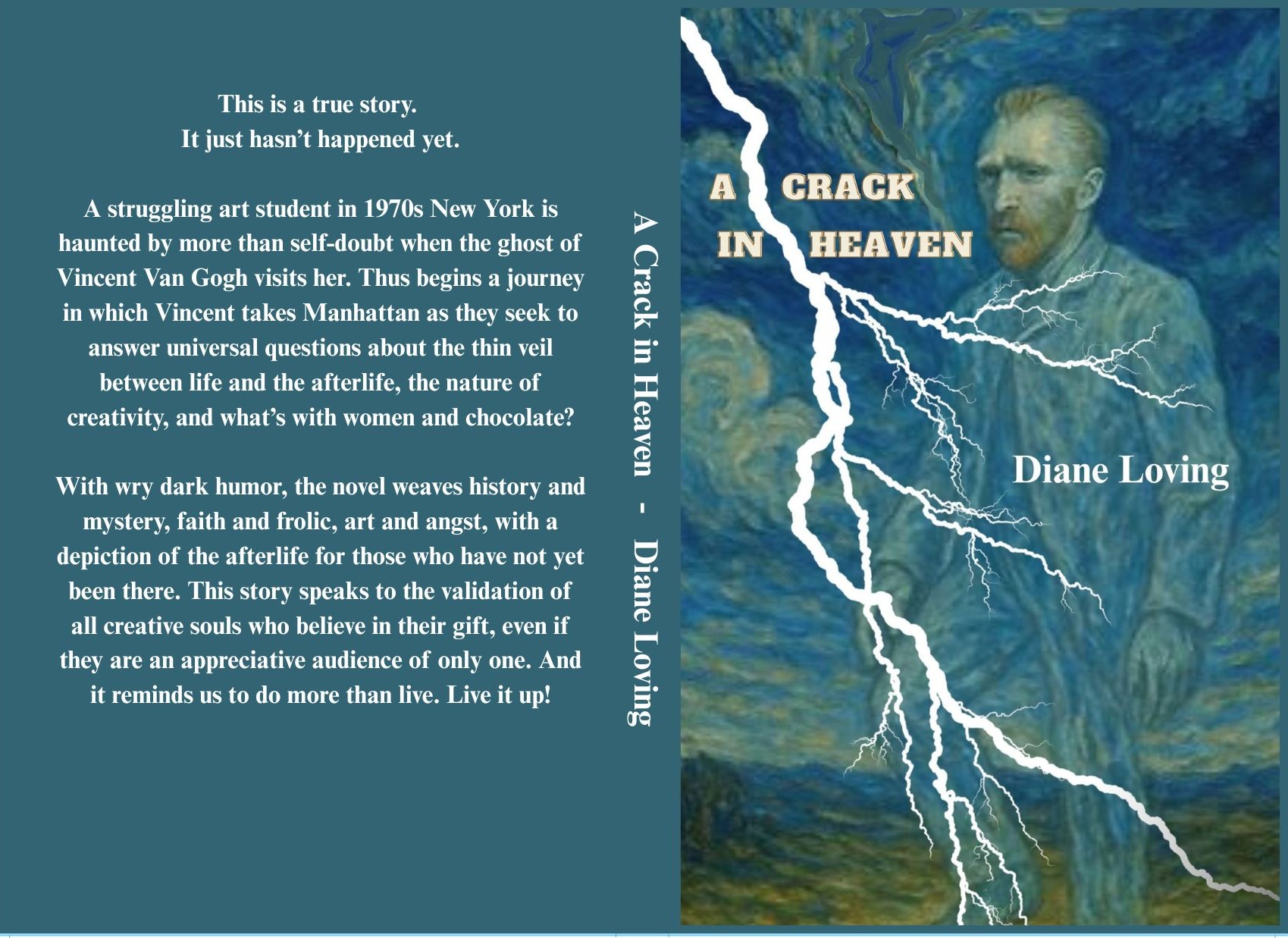
Cover – A Crack in Heaven
Diane’s passion for art history and her understanding of an artist’s struggles inspired her to write “A Crack in Heaven,” a novel that asks: What if Vincent van Gogh could return and see that he had actually succeeded?
The book (available online at Amazon, Barnes & Noble, and Walmart.com) follows a struggling art student in 1970s New York who is visited by the ghost of Van Gogh. Together, they explore Manhattan—van Gogh attends a Yankees game, visits the Algonquin Round Table with other ghosts, and sees the modern art world that has embraced his work.
“I had the best time because I could tell Vincent’s story the way I could picture it,” Diane says. The book combines art history with humor, philosophy, and mystery, addressing universal questions about creativity, validation, and the nature of artistic souls who believe in their gift, even if they are an appreciative audience of only one.”
For Diane, van Gogh’s story resonates with every creative person today. “Anybody who makes anything knows the feeling of Vincent van Gogh,” she observes. “I think about people on social media, especially influencers trying to be famous, trying to get stuff out there. There are trolls that pick on them. Or they’ve gone viral, and everybody loves them, but now they’ve got to keep doing that. Why isn’t the next one as good? Or worst of all, nobody even notices—you don’t get any likes, or you get one or two likes.”
The book’s message: “How do you rise above that? How do you find gratitude in what you do get and let the rest of it go?”
Diane’s decades of teaching art history at Pima Community College shaped not just her artistic vision but her approach to leading SAAG. “If Covid hadn’t happened, I probably would have taught until I died in front of the students at 99 years of age,” she says with characteristic humor.
She credits teaching with helping her “navigate the world and helping people to build consensus and to stay flexible and positive.” Those skills have proven essential in managing an organization of 300 creative individuals, each with their own vision and needs.
“When you’re an educator and an artist, it’s good to have flexible thinking. It’s good not get too dug in with things. It’s good to realize subjectivity is not a bad thing. It’s good to realize we can reach consensus on many things. It’s good to realize that there’s hardly ever one answer, and anytime there’s one answer, there’s a lot of ways to get there.”
Her teaching style emphasized asking “what if” questions to engage students and inspire creative thinking. That same approach led to her novel’s premise and continues to guide how she encourages artists to develop their work.
More than a third of SAAG’s 300 members live in greater Oro Valley, a testament to the organization’s roots in the Greater Oro Valley Arts Council. The connection runs deep—SAAG was literally born out of conversations among Oro Valley artists seeking to connect with their peers.
The organization’s commitment to Oro Valley shows in its ongoing exhibitions at local venues. Beyond the gallery, SAAG maintains shows at the Overlook restaurant, in the fitness center downstairs, and partners with other local institutions. Diane was even invited to serve on one of the initial panels for Oro Valley’s Path Forward, where she advocated for public art and arts and culture initiatives.
“The answer would be yes,” Diane says when asked if living in Oro Valley influences her art. “That view is inspirational. To go out on that back patio, that sacred space… sometimes somebody buys something. And you’re just grateful that you touched somebody’s heart through their eyes. What could be better than that?”
For Diane, the mission remains what it was at that first meeting at Millie’s Pancake House: helping artists feel less alone and more supported in their creative journeys.
“Being an artist is lonely,” she reiterates. “What can we do to make you feel less lonely, to make you feel like you belong, to make you feel like you have a champion? They need a listening ear, they need a critical eye—but that’s the only part of the critic they need. Just ‘I’ll help you analyze this, but I’m not going to dump on it.’ The fact that it exists at all is amazing. Let’s start with: it wasn’t anywhere, and now it’s here. That’s amazing. How can we get better? How can we be braver?”
Whether you’re an established artist, a beginner wanting to take a workshop, or someone who simply appreciates art, SAAG welcomes you. Visit the new gallery at Joesler Village (Campbell and River, next to Villa Peru restaurant), attend the monthly Art Fest on the third Saturday, or join one of the social meetups at Panera.
And if you’re dining at the Overlook restaurant, take a moment to view the exhibition on the walls. Each piece represents an artist’s courage to create, to share, and to connect with their community.
As Diane puts it simply: “Reaching out to more artists and collaborating—that’s what we’re about.”
The Southern Arizona Arts Guild is a 501(c)3 nonprofit organization. For more information about membership, classes, exhibitions, or events, visit SouthernArizonaArtsGuild.com. Annual membership is $50, prorated for mid-year joiners. Diane Loving’s novel “A Crack in Heaven” is available online on Amazon, Barnes & Noble, and Walmart.com.
